



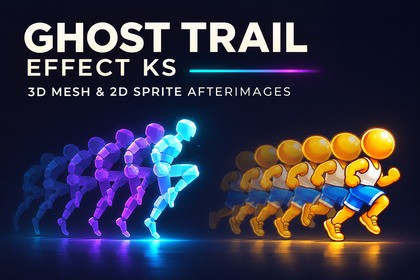
Create fading afterimages for 3D meshes and 2D sprites in Unity. Two trail components for dashes, jumps, attacks, and other fast moves.Ghost Trail Effect KS gives fast movement a visible history. Leave a fading chain of poses behind a dashing 3D character, or echo the individual sprite frames of a 2D attack. The package includes two dedicated afterimage systems.3D Mesh TrailsCapture the current pose of an animated skinned mesh or leave snapshots of a regular mesh as it moves. Use continuous emission for sustained movement or trigger a finite burst for a dodge, jump, or attack. Shape each ghost with a lifetime color gradient, emission fade on compatible materials, independent scale curves for each axis, and optional world-space drift. Included URP presets cover additive echo and a procedural wireframe look.2D Sprite TrailsCapture the current frame of a single SpriteRenderer or an active child sprite hierarchy. Keep the source colors or give the trail its own tint or lifetime gradient. Control sorting, set a movement threshold to avoid leaving ghosts while idle, and preview the result in Edit Mode.Both components let you choose world or local space and adjust the spawn interval, ghost lifetime, and maximum ghost count. Start with the self-contained 3D Quick Start or the looping 2D sprite demo. A bonus sprite sequence player plays frame animations on a SpriteRenderer or Unity UI Image.Package version and format — 1.0.0, distributed as a .unitypackage.Verified setup — Unity 6.3 LTS (6000.3.27f2), URP 17.3.0, Windows Editor.Render pipeline — Supplied shaders and materials target URP. Built-in and HDRP require replacement materials and are outside the verified shader configuration.3D sources — MeshFilter with MeshRenderer and SkinnedMeshRenderer. Animated poses are captured with BakeMesh. Shared materials and per-renderer MaterialPropertyBlocks control supported fade and emission properties.2D sources — SpriteRenderer and active child sprite hierarchies. Snapshots preserve sprite frames and renderer state. SpriteSkin and custom shader deformation are outside capture support. Trail capture is SpriteRenderer-only.Runtime budgets — Both components expose spawn interval, lifetime, and a per-emitter cap. Snapshots allocate and destroy runtime objects without pooling. Mesh count and sprite hierarchy size affect the cost of each snapshot.Bonus sequence player — Supports SpriteRenderer and Unity UI Image playback. Requires the Unity UI package (com.unity.ugui).Included examples and documentation — Self-contained 3D Quick Start, looping 2D sprite demo, sample prefabs and materials, and offline user manuals. The extended Motion Lab Runner workbench shown in reference screenshots is outside the portable package.AI assisted with C# implementation and debugging, URP shader development, demo presentation text, documentation, and automated validation. The implementation was adapted to the existing project and tested in Unity for animation, rendering, and compatibility.