


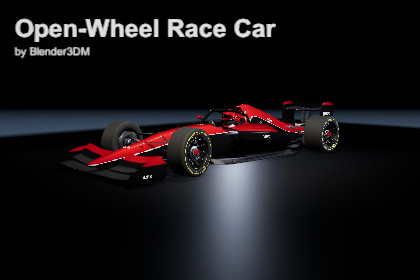
A realistic open-wheel race car with a seated driver: physics, engine sound, 8 liveries, steering wheels and hands, live dash, cockpit view, 5 km demo circuit. URP.Made and tested in Unity 6.3 LTS (6000.3.28f1) with URP 17.3 only. Uses URP Lit and Complex Lit plus two included URP shaders: Lit AO (baked AO on UV2; Forward/Forward+) and a demo sky. The steering-wheel display uses Unity UI (uGUI). The drivable car uses built-in WheelColliders. The demo works with the Input System or the old Input Manager. No Built-in or HDRP materials.A realistic modern single-seater race car of the ground-effect era, built at real size for the Universal Render Pipeline and detailed for close-ups: outside, underneath, inside the cockpit - and with its driver in the seat.DRIVE IT- A drivable prefab: Rigidbody and WheelColliders, about 1000 hp, traction control, downforce and drag, brakes, a stable balance and a stability assist - quick and fun, not a simulation.- An eight-speed gearbox with automatic shifts and a synthesised V6 turbo-hybrid engine sound (eight engine-speed loops, turbo whine, road rumble, shift crack).- A 5 km demo circuit with kerbs, a grid and a start line; chase, cockpit and orbit cameras.RIGGED AND ALIVE- The wheels spin with the road speed; the front wheels steer about the real kingpin axis (with Ackermann); the steering wheel and column turn with them, and so do the driver's hands and arms.- The driver's helmet turns a little into corners; the driver can be hidden (the empty seat shows its own harness).- A live steering-wheel display: speed, gear, lap timer and 15 shift lights filling with the revs.- A rear rain light with off, on, flashing and auto modes.- The posed prefab is driven by four values (steer, speed, throttle, brake): connect your own vehicle physics or AI.EIGHT LIVERIES, THREE TYRE COMPOUNDS- One line of code (or the V key in the demo) switches the paint, pinstripe, race number, wordmarks and the driver's suit and helmet; soft, medium and hard tyre markings. Every car in a scene can wear its own.DETAILED LIKE THE REAL THING- Monocoque, nose, sidepods with undercuts, engine cover, floor with tunnels, fences and a diffuser, multi-element wings with real thickness, halo, mirrors.- Push-rod suspension with aerodynamic wishbones, uprights, ventilated discs, calipers, brake ducts.- An explorable cockpit: moulded seat, six-point harness, pedal box, a steering wheel with buttons, rotaries, paddles and a quick release.- The driver: helmet with a dark visor, suit with panels and piping, gloves gripping the wheel, HANS, the worn harness.- Clear-coated paint, carbon-fibre twill weave, matte raw carbon, suede, webbing, rubber, brushed metal; baked ambient occlusion in the cockpit and underneath.- Fictional liveries and numbers. No real team, series, sponsor or tyre brand.READY FOR MANY CARS: a far LOD (about 21k triangles) through a LOD Group, plus Unity Mesh LOD.SCENES: Demo (drive the circuit) and Showcase (photo studio). Documentation included.- Number of textures: 17 (16 tiling detail maps, 1 baked AO atlas)- Texture dimensions: detail maps 512x512 and 1024x1024; AO atlas 4096x4096- Polygon count of race_car_a: 255,252 triangles with the driver (237,492 without)- Minimum polygon count: 20,926 (far LOD)- Maximum polygon count: 255,252- Number of meshes/prefabs: 40 meshes in 1 model; 2 prefabs (race_car_a posed by script, race_car_a_drivable with physics)- Rigging: No (moving parts are separate meshes with their own pivots, posed by scripts)- Animation count: 0- Animation type list: none - wheel spin, steering, pedals, the driver's arms and head are driven by scripts- UV mapping: Yes (UV0 in metres for tiling detail maps, UV1 for the baked AO atlas)- LOD information: LOD Group with 2 levels (full detail with 2 Unity Mesh LOD levels, about 55% and 31%; far LOD 20,926 triangles), culled below 1% screen height- Types of materials and texture maps: PBR, URP Lit and Complex Lit (clear coat); 36 shared materials + 24 baked-AO copies on the included Lit AO shader; tiling detail albedo/normal maps; baked AO- Audio: 11 WAV clips (engine loops 4,500-15,000 rpm, turbo, rumble, shift), synthesised- Scripts (C#): RaceCarRig, RaceCarPhysics, RaceCarGearbox, RaceCarSound, RaceCarPilot, RaceCarLivery, RaceCarDisplay, RaceCarLights, RaceCarDriver, RaceCarCamera, RaceCarDemoKeys, RaceCarInput- Real-world scale (1 unit = 1 m), front facing +Z; size 1.97 x 5.66 x 1.00 mThe publisher designed the car, its driver and their look, and directed and reviewed every step; an AI assistant (Anthropic Claude, used through Claude Code) did the implementation work:- 3D models: the car and the seated driver were built by generator scripts (Python for Blender) that the assistant wrote to the publisher's specifications; the publisher reviewed every model in renders and in Unity and directed all changes. No AI-generated meshes, images or scans are included.- Textures: the tiling detail maps (carbon weave, suede, webbing, rubber, metal, paint flakes) and the ambient-occlusion bake were produced by scripts written the same way - procedural, not AI-generated images.- Sound: the engine, turbo, road and shift sounds were synthesised by a script the assistant wrote (no recordings); the publisher chose the engine character by ear.- Code: the runtime scripts (rig, physics, gearbox, sound, driver, liveries, dash, lights, demo controls), the two shaders, the demo circuit and the scenes were written or set up with the assistant and tested by the publisher in Play mode.- References: the publisher's design reference sheets of the car and the driver were made with an AI image generator; they guided the design and are not included in the package.- The store images and video were rendered in Unity from the package itself (video music synthesised by a script); the documentation and store text were drafted with the assistant and reviewed by the publisher.The lettering uses letter shapes of the Inter typeface (SIL Open Font License 1.1) converted to geometry; the Lit AO shader is derived from Unity's URP Lit (Unity Companion License).