



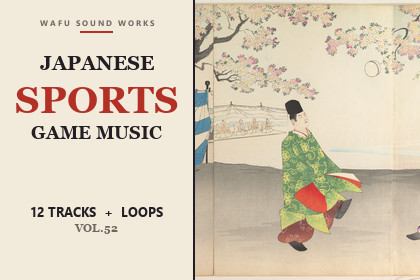
Japanese Sports Music Pack - The Summer Tournament (Vol.52)
WAFU Sound Works
$8.79
(no ratings)
Jump AssetStore
12 looping tracks and 8 match cues for sports games: taiko and a school brass band in the stands, locker room, practice, results. Full and seamless-loop WAV.The sound of a Japanese high-school summer tournament: the school band and cheer squad playing cheer tunes in the stands all match long. Twelve tracks and eight match cues for sports games — taiko and a school brass band, with shinobue and shamisen on top and a drum kit and bass underneath. Two takes of every scene:Home Stand I / II — the match, a comfortable lead: the calm layer (3:30 / 3:29)Alps Stand I / II — a stand-alone match theme, a rival school: a stop-and-go chant (3:29 / 3:30)Full Stands I / II — close and late, extra time, the final: the close layer (3:30 / 3:30)Locker Room I / II — menus, team select, half-time, tactics (3:00 / 2:59)Riverbank Practice I / II — training, season screens, the map (3:00 / 3:00)Summer Evening I / II — results, awards, title screen, credits (2:59 / 3:01)Cues (two variants each): point (2.0 s) · miss (1.5 s) · kick-off (2.5 s) · champion (4.0 s)38 minutes 56 seconds; every track runs 2:59 to 3:30. Full and loop versions, in WAV; every loop is cut where the beat lines up with its opening, so the drums do not stumble at the seam. No vocals or crowd voices, so your crowd, whistle and commentary stay on top.The match as two layers. Measured on the finished files: Home Stand I / II and Full Stands I / II share one tonal centre (G) at 130 to 134 BPM, so they can run together and fade by score difference and time left. Only these four form the layers. Alps Stand came out in its own keys (I around E-flat minor, about 124 BPM; II in F major, about 111 BPM): use it on its own as a stand-alone match theme, not as a layer. These are separate arrangements, not stems, so the layers crossfade over a few seconds. The cues are drum hits and short phrases cut from longer pieces; there is no separate clapper or gong, and they are not all in one key.The README has Unity (C#) code: both layers play for the whole match and only their volumes move, with two thresholds and a 4-second hold so an equaliser does not flicker the music; a point never restarts anything; half-time brings in Locker Room while the match keeps running silently; replays and slow motion leave the music alone; and one switch puts the band in the stands with a low-pass.Listen first: every track, about fifteen seconds each: https://youtu.be/t-z3BiVWfuoLicense. Sold under the Unity Asset Store End User License Agreement (Standard): use the tracks in commercial and non-commercial projects, edit them freely, no credit required. WAFU Sound Works does not register these tracks with YouTube Content ID or any other fingerprinting service, so your videos and streams will not receive claims from us.Created with AI. The tracks were composed with generative AI (Suno, commercial plan). Take selection, scene design, loop engineering, level matching and cue editing are human work. If your project requires disclosure, this is AI-generated audio.More volumes. Other WAFU Sound Works packs share the same instruments and loudness, so they sit together in one game. See the publisher page.12 tracks: six scenes, two takes each (_01 / _02), plus 8 cues. Every track as Full (natural ending) and Loop (silence trimmed, tail crossfaded into the head).32 WAV files: WAV, 48 kHz, 16-bit, stereo.Loopable: Yes. Loop versions play seamlessly with AudioSource.loop = true; no loop points to set.Folders: Assets/WAFU Sound Works/Vol52/ Full, Loop, Stingers. README.txt with usage notes and C# snippets.Import settings: music as Vorbis + Streaming, cues as Decompress On Load (adjust to taste).Integrated loudness -14.0 to -15.0 LUFS (Full Stands -14.0, Home Stand -15.0, the rest -14.5); sample peaks at or below -1 dBFS.Generative AI: composed with Suno (commercial plan); human-curated and edited.Key image artwork: Yōshū Chikanobu, kemari from the series "Chiyoda Castle (Album of Men)", 1897. Public domain (CC0), The Metropolitan Museum of Art.Music composed with generative AI (Suno, commercial plan). Take selection, scene design, loop engineering (silence trim + tail-to-head crossfade), loudness matching and cue editing were done manually. No AI was used for the artwork; the key images use public-domain ukiyo-e prints.