



Real Expo Center Generator - Procedural Exhibition & Convention Center Generator
u3d
$26.95
$53.90
50%OFF
(no ratings)
Jump AssetStore
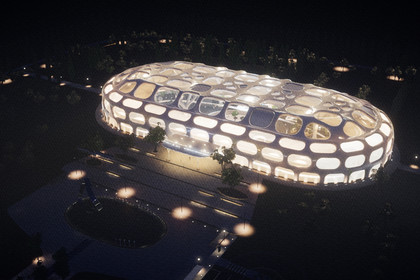
Generate futuristic exhibition and convention centres from a seed: gridshell roofs, atriums, mezzanines, eco zones, waterfalls, video walls and the site outside. Editor or runtime. URP, Unity 6.3.Generate a complete futuristic exhibition and convention centre from a seed — a glazed gridshell roof on branching tree columns, mezzanines round an atrium, escalators, stairs and glass lifts, booths, a stage, galleries, eco zones with living walls and waterfalls, video screens, service rooms, and the whole site outside with a forecourt, a water mirror, parking, roads and fields — right in the Editor without Play mode or live at runtime, for the Universal Render Pipeline (URP) in Unity 6.3 (6000.3.21f1).Pick one of ten presets or set your own parameters and press Generate. Every seed gives a new, believable venue, and the same seed always gives the same one. Drag a slider and the hall rebuilds while you drag: footprint, roof form, the web of glazed cells, columns, levels, circulation, the programme, the exterior. Change the time of day, the LED accent colour or the shell and floor finishes and the hall restyles on the spot, without a rebuild.A whole venue, not a kit of parts- Footprints: capsule, ellipse, rounded rectangle, circle and organic blob, 40 to 260 m long and 30 to 140 m wide. Roofs: pillow, barrel, dome, wave, saddle or flat, rolling tangentially into the facade.- A shell web in six patterns (grid, Voronoi, diagrid, hex, radial, slots) cut into glazed and solid cells, with glazed ground arches and doors.- Branching tree columns, Y columns or tapered columns; up to three mezzanine levels round atrium voids with bridges.- Circulation that always works: escalator pairs and glass-balustrade stairs between every two levels, glass lifts on multi-level halls; every level is reachable on foot.- The programme: a central plaza, reception, a stage with an LED wall, exhibitor booths, a gallery with partitions, a café, sculptures, pedestals and turntables with show cars, wayfinding, lounges.- Eco zones: raised planted beds with trees, ferns, grasses and stepping stones in front of living walls, hanging gardens along the mezzanine edges, and waterfalls — a curtain of water from a mezzanine edge or a free-standing water wall — with foam, spray and a procedural water sound.- Video: LED walls, free-standing screens, media bands and a hanging media cube playing six included motion-graphics clips.- Rooms: back of house round a service door (loading, storage, plant, electrical, office, kitchen) and front of house by the entrance (cloakroom, security, first aid, toilets), each public room with a venue frontage, a lit sign and an LED cove.The site outside- An entrance monolith with a generated venue name, a forecourt with a canopy, a water mirror with jets, approach paths, lawns, lamp posts, bollards, benches, flags, a bus stop, a parking lot with cars, roads and a service yard.- A patchwork of fields around the site (pasture, hay, cereal, stubble, ploughed land, rapeseed, fallow) with hedgerows, tree lines, groves and woods of volume-rendered poplars, broadleaf trees and shrubs, and a ground splat of lawn, meadow, trampled grass, gravel verges, mulch and leaf litter that follows the roads, paths and planting.- A distant City, Waterfront or Parkland context and horizon hills.Light and look- Six times of day — Morning, Day, Overcast, Golden Hour, Blue Hour, Night — each an editable mood with its own HDR sky panorama.- Physical light units: lamps in candela, emissive surfaces in nits, sun and sky on one photometric scale, and an exposure that eases between the interior and the exterior as the camera crosses the facade.- Day light through the glazed web with light shafts; at Blue Hour and Night a uniform walkway grid, column and facade uplights, lamp posts, LED lines in the paving, lit signs and city windows.- Planar reflections on still water, glow decals for light pools and wall washes, a colour grade per mood (tonemapping, bloom, split toning, vignette).- Eight LED accent colours, five shell finishes and five floor finishes.- Optional: Real Volumetric for volumetric fog and god rays, and Dynamic Ivy for living ivy on the columns and mezzanine edges (both sold separately; without them the package uses its own height fog and skips the ivy).Save and bake- Save to scene turns a hall into meshes, materials and a prefab that live without the generator; video screens, waterfalls, mirrors and the look keep working.- Save & Bake Lighting saves the hall and bakes its lightmaps, light probes and reflection probes in one click, in Draft, Standard or Presentation quality, with a memory check before the bake. Also from code and the command line.In the Editor and in your game- Editor: a generator inspector with Generate, New seed, a seed lock, the preset, Live and one foldout per settings group; every change is undoable. Copy and paste any hall as a small JSON recipe.- Runtime: a uGUI panel (no IMGUI) with presets, seed, every setting and the time of day. The plan and the meshes are built on a worker thread and the objects are created in time slices, so Play mode keeps running during a rebuild.- Cameras: an orbit camera, a film camera that flies the camera paths the generator made for each hall with depth of field (F3), a first-person walker that climbs the stairs (F4) and a free-fly camera (F5).- Every generated hall carries colliders, plan ids and tags, markers for the entrance, the spawn point and camera spots, and an SVG plan of its layout (ExpoBlueprintSvg).AI Ready. Built to be driven by AI coding agents as well as by hand. Documentation/AGENTS.md gives Claude Code, Codex, Cursor or a Unity MCP bridge the exact entry points: the ExpoGenerator component and its public API (LoadPreset, SetParam, Generate, BuildNow, RecipeJson / TryApplyRecipeJson, the Built and Failed events and the build report), the engine-free ExpoPlanner and ExpoCompiler, the ten presets and all 65 settings as plain data in ExpoPresets and ExpoParams, the Tools > Real Expo Center Generator menu commands, the command-line bake, task recipes, and a Verify section that checks a build by its report, its plan hash and its markers. An agent can build, tune and check halls without guessing.Technical details- Unity 6000.3.21f1, URP 17.3 only (Forward+ renderer, HDR). HDRP and the Built-in pipeline are not supported.- Generated geometry per hall at seed 1: about 350,000 (Auto Showroom) to 1,000,000 (Grand Expo Hall) triangles, plus 750 to 2,000 placed props; up to 200 real-time lights (a setting) with at most 4 shadowed.- 95 props modelled procedurally in Blender for this package, procedural PBR texture sets (PNG, up to 2048 px), six HDR skies, six video clips, own URP shaders (hall surfaces, water and waterfall, ground splat, volume trees, glow decals, planar mirror, sky).- One sample scene with the live generator, camera rig, look, post-processing and runtime panel.CreditsThe interface uses the font Source Sans Pro by Adobe under the SIL Open Font License 1.1; see ThirdPartyNotices in the package.SupportQuestions and bug reports: cgteamorg@gmail.com. Please include your Unity version and the recipe (Copy recipe).More from this family- Real Horror Hospital — procedural hospital and asylum horror level generator, the same live-generator architecture: https://assetstore.unity.com/packages/slug/415078- Dynamic Ivy — grow climbing plants over your halls: https://assetstore.unity.com/packages/slug/407934- Real Volumetric — volumetric fog, lighting and god rays for URP, used by the haze when installed: https://assetstore.unity.com/packages/slug/406144- Real Earth Planet — real-world terrain, roads and railways generator: https://assetstore.unity.com/packages/slug/412072- Built and tested on Unity 6000.3.21f1 with URP 17.3 (Forward+ renderer, HDR), and URP only: HDRP and the Built-in pipeline are not supported.- Tested on Windows desktop (Editor and a standalone player). No mobile, console or WebGL claims.- Dependencies: URP and uGUI. Optional: the Input System (the cameras and the panel use it when present, the Input Manager otherwise); Real Volumetric (volumetric fog and god rays) and Dynamic Ivy (living ivy), both sold separately and not required.- Generation in the Editor without Play mode (an inspector with all 65 settings in 9 groups) and at runtime (a uGUI panel, no IMGUI); 10 presets; the same seed and settings give the same hall.- Generated geometry per hall at seed 1: about 350,000 to 1,000,000 triangles plus 750 to 2,000 placed props; up to 200 real-time lights (at most 4 shadowed) and up to 32 reflection probes; colliders on floors, stairs, escalators and walls.- Content: 95 props (Blender-modelled, prefabs), procedural PBR texture sets as PNG up to 2048 px, six HDR sky panoramas (EXR), six H.264 video clips with PNG posters, volume tree banks (poplar, shrub), own URP shaders, one sample scene, no JPG.- Save to scene and Save & Bake Lighting (Draft, Standard, Presentation) with a memory check; command-line bake (ExpoLightBaker.BakeBatch).- Rebuild: plan and geometry on a worker thread, objects created in time slices; look changes (time of day, accent, finishes, haze) restyle without a rebuild.- Fonts: Source Sans Pro (SIL Open Font License 1.1) for the runtime panel, in Resources/REHG/Fonts.- Source: about 36,500 lines of C# (an engine-free planner and geometry compiler, the Unity runtime, the editor, the optional Dynamic Ivy adapter).- Everything ships under Assets/RealExpoCenterGenerator: a 976 MB download (.unitypackage, 1,023,147,800 bytes), about 1.0 GB in Assets after import (866 files).Yes - AI was used in the creation of this package.Code and documentation were written with AI coding assistants and reviewed and tested by the publisher: engine-free test harnesses for the plan and the geometry (10 presets x 2 seeds, determinism, mesh checks, time budgets), compile checks of the editor and player variants, Unity batch and standalone player runs and Unity's Asset Store validator.No AI-generated art is bundled. All hall and site geometry is generated by the package's own code; the 95 props were modelled by the publisher's Blender scripts; the textures are the publisher's own procedural maps (Python/numpy); the skies and the six video clips are the publisher's own Blender renders; the trees are baked from the publisher's own procedural Houdini tree generator. No image in the package carries generator metadata (every PNG scanned).