


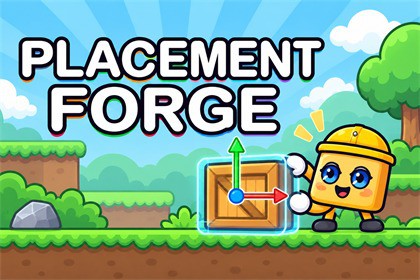
Move, rotate and scatter props with real physics, paint prefabs onto any surface, and give meshes colliders that actually fit. Editor only, full undo.Dressing a level by hand is slow in small, annoying ways. A crate floats a few centimetres off the floor. A barrel sinks into a ramp. Two rocks sit inside each other and nobody notices until a playtest. Placement Forge fixes that by letting the objects collide while you place them.Physics Move and RotateSame handles as Unity's Move and Rotate tools, but the object bumps into things. Push a crate into a wall and it stops there, with a readout showing how far the handle ran ahead. Drag the object itself and it slides along the ground. Hold Space and it drops under gravity; let go and it stays exactly where it is. Rotating a group turns everything around one pivot without anything cutting through a wall.Arrange and ScatterHold Space to push a group of props together until they touch, or spread them apart. Fix overlaps, level a group onto one height, and line things up in rows, grids and rings based on their real size. Array can drop copies into a pile and let physics settle them. Scatter blows a stack apart, heaps loose props into a pile, or nudges a row so it stops looking placed. Every effect plays out in the Scene view, and Esc puts everything back.Prefab paintingA brush for palettes of prefabs, with spacing, density, slope and height limits, random rotation and scale, and erase, swap and vary modes. Objects sit on the surface whatever their pivot, and "Settle after stroke" drops painted rocks with physics so they rest on the ground instead of hovering over it.Colliders that fitSelect some meshes and press Generate. Simple shapes get a box, sphere, capsule or cylinder. Everything else gets a collider built from the mesh itself, and tables and arches keep the space under them. Analyse tells you what each object will get and why before anything changes. You can bake colliders straight onto prefab assets, and they are ordinary Unity colliders with no runtime code.Also includedDrag a prefab in from the Project window and it lands sitting on the surface.Select everything made from the same prefab, of a similar size, or resting on the same floor.Audit a scene for duplicates, floating props, strays, missing scripts and empty groups, then fix them.Your scene's physics is never touchedThe simulation runs in a separate hidden scene built from copies of your objects. Only the final positions are written back, so your Rigidbodies stay asleep and your physics settings stay as they are. Objects without colliders still collide. Every action is one undo step, and a recompile or pressing Play in the middle of a drag puts everything back cleanly, including with Domain Reload turned off.A demo scene, a Quick Start PDF, a full manual, an FAQ and a scripting reference are included. Questions or bugs: fegeqn@gmail.com.Tools (keys can be changed in Edit > Shortcuts)Physics Move (U), Physics Rotate (I), Arrange (O), Scatter (J), Paint (Shift+X), Select (K)Drop to create, Colliders, Clean and Selection commands in the Placement Forge windowCollidersAuto plus 10 shapes: Match mesh, Box, Oriented box, Sphere, Capsule, Cylinder, Convex mesh, Exact mesh, Compound boxes, DecomposedPerformance / Balanced / Precise qualityBake onto prefab assets from the Project windowRequirements and compatibilityUnity 2022.3 LTS or newer, including Unity 6Editor only. Nothing runs in your build; the optional marker components have no Update and can be stripped with one menu command.Works with Built-in, URP and HDRP. The included demo materials are URP; use Tools > Placement Forge > Help > Create Demo Scene to build the demo for Built-in or HDRP.Works with Domain Reload disabled (Enter Play Mode settings)3D only. The tools work in Edit mode, not Play mode.Package contentsC# source for everything, in the PlacementForge and PlacementForge.Editors namespaces, with XML documentationDemo scene with example prefabs and a paletteDocumentation: Quick Start (PDF), Manual, FAQ, Scripting reference, ChangelogNo third-party code, fonts or assets are included.The C# code, documentation, and demo content were developed with the assistance of an AI coding assistant, based on my own design, requirements, and feature decisions. I directed the tool’s development, tested every tool manually in Unity, identified and reported issues such as collider stacking, painted objects appearing beneath planes, and rotation behaviour, and guided the fixes. I also reviewed and finalized the complete package.