

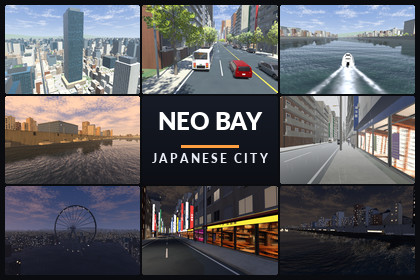
A huge Japanese-style bay city for Unity 6 URP: 440,000 buildings, living traffic with buses, a river and bay with boats, dynamic rain and day/night lighting, streamed with LODs.URP only (Universal Render Pipeline 17, Unity 6). Built and tested with Unity 6000.6.2f1 and URP 17.6; the Forward+ renderer is recommended. The Built-in Render Pipeline and HDRP are not supported. The first import takes about an hour and needs about 32 GB of RAM and 50 GB of free disk.Neo Bay — Japanese City is a complete, explorable Japanese-style metropolis for Unity 6 (URP): a bay city of about 20 × 20 km with downtown towers, residential districts, narrow yokocho alleys, canals, the Kosei river, a marina and a port, elevated highways and tunnels. It is streamed by sector, so the whole city runs on ordinary hardware.What's inside:• 1,600 city sectors streamed around the camera, with LODs for every building and a merged far city.• About 440,000 buildings with facades and roofs, shop windows with merchandise, 130,000 shop signs, advertising and 38,000 alleys.• Streets full of detail: 26,000 vending machines, 34,000 utility poles, 19,000 street lamps, 13,500 traffic-light poles, 549 bus stops, bollards, bicycles, planters and street trees (ginkgo, zelkova, camphor and sakura) that sway in the wind.• Living traffic: cars, vans, trucks, taxis and motorbikes that follow lanes, stop at traffic lights and use turn signals, brake lights and headlights; city buses that stop at the bus stops.• Street life: 92 unique people and 19 vehicle and boat models, placed as about 164,000 instances on sidewalks, parking lanes, alleys and quays, drawn with GPU instancing and three LODs (detailed close-up versions load near the camera).• Living water: real-time reflections, wind-driven waves, shore foam and boat wakes; 708 moored yachts, sailboats, launches and yakatabune, boats cruising the river and the bay, schools of fish and seagulls.• Dynamic rain: rain streaks, wet streets that dry slowly, rippling puddles, rain on the water and umbrellas.• Six lighting profiles: morning, midday, afternoon, blue hour, night (lit windows, neon signs and street lamps) and overcast.• Collision data for every sector.• A demo scene to fly and walk around the city.Performance: around 30 fps at street level on an Intel Iris Xe laptop GPU in our WebGL build (quality level 1, with street life and traffic).Requirements: Unity 6 (6000.x) with the Universal Render Pipeline (URP 17). People are static meshes; vehicles and boats are rigid meshes moved by script (no skeletal animation).Import: a 2.2 GB download. The first import takes about an hour and needs a lot of memory, because Unity keeps the city’s meshes in memory until it finishes: 32 GB of RAM is recommended (with 16 GB the import may run out of memory). It needs about 50 GB of free disk while importing; the imported city takes about 25 GB.Number of textures: 148 city textures, 92 close-up textures for people, 1 texture array (256 × 256 × 96 layers) and 3 shared vehicle textures (reflection panoramas and license plates)Texture dimensions: city 256–1024 px (tiling PBR maps); people close-ups 2048 × 2048; vehicle reflection panoramas 2048 × 1024Polygon count: about 121 million triangles at full detail across the whole city, streamed by sector (only nearby sectors are loaded)Minimum polygon count: about 400 triangles (far LOD of a street-life model)Maximum polygon count: about 80,000 triangles (close-up version of a person)Number of meshes/prefabs: about 7,300 meshes and 3,550 prefabs (city sectors, buildings, props and 112 street-life prefabs: 92 people, 19 vehicles and boats, 1 bus stop)Rigging: NoAnimation count: 0 (people are static; vehicles and boats are moved by script)UV mapping: YesLOD information: buildings have 2 LODs plus a far LOD per sector; street life has 3 LODs (close-up, mid, far)Types of materials and texture maps: URP materials with custom city, water and vehicle shaders; PBR maps (base color, normal, mask with metallic, occlusion, height and smoothness)Collision: per-sector collision data (primitives, plus mesh colliders for terrain and streets)Render pipeline: Universal Render Pipeline (URP 17), Unity 6 (6000.x)The 92 people models were created with generative AI: reference images with FLUX.1 [schnell] (Apache-2.0) and 3D meshes with Microsoft TRELLIS.2 (MIT). We then cleaned them, built their LODs and re-baked their textures with our own tools. The product images in shop windows, the posters and the advertising were also generated with AI image models.The city itself (layout, buildings, streets, alleys, signs, props and textures), the vehicles and the boats are generated procedurally by our own code, without generative AI models; that code was written with the help of an AI coding assistant.