




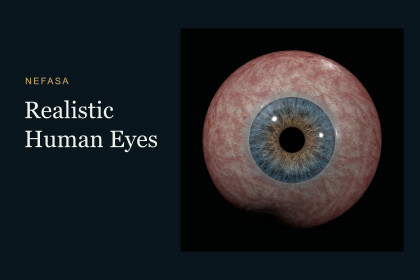
Photoreal 4K human eyes with geometry-based pupil dilation, optional light response, six color presets, optic nerves, game LODs and high-resolution source. Built-in, URP and HDRP.Tested in Unity 6000.3.23f1. URP 17.3.0 is the base package; Built-in and HDRP 17.3.0 are separate supplements. Import only the matching variant; see Documentation/AssetStore_Setup.md. URP/HDRP need matching Unity pipeline packages; HDRP also needs Shader Graph. Linear color space recommended. Other Unity versions and mobile devices are untested.Realistic Human Eyes by NEFASA provides customizable eyes for 3D characters, with a photoreal material set in version 1.4.0.Detailed iris fibers, scleral tissue and optional optic nerves use twelve 4096 x 4096 working maps. Single-eye and eye-pair prefabs include three detail levels; separate full-resolution source variants are supplied for macro work.Try the controls directly in Unity: Tools > NEFASA Eyes > Interactive Demo opens the supplied scene and Eye Controls together. Press Play, move the pupil slider, choose free iris and inner colors, or try the six natural color presets. An Automatic light toggle and a live radius readout are included. No customer-written code is needed for these controls.The pupil changes through real mesh deformation. Use configurable scene-light response, manual size, or the included API. Response times and sensitivity can be calibrated for your scene. Appearance controls also cover pigmentation, vessels, fiber relief, limbal darkness, gloss and moisture.URP is the base package. Built-in and HDRP are supplied as separate importable supplements. Import only the matching variant and follow the illustrated offline German/English guide. Three actual Unity video demonstrations are supplied for the product gallery, linked from the guide.Includes the Blender source, material provenance, optional optic nerves and an explicit upgrade tool for standard legacy 1.3 eye roots. Existing legacy controllers and GUIDs remain available. The Santa character shown in one image is a usage example and is not included.Created, developed and published by NEFASA / Nefasa AS Publisher. Original eye model and creative direction: NEFASA. The updated asset was developed under NEFASA's direction with AI assistance for textures, materials, scripts and documentation. See the included credits and material provenance.Unity uses realtime corneal reflections rather than Blender Cycles layered refraction. Automatic pupil response estimates scene lighting; it is not a calibrated physiological or lux simulation. Gaze animation, blinking, eyelids, skeletal rigging and automatic character fitting are not included.Includes UnityMeshSimplifier editor utilities under the MIT License; see Documentation/Third-Party Notices.txt and Editor/MeshTools/LICENSE.md. No external model, commercial texture pack or HDRI was added.Version: 1.4.0. Unity Editor: 6000.3.23f1.Pipelines: URP 17.3.0 base package; Built-in and HDRP 17.3.0 supplements. HDRP requires Shader Graph. Linear color space recommended.Current final-build verification: URP / Metal on Apple M2, native Unity controls, nine manual pupil/LOD combinations and automatic light response in advancing Play-mode frames. Earlier Windows / Direct3D 11 pipeline checks predate the final geometry refinements. Other Unity versions, mobile devices and other graphics APIs are untested.Twelve photoreal 4096 x 4096 maps: base color, normals and masks for iris, sclera and each optic nerve. Legacy maps retained. 4K working maps are baked from generated image foundations and Blender material detail; they are not native 4K photographs or tissue scans. Per-instance recoloring defaults to 2048, adjustable to 4096.Detail-level triangle counts per pair including both nerves: LOD0 431,016; LOD1 378,648; LOD2 359,988. The dense sclera is retained to preserve the corneal junction. These detailed prefabs are intended for individual characters and close-ups, not crowds or an assumed mobile budget. Profile your target project. Separate full-resolution source variants retain about 2.49 million active triangles per pair with nerves.Prefabs: single eye, eye pair, high-resolution source variants and retained legacy versions. UV mapped. No skeletal rig. Iris and pupil use five deformation targets plus basis; pupil radius 0.9-3.2 mm.Six presets: Blue, Brown, Green, Gray, Hazel, Amber. Free native color pickers, pupil slider, automatic-light toggle and current-radius display in Unity Eye Controls.Scene-light estimator supports Directional, Point and Spot lights and classic ambient/probe data. External brightness API included. Cookies, APV, emissive-only lighting and special SRP light layers are not sampled pixel-perfectly.No gaze, blink or eyelid animations. Scripted lighting demo, illustrated offline DE/EN browser guide and three actual Unity demonstration videos supplied for the online product gallery. Full-resolution Blender source supplied. No third-party Asset Store package required. Santa character is an example only, not included.Known import notices: retained legacy 1.3 FBX LOD-name warnings preserve update compatibility; the actual LOD groups are configured. Source and pipeline archives are intentional. See Documentation/Validation_Notes.md.OpenAI Codex/Imagegen was used to create three original image foundations for iris, scleral tissue and optic-nerve sheath. The generated foundations were 1254 x 1254, 8-bit images. They were combined with Blender material fields, UV projection and microrelief to bake the supplied 4096 x 4096 working maps; they are not photographs, tissue scans or native 4K photographic captures. Codex also assisted scripting, procedural setup, Unity shaders/controllers and documentation. Material provenance and process notes are included with the asset.