




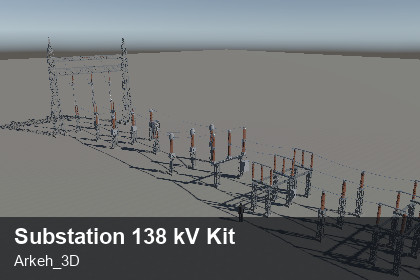
14 real-scale 138 kV substation models with operable parts, connection points and a conductor tool, ready to build training scenes in Unity.URP works out of the box. For the Built-in Render Pipeline, import Extras/BuiltInRP_Materials.unitypackage. HDRP is not supported.This kit is for building scenes for substation training, games in general, VR simulators, companies and technical schools.I work on 3D services for electrical substations, and I saw the chance to offer this kit to others who also work in this field.What makes it different: parts that move, connection points, real scale, and a bay assembled in the correct order.Right after importing, you can open the Demo, explore the bay, operate the disconnectors and connect conductors between the equipment.I plan to produce more of our equipment to grow the collection.WHAT IS INSIDE• 14 prefabs: live-tank circuit breaker; centre-break, double-break and semi-pantograph disconnectors; current transformer; voltage transformer; surge arrester; post insulator; line trap; single and double insulator strings; gantry; gantry with switch beam; 138/13.8 kV power transformer.• A 1.75 m scale figure.• 2 scenes: Demo_Bay138kV, a complete line bay in the real order of equipment, and Showcase, every piece side by side.• Scripts: OperablePart (Open / Close / Toggle), ConnectionPoint on every terminal, ConductorSpan (links two points with sag and radius, in the editor and at runtime) and KitDemoController (orbit camera, click a part to open or close it, O opens all, C closes all).• 8 shared PBR materials, 24 tileable textures 1024 × 1024 (albedo, normal, metallic + smoothness), label atlas 256 × 256.• Documentation in PDF.MADE FOR REAL-TIME• 3 LODs per prefab with LOD Group, primitive colliders, 8 materials shared by the whole kit (SRP Batcher), UV2 generated on import.• Demo scene: 552 k triangles, 184 renderers, 1 307 fps average and 580 fps 1 % low in a 60-second player build (RTX 4050, 1920 × 1080).COMPATIBILITY• Unity 6000.0 LTS or newer.• URP out of the box. Built-in Render Pipeline: import Extras/BuiltInRP_Materials.unitypackage. HDRP is not supported.• No dependencies. The Input System package is optional.GOOD TO KNOW• The models are generic, based on typical 138 kV dimensions; they do not reproduce any manufacturer's product.• ConductorSpan uses a parabola, a close approximation of the catenary up to about 10 % sag.Support: arkeh3d@gmail.com · https://arkeh3d.github.io• Number of meshes/prefabs: 14 equipment prefabs + 1 scale figure; 2 scenes• Number of textures: 24 PNG (3 per material) + label atlas• Texture dimensions: 1024 × 1024, tileable, 1 m per repetition; label atlas 256 × 256• Types of materials and texture maps: 8 PBR materials (URP Lit; Standard in the Built-in extra); albedo, normal, metallic (R) + smoothness (A)• Minimum polygon count: 6 612 triangles (InsulatorString_138kV_Single, LOD0)• Maximum polygon count: 110 532 triangles (Disconnector_DoubleBreak_138kV, LOD0)• LOD information: 3 levels per prefab, LOD Group• UV mapping: Yes (UV2 generated on import for baked lighting)• Rigging: No• Animation count: 0 (parts move by script: OperablePart)• Colliders: primitive colliders on every prefab• Scale: 1 unit = 1 m, pivot at the base, front at +Z• Scripts: 4 runtime scripts in their own assembly (Arkeh3D.Substation138kV.Runtime)• Triangles LOD0 / LOD1 / LOD2:Breaker_138kV 59 108 / 29 744 / 12 392Disconnector_CenterBreak_138kV 89 968 / 51 684 / 22 340Disconnector_DoubleBreak_138kV 110 532 / 51 648 / 26 472Disconnector_SemiPantograph_138kV 88 796 / 43 696 / 18 288CurrentTransformer_138kV 17 916 / 10 380 / 3 932VoltageTransformer_138kV 19 300 / 9 348 / 4 228SurgeArrester_138kV 16 900 / 8 244 / 4 148PostInsulator_138kV 14 460 / 7 756 / 2 764LineTrap_138kV 29 456 / 16 152 / 5 712InsulatorString_138kV_Single 6 612 / 2 788 / 1 508InsulatorString_138kV_Double 12 828 / 5 460 / 2 900Gantry_138kV 49 056 / 15 840 / 7 888Gantry_138kV_SwitchBeam 60 416 / 20 672 / 10 656PowerTransformer_138kV 53 844 / 31 912 / 12 968All 3D models are procedural: every mesh is generated by the author's own Python toolchain for Blender, from typical 138 kV dimensions specified and approved by the author. Claude (Anthropic) was used as a coding assistant to write parts of that toolchain and the included C# scripts, under the author's direction and review. No generative AI was used to create meshes, textures, materials, documentation images or marketing images; all textures are procedural and were generated by the author's own code. Claude also wrote the text of the included PDF documentation and helped draft and translate this store description, from the author's answers and measured data, reviewed and approved by the author.