



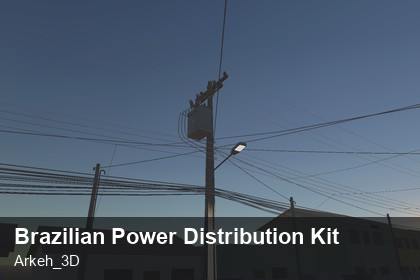
Brazilian street power lines in minutes: concrete poles, 13.8 kV and low-voltage networks, transformers, street lights, tangled telecom cables and the Line Builder tool.Build the power grid of a Brazilian street the way it really looks: concrete double-T poles, 13.8 kV crossarms, pole-mounted transformers, low-voltage racks, street lights and the famous tangle of telecom cables, all placed by a tool instead of by hand.LINE BUILDERClick points along a street (Shift + click) and the Line Builder places the poles and picks the right structure for each one: tangent, dead end with guy wire, corner, transformer pole with fuse cutouts and surge arresters. It strings every span with real sag: medium voltage (bare or compact spacer cable), low voltage, three telecom messengers with an optional tangle mode, service drops to the houses and even illegal taps ("gatos") to the rooftops. 200 poles are built in seconds and run at hundreds of fps.BRAZILIAN DETAILS"Danger" signs, pole numbers, posters glued to the poles, an ovenbird nest on the crossarm, a kite caught in the wires and sneakers hanging from the cables: cheap, recognizable details that make a street feel Brazilian.STREET LIGHTS THAT TURN ONLight and lens switch together, with a photocell driven by the scene's sun. LED (white) and sodium (orange) versions.READY TO DRAG AND DROP5 pre-assembled poles (MV + LV tangent, 75 kVA transformer, dead end, switches, low voltage only) for quick set dressing.WHAT'S INCLUDED• 37 prefabs (15 parts with variants) + 5 pre-assembled poles + 1 scale figure (1.75 m)• Line Builder tool (PowerLine component + custom editor)• Runtime scripts: StreetLight, OperablePart (meter box door, fuse cutout that opens), ConnectionPoint, ConductorSpan, demo camera controller• 4 scenes: Demo_StreetBR (street at dusk with houses, walls, service entrances and tangled network), Demo_LineBuilder, Assemblies, Showcase• PDF documentationTECHNICAL DETAILS• Real-world scale (1 unit = 1 m); common pivot at the pole top, so parts fit any pole height• Triangles (all 37 variants): LOD0 95,456 / LOD1 49,794 / LOD2 18,194; largest part: 75 kVA transformer, 10,932 triangles at LOD0; decals 12 triangles, single LOD• 3 LODs, primitive colliders• 8 shared materials; 24 PNG textures, 1024 x 1024 (albedo, normal map, metallic/smoothness); weathering on concrete and galvanized steel; one atlas for signs, numbers and posters• UV2 generated on import (baked lighting works)• URP ready; Built-in RP by importing Extras/BuiltInRP_Materials.unitypackage. HDRP not supported.• Unity 6000.0 LTS or newer. No dependencies (Input System optional).• Measured: 200 poles (10 Line Builder lines), 200 lit street lights, 8,691 renderers: 597 fps average, 1% low 285 fps (Windows player, 1920 x 1080, RTX 4050 Laptop).GOOD TO KNOWParts are generic, with typical dimensions from public Brazilian standards, not from a specific utility or manufacturer. Demo houses are simple boxes on purpose. Version 1.0 has a 75 kVA transformer only and no round, wooden or recloser poles; these are planned for a free 1.1 update. Cables use parabolic sag.• Number of textures: 24 (PNG)• Texture dimensions: 1024 x 1024• Polygon count (triangles, LOD0): 95,456 for all 37 variants; largest part 75 kVA transformer 10,932• Minimum polygon count: 12 (decals)• Maximum polygon count: 10,932• Number of meshes/prefabs: 37 part prefabs + 5 pre-assembled poles + 1 scale figure• Rigging: No• Animation count: 0 (operable parts are scripted: meter box door, fuse cutout)• UV mapping: Yes (UV2 generated on import)• LOD information: 3 levels (LOD0 95,456 / LOD1 49,794 / LOD2 18,194 triangles); decals single LOD• Materials and texture maps: 8 PBR materials (albedo, normal map, metallic/smoothness); URP and Built-in• Line Builder editor tool and runtime scripts (StreetLight, OperablePart, ConnectionPoint, ConductorSpan)• Real-world scale (1 unit = 1 m), primitive colliders, Unity 6000.0 LTS or newerAll 3D models are procedural: every mesh is generated by the author's own Python toolchain for Blender, from typical Brazilian 13.8 kV distribution dimensions specified and approved by the author. Claude (Anthropic) was used as a coding assistant to write parts of that toolchain and the included C# scripts (including the Line Builder), under the author's direction and review. No generative AI was used to create meshes, textures, materials, documentation images or marketing images; all textures, signs and posters are procedural and were generated by the author's own code. Claude also wrote the text of the included PDF documentation and helped draft and translate this store description, from the author's answers and measured data, reviewed and approved by the author.