




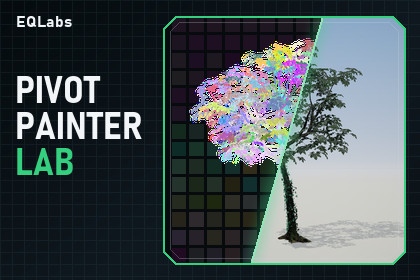
Bake Pivot Painter foliage wind inside Unity , no DCC round-trip. Solves the
branch hierarchy, pivots and swing arms from any mesh, then drives a four-level wind cascade in Built-In, URP and HDRP.Documentation PageEQLabs WebsiteYour mesh already knows how it should move. This finds out.Point EQ Pivot Painter Lab at a tree, a plant or a prop and it works out thethings that make foliage move like foliage: which parts are branches and whichare leaves, which branch each part hangs from, where each part should pivot, andhow far it swings. It bakes that into data textures and a mesh with lookup UVs,and ships hero foliage shaders that replay it on the GPU — trunk, big branches,small branches, leaves — with every part inheriting its parents' motion beforeadding its own.All of it happens inside Unity. No Houdini. No 3ds Max. No export, no reimport,no manual UV bookkeeping.If you have used Pivot Painter in Unreal, this is that workflow, native to Unity,without the DCC dependency.It solves the hierarchy — that is the hard partAnyone can wave a vertex shader at a tree. The difficulty is knowing what isattached to what. Five detection modes cover the range of real assets:skeleton and a support-first hierarchy.Skeleton First (RGS-PA) — for dense, single-mesh trees where nothing isconveniently separated. Builds a reduced connectivity graph, a spanningIslands — for meshes already split into separate branch and leaf pieces.Material Guided — when your materials already separate bark from foliage.Submesh Sections — one submesh per logical part.SmartCut — one welded mesh, split on sharp creases.Then it computes a real pivot, a forward axis from a PCA eigensolver, and aphysical swing-arm extent in metres for every element, and assembles a parentchain the shader can replay.It refuses to bake data that would animate wrongMost tools hand you whatever they produced and let you discover the problem inyour scene. This one has a hard pre-bake gate. It refuses outright on:triangles owned by more than one elementtriangle coverage below 98%parent cycles or self-parentingchains deeper than the shader can replaymore than 30,000 elements— and it names the elements at fault instead of silently baking something subtlybroken. Bake Doctor gives you the same verdict as a visual pre-flight, withoffender counts and click-to-select navigation.The same input bakes byte-identical output every time, guarded by goldenhashes in the test suite. Your version control will not see phantom diffs, andtwo artists baking the same asset get the same bytes.Everything you need around the bakeAuthoringMerge, split, detach and re-parent elements. Paint static and wind buckets byhand — painted overrides survive re-detection. Pivot, axis and extent overrides.Branch Group authoring for whole limbs at once. Pinned roots, parent locks, andper-element freezing for moss, bark and fixed attachments. All of it undoable.ReviewAn embedded workbench viewport with orbit, pan, zoom and click or drag selection,plus debug views for hierarchy level, element index, parent index, pivot, axis,extent, static mask and a problem finder. Scene view overlays for pivots, parentlinks, bounds and root markers.Look and performanceHero Foliage Lit shaders for all three pipelines, SRP Batcher compatible, withtranslucency, rim, normal and detail maps, and packed-mask support that readsyour real channel layout — Unity MaskMap, ORM, ORT or AO/Rough/Height — ratherthan forcing one convention. Albedo, normal and packed maps are classified byname and bound automatically, with a per-slot review panel when it guesses wrong.Wind that behaves like windA three-octave fractal gust, leeward shelter, downwind lean, and per-instancegust fronts so gusts travel across a forest instead of pulsing in unison. Windinteractors let characters and objects push foliage aside — wood resisting,leaves yielding. A runtime wind controller drives every foliage material in thescene at once, with per-renderer phase and strength variation.DistanceOctahedral impostor LODs captured in-editor and assembled into an LODGroupalongside a graduated chain built from your source LODs.CompatibilityUnity Built-In URP HDRP2022.3 LTS ✔ ✔ ✔Unity 6.0 ✔ ✔ ✔Unity 6.3 ✔ ✔ ✔Unity 6.4 ✔ ✔ ✔Unity 6.5 ✔ ✔ ✔All twelve combinations are verified by a recorded compile gate, not assumed.Package root: Assets/EQPivotPainterLab. Self-contained.Authoring code is Editor-only and excluded from player builds. Only the runtimewind components ship in a build.No dependency on any other package or EQLabs product.Honest limitationsListed up front because you will find them anyway, and because a tool that hidesits edges is not one you should trust with your pipeline.HDRP lighting. The HDRP hero shader is lit by the scene's main directionallight — direction, colour, intensity and its cascade shadow — plusspherical-harmonics environment from sky and light probes. Additionalpunctual and area lights do not reach it. Built-In and URP use theirpipeline's full lighting path. If you need a richer rig on hero foliage inHDRP, the deformation is a plain HLSL include designed to be wrapped in aShader Graph and shaded with HDRP's Lit master node.HDRP motion vectors. The HDRP hero shader writes none, so wind motion isnot represented to TAA. Whole-object movement is unaffected.Vertex colours. Baked meshes carry a per-element material family in vertexcolour alpha, so source vertex colours are not preserved.Budget. A single asset is capped at 30,000 elements and a parent chaindepth of 3, matching what the wind shader replays.