



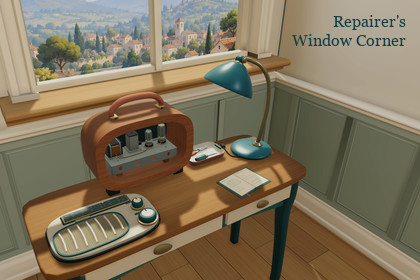
A stylized repair workspace for narrative, light puzzle and life simulation scenes. Includes 12 asset categories, two URP demo layouts and controllable desk drawers.Tested on Windows with Unity 6000.5.5f1 and URP 17.5.0. URP required; Built-in and HDRP are not supported. Follow the included customer guide for URP setup and demo scenes. Keep included LightingData and lightmaps for baked lighting. Choose No on the initial Input System backend prompt for the tested setup. No other Asset Store purchases required.Give your story a place where something is being repaired. A radio with its front panel removed, a tray of tools, printed notes and a town view beyond the window set the scene for a quiet workshop moment.Start with the furnished corner, or use the independent prefabs to arrange a workspace in your own scene. Choose the shelf layout for a stocked work area or the open corner layout for a clearer view of the desk. The desk's left and right drawers can be controlled separately when you connect them to your own interaction system.Included- 12 asset categories: desk, floor, wall/paneling, window, chair, shelf, lamp, radio, tray, tools, notebook and storage boxes.- 14 independent prefabs covering those categories, including closed and static service radio variants and a tray-with-tools assembly.- Two furnished demo layouts, with lighting, camera views and camera motion demonstrations.- Meshes, materials, textures, configured LODs and collision for Unity, plus drawer controller scripts and a setup README.- A 2D town backdrop used in the window view.- An included Blender source ZIP with 14 editable model files and 9 PNG images (individual models/assembly; not a complete Blender room).Setup and interactionImport the full Unity package into a URP project and follow the included pipeline setup instructions. In Play Mode, use the on-screen camera and Open drawers / Close drawers buttons. The independent desk exposes SetLeftOpen and SetRightOpen for your own controls; the README explains where to attach drawer contents.Retain the package's scene and asset dependencies: the included older-named scenes are required for baked lighting, even though they are not the current demo entry points. Changes to scene geometry or lighting may require rebaking.Compatibility and scopeTested in Unity 6000.5.5f1, URP 17.5.0, on Windows / D3D11. URP is required; Built-in and HDRP compatibility is not verified. Other Unity versions and platforms are unverified.The open-edged interior corner offers two arrangements and a 2D window backdrop suited to the supplied camera views and motions. The radio comes in closed and static service states; the desk provides separate left and right drawer controls.Delivered as a Unity .unitypackage, including RepairersWindowCorner_Blender_source.zip. Extract the source ZIP outside your Assets folder and follow its README.Scene, layout and drawer images are rendered in Unity. The service-detail image is rendered from the source models in Blender/Cycles; lighting and shading differ between renderers.31 LOD0 part meshes with three configured LOD levels, plus three OBJ background mesh assets. 96 imported mesh objects including LOD variants; 31 distinct LOD0/background geometry-and-UV shapes after deduplication. Individual meshes range from 2 to 27,924 triangles across all levels. All 14 public prefab entries have BoxCollider collision; demo background planes have none. 66 materials, 13 surface/backdrop textures and 8 baked-lighting textures. Color/printed/backdrop, normal/detail-normal and baked color/directional maps are supplied; metallic and roughness are primarily material parameters. Imported texture sizes: 256², 512×128, 512², 1024×512, 1024², 1254², 1448×1086 and 2048². Per-mesh counts follow below.URP 17.5.0 is required. The tested project also used Input System 1.19.0 and UGUI 2.5.0; the supplied IMGUI demo does not require the Input System native backend. Follow the offline setup README for pipeline assignment and the first-run prompt.Per-mesh countsVertices / triangles, per LOD. Repeated entries are configured levels of the same part, not extra product categories.A01_Desk / Body: LOD0 11038 / 11660; LOD1 10365 / 10798; LOD2 10054 / 10406.A01_Desk / Drawer_L: LOD0 3590 / 2732; LOD1 2828 / 1928; LOD2 2517 / 1740.A01_Desk / Drawer_R: LOD0 3590 / 2732; LOD1 2807 / 1928; LOD2 2487 / 1740.A02_Floor / Base: LOD0 6982 / 6968; LOD1 6982 / 6968; LOD2 6982 / 6968.A02_Floor / Body: LOD0 38866 / 27924; LOD1 38642 / 27760; LOD2 38642 / 27760.A03_Walls / Body: LOD0 2244 / 2576; LOD1 2244 / 2576; LOD2 2244 / 2576.A03_Walls / Paneling: LOD0 11128 / 7364; LOD1 10664 / 6900; LOD2 10428 / 6668.A03_Walls / SideWall: LOD0 2304 / 2812; LOD1 2304 / 2812; LOD2 2304 / 2812.A03_Walls / Trim: LOD0 4609 / 4512; LOD1 4609 / 4512; LOD2 4609 / 4512.A04_Window / Backdrop: LOD0 976 / 892; LOD1 976 / 892; LOD2 976 / 892.A04_Window / Body: LOD0 3020 / 2408; LOD1 2549 / 2188; LOD2 2331 / 2076.A04_Window / Hardware: LOD0 1143 / 808; LOD1 495 / 404; LOD2 221 / 200.A04_Window / Sash: LOD0 3712 / 2536; LOD1 3712 / 2536; LOD2 3712 / 2536.A04_Window / Sill: LOD0 384 / 356; LOD1 384 / 356; LOD2 384 / 356.A05_Chair / Body: LOD0 8059 / 10844; LOD1 5789 / 7692; LOD2 5018 / 6830.A06_Shelf / Body: LOD0 19430 / 18588; LOD1 11051 / 9448; LOD2 8224 / 6522.A07_Lamp / Body: LOD0 11043 / 16504; LOD1 7637 / 11796; LOD2 6276 / 9664.A07_Lamp / CablePlug: LOD0 384 / 188; LOD1 384 / 188; LOD2 384 / 188.A08_Radio_Closed / Body: LOD0 31309 / 22500; LOD1 18718 / 14586; LOD2 11849 / 9466.A08_Radio_Closed / Face: LOD0 11184 / 10584; LOD1 8118 / 6926; LOD2 6228 / 4564.A08_Radio_Closed / Glass: LOD0 738 / 1120; LOD1 380 / 616; LOD2 184 / 280.A08_Radio_Service / Body: LOD0 31309 / 22500; LOD1 18718 / 14586; LOD2 11849 / 9466.A08_Radio_Service / Face: LOD0 11184 / 10584; LOD1 8129 / 6926; LOD2 6231 / 4564.A08_Radio_Service / Glass: LOD0 738 / 1120; LOD1 380 / 616; LOD2 184 / 280.A09_Tray / Tray: LOD0 1834 / 1648; LOD1 936 / 902; LOD2 610 / 646.A10_Tools / Driver: LOD0 1148 / 1332; LOD1 615 / 728; LOD2 285 / 332.A10_Tools / Pliers: LOD0 1846 / 1796; LOD1 1046 / 988; LOD2 767 / 608.A11_Notebook / Body: LOD0 1152 / 564; LOD1 682 / 376; LOD2 495 / 280.A11_Notebook / Pages: LOD0 1212 / 1536; LOD1 1212 / 1536; LOD2 1212 / 1536.A12_Boxes / Body: LOD0 2294 / 2032; LOD1 1106 / 1016; LOD2 598 / 506.A12_Boxes / Label: LOD0 2554 / 1416; LOD1 2554 / 1416; LOD2 2554 / 1416.WindowMotion02/A backdrop: LOD0 4 / 2; LOD1 —; LOD2 —.WindowMotion02/B backdrop: LOD0 4 / 2; LOD1 —; LOD2 —.WindowTexture02 backdrop: LOD0 4 / 2; LOD1 —; LOD2 —. OpenAI Codex assisted with Blender modeling, UV/material and procedural image scripts, Unity C# scripts, Unreal Blueprint assembly/configuration, and documentation. OpenAI ImageGen generated the 2D town backdrop and generated or edited the wood-color textures used for furniture and radio veneer. The current radio veneer was edited to reduce fine dark grain contrast while retaining its warm color and horizontal fibers. Generated/edited bitmap outputs were retained and integrated into authored UVs and engine materials. Radio dial, notebook and box-label graphics, speaker-fabric maps and detail normal maps were created with AI-assisted procedural scripts; the furniture normal map was baked from procedural Blender material detail. Additional work includes editable model structure, LODs, component collision, drawer controls and content attachment, two furnished layouts, lighting and native-engine integration/testing.