



RPG Enemies - Combat AI + Utility AI Included
Tinny Studios
$46.19
$65.99
30%OFF
(no ratings)
Jump AssetStore
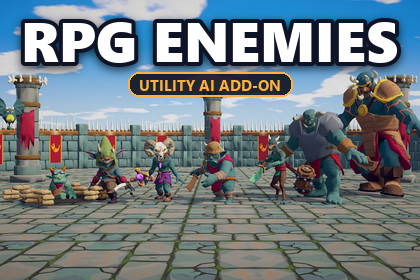
8 game ready action-RPG enemy archetypes with drop-in combat AI.
All character art and animations included. The Utility AI framework is included.All AI, behaviour and editor code is render-pipeline independent and works unchanged in URP and HDRP. Only the demo scenes use Built-in materials, if you import them into a URP or HDRP project, run Window > Rendering > Render Pipeline Converter (URP) or the HDRP Wizard material upgrader to convert the demo materials. No shaders or post-processing are included.ALL ART AND CHARACTER ASSETS INCLUDED. 7 rigged humanoid enemies, 1 flying swarm creature, weapons, projectiles, props, 131 animation clips and a 7-zone demo level. Nothing to buy or make before the enemies fight.DROP-IN ENEMY COMBAT AI. Drag an enemy prefab into your scene, press Play, and it patrols, notices you, calls its friends, telegraphs its attacks, takes turns, flanks, guards, grabs weapons and throws barrels. Every enemy talks to your game through three small interfaces, so it fights your player, not only ours.COMES WITH UTILITY AI. The full Utility AI decision-making framework is inside the package. You do not need to buy anything else. If you already own Utility AI, the upgrade price applies automatically.Enemies that fight like they came from a real action-adventure game, and show you why they did it.RPG Enemies gives you 8 enemy archetypes, from camp soldiers to a two-phase boss. They telegraph their attacks, take turns, flank when you are busy, raise guards you can read and break, grab weapons, throw barrels, hide, heal each other and call for help.Every enemy is built from small actions (Chase, Circle, Flank, Guard, Attack, Take Cover...) and considerations (Can I see the target? Is it blocking? Am I hurt? Do I have allies nearby?). Utility AI scores all of them on every decision and picks the best, so behaviour comes out of the situation rather than a hand-wired tree. To make a new enemy you mix actions and considerations in the Inspector. No behaviour trees, no state machines.Press F1 in the demo and every enemy shows its awareness, its current action and its top-scoring alternatives above its head. You can see why it did what it did, and tuning is a matter of adjusting numbers.YOUR MODEL, OUR BRAINS. Pick any enemy, press Swap Model, drop in your own humanoid character, and it fights straight away with the same AI, attacks, weapon and guard. The included characters are ready to ship, and they are also a shell you can replace with your own art in one click.THE ARCHETYPESMelee Soldier: sits at the campfire or sleeps in a tent, patrols, investigates noises, blows the alarm, runs to the weapon rack when caught unarmed, circles, flanks while you face its friends, uses a two-hit combo, throws barrels, raises a guard you can see coming, taunts, and flees when hurt and alone.Heavy Melee: slow and hard to stagger. Huge telegraphed smashes, a ground slam and a charge that score higher while you hold your block. Two smashes break a full guard.Agile Melee: circles fast, dodges your swings, chains a three-hit combo, lunges from range, and waits for you to drop your guard rather than hitting a raised shield.Archer: looks for high ground and a clear shot, backs off when rushed, kicks when cornered, and ducks behind cover to recover when hurt.Mage: fireballs, a fire circle telegraphed on the ground, teleports away when you get close, summons a swarm, and heals wounded allies. Take it out first.Swarm: small flyers that flock, circle overhead and dive-bomb. Weak alone, dangerous in numbers.Pop-up Shooter: a stationary turret that pops up to fire and ducks underground when hit or approached. Block its shot and send it straight back.Boss (2 phases): swipe combos, slams, boulder throws, a charge that punishes healing and a delayed smash that punishes dodge-spamming. At half health it roars, pushes you back, drops its guard and unlocks a fire ring and swarm summons.COMBAT SYSTEMSSenses and awareness: sight cone, hearing (sprinting and explosions make noise) and memory. An awareness meter fills rather than detecting instantly, with a "?" marker while suspicious, "!" when alert and "z" while asleep.Attack Data: each attack is an asset with wind-up (telegraph), active and recovery (punish window) timings, range, damage, poise damage, knockback, combos and follow-up chance. Melee, lunge, projectile, ground-telegraphed area and charge attacks. New attacks are data, not code.Group tactics: attack tokens limit how many enemies swing at once while the rest circle. Surround slots spread them around you, flankers take the side with fewer allies, and one enemy can alert the whole group.Readable guards: guards take time to raise and show a shield icon that turns from blue to red as it wears down. Front hits chip, flanks land in full, heavy hits break the guard into a long stagger.Weapons and the world: enemies drop weapons when parried, staggered or killed, then run to pick one up or grab one from a rack. They pick up and throw explosive barrels and other props.Position picking: a scored ring of points around the target (line of sight, high ground, ally spacing, travel cost). Archers use it for vantage points, mages for teleports, everyone for cover.Boss phases: health thresholds, a phase roar, and a Phase consideration that unlocks moves per phase.Difficulty profiles: Easy / Normal / Hard / Elite, colour-tinted. One archetype becomes four enemies that react faster, hit harder, combo longer and allow extra attackers.Wave spawner: an ambush arena where portals open, enemies rise already alert, barriers lock the player in, and the next wave starts when the current one falls.TOOLSOne-click Swap Model: humanoid models retarget the existing animations straight away. Weapons move to your model's hand and bone-attached props follow the matching bone. Generic rigs work with your own clips.Shared base Animator + override controllers: every enemy uses the same state names. Build a character's override controller from a folder of clips in one menu click.Animator state dropdowns, hit-frame detection and a clip report in the Enemy Animator inspector.Procedural guard pose: raises a humanoid's arms into a shield or weapon guard with no extra clips.Character Color Variant: recolour a character's texture by hue band without touching skin tones.AI debug view (F1): live action scores above every enemy.Dependency check: offers to install AI Navigation on import.PLAYABLE DEMOOne scene with 7 zones: Camp, Ruins, Duel Grounds, Pop-up Field, Swarm Nest, Boss Arena and a Spawn Arena. A full action-RPG test player (light and heavy attacks, block, parry, projectile reflect, dodge roll, heal, pick up and throw), live difficulty switching, zone teleports and the F1 AI view.PLUGS INTO YOUR GAMEThe enemies only talk to small interfaces: ICombatTarget (your player), IDamageable / IDamageInterceptor (health, blocking, parry), IProjectileReflector and EnemyMoverBase (swap NavMesh for your own locomotion). The demo player is a reference implementation. Replace it with your own controller. Everything you write lives outside the package folder, so updates never overwrite your work.WHAT IS INCLUDEDThe Utility AI framework: actions, considerations, deciders, the debugger, its demos and manual8 enemy prefabs, 23 actions, 40+ consideration assets, 26 attack assets, 4 difficulty profiles7 rigged humanoid characters + 1 flying creature, weapons, projectiles, props, 131 animation clips, shared base Animator + 8 override controllersLow-poly camp / ruins / arena environment setEditor tools: Swap Model, Create Enemy Animator From Folder, Animator state dropdowns, hit-frame detection, Character Color Variant7-zone demo scene, demo player, HUD and cameraPDF manual, Customization guide and Code Extending guideREQUIREMENTSUnity 6 (6000.0 or newer)Built-in Render Pipeline (URP after running the Render Pipeline Converter; HDRP not supported)AI Navigation package (installed on import if you accept the prompt)Legacy Input Manager for the demo player and the F1 view (set Active Input Handling to "Input Manager (Old)" or "Both")Already own Utility AI? This package contains the same core files at the same paths, so importing it over your copy updates the core in place.Demo: https://play.unity.com/en/games/b90996bd-b35c-4508-b9ca-122b318c62ce/rpgenemiesdemoSupport: tinnystudios@gmail.com Documentation: https://tinnystudios.github.io/rpg-enemies/Unity 6000.0+, developed on 6000.4. Built-in RP; URP via the Render Pipeline Converter; HDRP not supported.Includes the Utility AI framework (the same files as the Utility AI listing).8 enemy prefabs, 23 action types, 40+ consideration assets, 26 Attack Data assets, 4 difficulty profiles.7 humanoid characters (Mecanim Humanoid rigs) + 1 generic-rig flyer. Low-poly, hand-painted style textures.131 animation clips, in place, humanoid retargetable, one shared base Animator Controller + 8 override controllers.Runtime: plain C#, NavMesh (AI Navigation package) or your own mover via EnemyMoverBase. Single-player. No platform APIs.Demo and F1 view use the legacy Input Manager.Docs: PDF manual, Customization guide, Code Extending guide, all in the package and online at tinnystudios.github.io/rpg-enemies.The 8 enemy character models (7 humanoids and 1 flying creature), the player character model, their textures and the concept images they were generated from were made with Meshy (text-to-3D and image-to-3D). Their animation clips come from Meshy's animation library, retargeted to the models. After generation, the models were rigged, scaled, weapon-mounted and cleaned up by hand, the animations were retimed and re-keyed in Blender (hit frames, planted feet, guard poses), and the override controllers were built by hand. Environment props are low-poly meshes [state: hand-modelled / generated with Meshy, whichever is true]. The music is synthesised procedurally by a script and uses no AI model and no third-party audio. All C# code, the AI design, the actions, considerations and attack data were written by hand.