






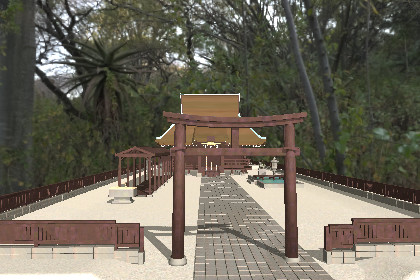
66 modular URP prefabs for a Japanese Shinto shrine: torii, worship hall, corridors, water court, temizu basin, fences, paving and guardians. Real-world scale, bottom-center pivots.Build a Japanese Shinto shrine precinct from modular pieces. The kit contains 66 prefabs in 10 categories, sized in real-world meters. Every mesh uses a bottom-center pivot, so parts can be placed directly on the ground and snapped together; only the hanging bells and sacred ropes use their upper attachment point. A demo scene shows every prefab and an assembled courtyard.Entrance (15): Courtyard 18 × 42 m, Courtyard Pool Opening, Earth Bank 2 m, Ground Patch 2 m, Landing 3 × 1.2 m, Paving 1 m A / B / Corner / Edge / Worn, Stair Curb Three Treads, Steps Single, Steps Three Treads, Stone Border 2 m, Torii Dark Cedar.Corridor (11): Complete Bay 2 m, Connector Roof 1.8 m, Corner Complete, Corner Floor, Corner Frame, Corner Roof, End Frame, Floor 2 m, Frame 2 m, Roof 2 m, Waistwall 2 m.Worship Hall (5): Haiden Complete, Haiden Frame, Haiden Roof, Haiden Walls and Doors, Honden (nagare style).Worship Front (10): Hengaku plaque (blank), Komainu Agyo and Ungyo guardians with pedestal, Offering Box, Shimenawa 2 m and 4 m, Kasuga stone lantern, single and triple Suzu bells.Water Court (5), Temizu handwashing basin (3), Sacred Fence and Gate (3), Boundary walls (5), Back Room (3) and Footwear arrangements (6, geta and zori).Scope: this product contains shrine architecture, gates, approach paths and courtyard components. Trees, sacred trees, undergrowth, moss and mossy rocks are not included. Some building materials and architectural components are also used by our Sacred Forest Shrine Kit for its assembled shrine; the forest environment belongs to that separate product.The kit does not include characters, animation, audio or a player controller. Clouds and distant scenery in the promotional images are presentation backgrounds and are not included.Render pipeline: Universal Render Pipeline (URP) Lit. Tested with Unity 6000.4.0f1 and URP 17.4.Number of meshes/prefabs: 66 FBX models and 66 static prefabs (369,784 triangles in total; 12–69,060 triangles per model). Quad-based meshes, not triangulated.Scale and pivots: 1 unit = 1 m. Bottom-center pivots on every mesh; hanging bells and sacred ropes use their upper central attachment point. Architecture faces +Z.Colliders: architecture and modules with openings use non-convex MeshColliders so entrances and corridors stay walkable; small props use BoxColliders or convex MeshColliders.Materials: 19 surface materials plus 1 demo sky material.Textures: 38 PNG textures at 2048 × 2048 plus one 1024 × 512 demo sky gradient. Base Color and Normal maps; guardians also include Metallic-Smoothness and Occlusion.Demo: one scene with every prefab and an assembled courtyard.AI tools used: OpenAI Codex and Anthropic Claude (AI coding assistants) wrote the Blender Python scripts that build most architectural and worship-front meshes in this package. AI-generated images were used only as concept references and are not included.The two guardian (komainu) source sculptures were created with image-to-3D generation, then retopologized to quad meshes, optimized and baked to base-color, normal and ORM maps.Human-directed changes included unifying dimensions to real-world meters, adjusting module connections, moving every mesh pivot to the bottom center (hanging bells and sacred ropes use their upper attachment point), fitting the guardian placement, preserving quad topology, converting ORM channels, and configuring materials, colliders and static prefabs in Unity.