





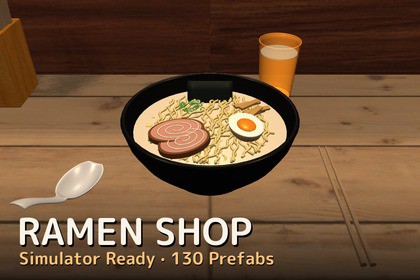
A modular Japanese ramen shop with 130 prefabs and a full kitchen. Food is split into bowls, broth, noodles and toppings, ready for cooking and restaurant simulators.Build a cozy Japanese ramen shop, and make it playable.Most food and restaurant packs are scenery. This kit is built for cooking and restaurant simulators: the ramen is split into stages and parts, the kitchen tools are separate grabbable props, and the shop follows a strict modular grid so you can lay out your own restaurant in minutes.WHAT'S INCLUDED- 2 demo scenes: a furnished 8 x 4 m shop with day and night lighting, and a catalog of every prefab- Built-in Render Pipeline + one-click URP converter (Tools > Japanese Ramen Shop)- Colliders on every prefab, LODs on all heavier models (70 models), real-world scale- PDF documentation: quick start, modular spec, pivots and simulator workflowNumber of textures: 56 (18 tiling PBR sets: albedo, normal, metallic/smoothness + print atlas + noren print)Texture dimensions: 2048 x 2048Polygon count: 14 - 35,000 triangles per model (most props under 5,000)Minimum polygon count: 14Maximum polygon count: 35,000Number of meshes/prefabs: 129 meshes / 130 prefabsRigging: NoAnimation count: 0 (fridge doors and lids have hinge pivots for scripted opening)UV mapping: Yes (tiling world-scale UVs, 1 unit = 1 m; printed parts use one atlas)LOD information: LOD0 + LOD1 (35%) on every model over 1,500 trianglesTypes of materials and texture maps: PBR (Standard / URP Lit), albedo, normal, metallic/smoothness, emissionColliders: Yes (box on props, mesh on large pieces)Render pipelines: Built-in and URP (one-click converter included)Documentation: PDF manual includedAll 3D models in this package were generated procedurally by Python scripts executed in Blender. These scripts, the Unity editor tools (material converter) and the scripts that render the printed graphics (menus, signs, posters, ticket-machine labels) were written with the assistance of an AI coding assistant (Anthropic Claude). The publisher defined the content, reviewed every model in-engine and directed revisions (layout, proportions, materials, modular grid, simulator-ready part splits, LODs and colliders).No text-to-image or text-to-3D generative models were used. PBR surface textures come from Poly Haven (CC0) and are not AI-generated. Lettering uses open-licensed fonts (SIL OFL).

