






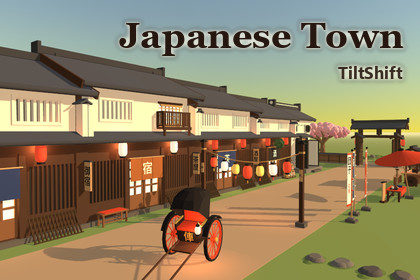
49 low poly models for a traditional Japanese town: machiya houses, a ryokan inn, a shrine with a pagoda, an onsen, a koi pond, modular walls, lanterns and cherry trees.Tested with Unity 6000.3.6f1 (6.3) and URP 17.3 (default): Lit and Simple Lit materials.Built-in: tested. Import Support/BuiltInRP_Materials.unitypackage to switch to Standard; prefabs and scenes keep working. Use Linear color space.HDRP: not included or tested; HDRP/Lit should work (only base map, color, emission, alpha clipping).Mobile: use SakuraTree_Lite (13,638 triangles, not 29,987).Japanese Town is a low poly kit for building a traditional Japanese town in Unity. You get 49 models and a lighter cherry tree variant as prefabs with colliders, plus two demo scenes. Use it for stylized games set in old Japan: a street of shops and houses, a shrine or temple level, a festival street, an onsen village or a hub area.The whole kit shares four materials, and almost every face samples one 256 × 256 palette texture. 23 of the models carry 72 kanji signs (茶屋 tea house, 御宿 inn, 酒屋 sake shop, 神社 shrine, 夏祭り summer festival and more) from one 1024 × 1024 sign atlas.WHAT'S INCLUDED50 prefabs (49 models + SakuraTree_Lite) in 8 category folders, each with a collider and marked static50 FBX meshes, plus 4 collision meshes without the water surface for KoiPond, OnsenPool, Temizuya and Minka4 kit materials (palette, glass/water, glow, signs) and 6 demo scene materials2 PNG textures: the palette and the kanji sign atlas2 demo scenes without scripts: Demo_JapaneseTown_Village and Demo_JapaneseTown_Catalog (every prefab, grouped by category)Support/BuiltInRP_Materials.unitypackage for the Built-in Render PipelineDocumentation (README.md) with the triangle count and size of every model, snap steps, materials, colliders and render pipeline notesTHE 49 MODELSBuildings (8): Machiya, MachiyaInn, MachiyaSake, Ryokan, Kura (storehouse), Minka (thatched farmhouse), Watchtower, TownGateShrine and temple (10): Torii, ToriiSmall, ShrineHall, Temizuya (purification pavilion), EmaRack, Komainu (pair of guardian statues), Hokora (wayside shrine), Pagoda, BellTower, TaikoDrumOnsen (4): OnsenHouse, OnsenPool, OnsenBench, OnsenBucketsStreet props and lanterns (7): StoneLantern, YukimiLantern, FestivalLanterns, Nobori (banners), Yatai (food stall), TeaBench, RickshawModular walls, fences and paths (8): TsuijiWall, TsuijiWallCorner, TsuijiGate, WoodFence, BambooFence, StonePath, StoneSteps, SteppingStonesWater and bridges (3): KoiPond, TaikoBridge (arched drum bridge), WoodBridgeTrees and plants (4 + 1 variant): SakuraTree, SakuraTree_Lite, Bush, BushSmall, MossMoundRocks (5): RockLarge, RockCluster, RockMedium, RockSmall, RockFlatSome models are variants of each other. The three machiya share one house body with a tea house, inn or sake shop front. ToriiSmall is a smaller torii, OnsenBench a variant of TeaBench and BushSmall a smaller Bush.TECHNICAL DETAILSTriangles: 164 to 33,678 per model (median 4,032), 301,332 for all 49 models. SakuraTree_Lite: 13,638.Heaviest models: Pagoda 33,678, SakuraTree 29,987, Ryokan 27,485, Kura 20,731, OnsenHouse 16,131. No LODs.Texture maps: base color only. No normal, metallic, roughness or occlusion maps. The palette is made of flat 16 × 16 px color cells; the sign atlas has transparency.Materials: 1 to 4 per model. Paper lanterns and shoji use the glow material (emission), water uses the transparent glass material.Scale: 1 unit = 1 meter, Y up, front +Z. Pivot at the bottom center of each model; prefab roots at position 0, rotation 0, scale 1.Colliders: 34 mesh colliders and 16 box colliders.Static meshes: no rigs, animations, scripts or audio. Buildings are exteriors without furnished interiors.MODULAR PIECESThe kit follows a 1.12 m grid. TsuijiWall and TsuijiGate are 4.48 m long, WoodFence and BambooFence 2.24 m, and StonePath tiles 2.24 × 2.24 m. StoneSteps rise 1.12 m per 2.24 m, SteppingStones repeat every 3.36 m, and the three machiya stand 5.88 m apart in a street row. Where a model's grid point is not its pivot, the prefab has an empty SnapPivot child. The documentation lists every snap step.RENDER PIPELINESURP (default): tested in Unity 6000.3.6f1 with URP 17.3. Materials use Universal Render Pipeline/Lit and Simple Lit.Built-in: tested. Import Support/BuiltInRP_Materials.unitypackage to switch the same 10 material files to the Standard shader; prefabs and demo scenes keep working. Use the Linear color space. A new Built-in project starts in Gamma, where the scenes look brighter.HDRP: not included and not tested. The materials use only a base map, a color, emission and alpha clipping, so HDRP's material conversion or a manual switch to HDRP/Lit should work.DEMO SCENESThe village scene is a small town: a street of machiya, a shrine and temple on a walled terrace, an onsen, a koi garden, a stream with two bridges and a farmhouse. It is lit by a low warm sun, a procedural sky material, fog and point lights at the lanterns, all realtime with nothing baked. The ground, road, terrace and stream are Unity cubes with the demo materials.HOW IT WAS MADEThe models were built by procedural scripts (Blender Python / Luau) that we wrote with the help of Anthropic's Claude, an AI coding assistant. No AI image or 3D generators were used. The AI description has the details.All store images are Unity URP renders of the demo scenes in this package. The wireframe image overlays the triangle edges of the package meshes on the same kind of render. Only the cover and the card carry added text: the product name and our name.SUPPORTcontact@tiltshift.xyzCompatibility:Unity version: 6000.3.6f1 (Unity 6.3) or newer.Render pipelines: URP (default); Built-in through the included Support/BuiltInRP_Materials.unitypackage; HDRP not included.No scripts, no Package Manager dependencies.Contents:49 models + 1 lighter variant (SakuraTree_Lite): 50 FBX files.50 prefabs in 8 category folders: Buildings 8, Shrine 10, Onsen 4, Props 7, Modular 8, Water 3, Nature 5, Rocks 5.10 materials: 4 kit materials (M_JapaneseTown_Palette, _Glass, _Glow, _Signs) and 6 demo-scene materials (M_Demo_*).2 textures, PNG: T_JapaneseTown_Palette 256 x 256, T_JapaneseTown_Signs 1024 x 1024.4 collision meshes (Models/Collision): KoiPond, OnsenPool, Temizuya, Minka.2 demo scenes: Demo_JapaneseTown_Village, Demo_JapaneseTown_Catalog.Documentation: Documentation/README.md.Geometry:Triangles per model: 164 to 33,678; all 49 models: 301,332. SakuraTree_Lite: 13,638.One mesh per model, 1 to 4 material slots. No LODs, rigs, animations or blend shapes.Built from primitives with exact boolean operations. Overlapping coplanar faces were removed or separated; transforms are applied.Textures and materials:Palette: flat 16 x 16 px color cells, UVs at the cell centers. Import settings: Point filter, no mipmaps, clamp, uncompressed. Alpha below 1 only in the water cells.Sign atlas: 72 kanji signs with transparency. Trilinear filter with mipmaps, BC7. Material: Lit with alpha clipping (cutoff 0.5).Base color only: no normal, metallic, roughness or occlusion maps.M_JapaneseTown_Glass: Simple Lit, transparent, no shadow casting (water).M_JapaneseTown_Glow: Lit with emission (palette as emission map, intensity 0.6) for paper lanterns and shoji; raise it for a night look.Scale, orientation and pivots:1 unit = 1 meter, Y up, front +Z.Pivot at the bottom center of each model's bounding box; every model stands on y = 0.Prefab roots at position 0, rotation 0, scale 1; the model is a nested child.Modular grid 1.12 m. 10 prefabs have an empty SnapPivot child at their grid point (the three machiya, Ryokan, Kura, Minka, Watchtower, TownGate, TsuijiWallCorner, SteppingStones).Colliders:Every prefab has a collider and is marked static.34 prefabs: non-convex MeshCollider on the render mesh (buildings, gates, walls, stairs, bridges, large props, trees, large rocks).16 prefabs: BoxCollider matching the bounds (small props, fences, flat path tiles, bushes, small rocks).KoiPond, OnsenPool, Temizuya and Minka use collision meshes without the water surface.Demo scenes:Realtime lighting only, nothing baked: directional sun, trilight ambient, exponential fog; the village scene adds point lights at the lanterns and a procedural sky material stored in the scene.Lit for the Linear color space (the URP default); a Gamma project renders them brighter.URP Forward renderer: 4 additional lights per object by default; the demo ground is split into tiles so the lantern lights reach it.Models (triangles; size W x H x D in meters):BuildingsMachiya: 8,147; 6.72 x 6.54 x 6.39MachiyaInn: 7,063; 6.72 x 6.87 x 6.39MachiyaSake: 8,817; 6.72 x 6.20 x 6.48Ryokan: 27,485; 10.26 x 8.19 x 9.35Kura: 20,731; 5.64 x 6.15 x 4.97Minka: 8,442; 7.28 x 6.21 x 5.24Watchtower: 5,328; 3.14 x 7.43 x 2.10TownGate: 4,214; 5.21 x 4.75 x 2.83Shrine and templeTorii: 776; 5.86 x 5.23 x 0.78ToriiSmall: 650; 2.88 x 2.50 x 0.39ShrineHall: 11,095; 7.43 x 5.39 x 6.45Temizuya: 940; 2.84 x 2.90 x 2.34EmaRack: 3,356; 2.23 x 2.11 x 0.95Komainu: 6,310; 2.46 x 1.75 x 0.81Hokora: 1,569; 0.84 x 1.28 x 1.15Pagoda: 33,678; 5.24 x 10.99 x 5.41BellTower: 4,308; 4.45 x 4.75 x 3.72TaikoDrum: 5,854; 1.68 x 1.86 x 1.31OnsenOnsenHouse: 16,131; 9.81 x 11.35 x 10.61OnsenPool: 12,780; 10.44 x 1.95 x 8.86OnsenBench: 2,879; 3.10 x 2.26 x 2.58OnsenBuckets: 4,709; 1.91 x 1.02 x 1.27Street props and lanternsStoneLantern: 856; 1.10 x 2.01 x 0.99YukimiLantern: 1,324; 1.69 x 1.51 x 1.56FestivalLanterns: 4,986; 4.82 x 3.09 x 0.38Nobori: 699; 3.04 x 2.76 x 0.58Yatai: 3,520; 3.26 x 2.51 x 2.01TeaBench: 5,578; 2.93 x 2.61 x 2.55Rickshaw: 2,824; 1.40 x 1.89 x 2.75Modular walls, fences and pathsTsuijiWall: 840; 4.48 x 2.07 x 1.01TsuijiWallCorner: 1,361; 1.64 x 2.09 x 1.64TsuijiGate: 4,091; 4.48 x 3.56 x 2.07WoodFence: 246; 2.24 x 1.13 x 0.31BambooFence: 1,304; 2.24 x 1.44 x 0.25StonePath: 598; 2.24 x 0.09 x 2.24StoneSteps: 2,300; 2.24 x 1.51 x 2.24SteppingStones: 2,140; 1.13 x 0.10 x 3.29Water and bridgesKoiPond: 11,403; 7.34 x 0.99 x 6.07TaikoBridge: 11,317; 2.48 x 2.35 x 8.51WoodBridge: 816; 1.68 x 0.90 x 4.59Trees and plantsSakuraTree: 29,987; 7.28 x 4.82 x 6.81SakuraTree_Lite: 13,638; 7.27 x 4.82 x 6.81Bush: 4,032; 2.27 x 0.88 x 1.90BushSmall: 1,424; 1.05 x 0.63 x 0.84MossMound: 4,841; 3.99 x 0.59 x 3.11RocksRockLarge: 1,514; 2.94 x 1.52 x 1.80RockCluster: 6,968; 3.27 x 1.27 x 2.50RockMedium: 595; 1.75 x 1.21 x 1.20RockSmall: 164; 1.09 x 0.63 x 0.91RockFlat: 342; 1.62 x 0.29 x 1.38The models were built by procedural scripts (Blender Python / Luau) that we wrote with the help of Anthropic's Claude, an AI coding assistant (a large language model). No AI image or 3D generators were used.What Claude helped us write:The generator scripts. Luau scripts assemble each model from primitive shapes (blocks, cylinders, wedges, spheres) and boolean operations. Blender Python scripts rebuild those shapes as meshes with exact booleans, remove overlapping faces, lay out the palette UVs, build the 256 x 256 palette texture and export the FBX files.The Python script that renders the 72 kanji signs into the 1024 x 1024 sign atlas. The signs are Japanese words typed into the script and rendered from a font, not generated images.The Unity editor scripts that set up the materials, prefabs, colliders and demo scenes and render the store images. These scripts are not part of the package.The documentation and the store texts. Claude drafted them, and we reviewed them.What was not used: no text-to-3D, image-to-3D, diffusion or other image, texture or 3D-model generator. No AI-generated image is used as a texture or as a store image.Our part: we chose the theme, the list of models, the look and the scale, directed the scripts and approved the results. Every model was checked in renders from several angles next to a 1.7 m reference figure and by automatic mesh checks (pivot, ground contact, inverted shells, overlapping faces). Defects found this way were fixed in the generator scripts, and the models were rebuilt.

