





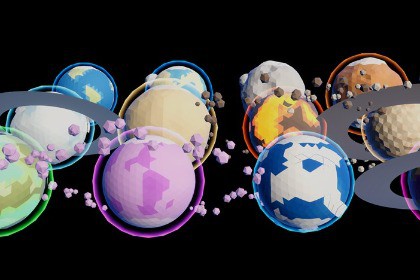
Procedural low-poly planet toolkit for URP: 12 ready-to-use presets, editable terrain, craters, emission masks, clouds, rings and debris belts - baked into prefabs, meshes and materials.URP only (Universal Render Pipeline 14.0+). Shaders and sample scene target URP; Built-in and HDRP are unsupported and render pink. Import into a URP project. Tested on Unity 2022.3 LTS and Unity 6 LTS. No other dependencies: runtime uses UnityEngine only, editor tools also reference Unity.RenderPipelines.Core/Universal.Stylized Planet Toolkit generates flat-shaded, stylized planets, moons, rings and debris belts for URP projects — then bakes them into ordinary prefabs, meshes and materials, so shipping builds pay no procedural generation cost.Pick one of 12 presets, drag a few sliders, and press Bake & Save As Prefab. Every planet ships as a prefab with its own mesh assets, atmospheric rim material, optional cloud layer, ring system, debris belt and orbiting moon — ready to drop into a scene, a menu, or a solar-system map.GENERATE- 12 editable presets: Real Earth, Earth (random), Moon, Mars, Ice, Desert, Lava, Gas Giant, Toxic, Crystal, Ocean, Alien.- Seam-free icosphere terrain with 3D fBm noise, mountain sharpness, spherical flat oceans and coastal cliffs — no UV seam, no pole pinching.- Terrain styles: standard low-poly, terraced steps, gas-giant bands.- Procedural impact craters (count, radius, depth, raised rims, seed).- Emission masks for lava lowlands, random city lights, glowing peaks and cracks/chasms.- Low-poly cloud shells, solid ring systems, debris asteroid belts (15–200 chunks, seeded) and orbiting moons/satellites with tidal locking.LOOK- Flat-shaded vertex-colour surface shader (half-Lambert diffuse, ambient, atmospheric rim, emission mask) plus a separate additive Fresnel atmosphere shader.- Auto Fit shells: the atmosphere and cloud radius is measured from the actual generated peaks, so the shells hug the terrain instead of floating far above it.- The showcase scene ships with URP camera data (post-processing, SMAA), soft shadows and a Global Volume (ACES tonemapping, Bloom, Vignette, colour adjustments).SHIP- One-click bake: prefabs + mesh .asset files + per-planet materials, with an overwrite mode that keeps prefab GUIDs so existing scene instances pick up rebaked assets automatically.- Batch bake all 12 presets, with stale sub-assets cleaned up — no orphan assets.- Landmass Mask Baker: bake real Earth continents from the bundled public-domain Natural Earth data, your own GeoJSON, or seamless procedural noise; import settings are applied for you.- 4K / FHD screenshot tool for store art and marketing.- Runtime components (rotator / orbit rotator) with editor preview toggles.WHAT'S INCLUDED- 12 demo planet prefabs (one per preset), 38 baked meshes, 16 materials, 2 URP shaders.- 4 runtime scripts and 6 editor tools (generator window, custom inspector, mask baker, GeoJSON rasteriser, import post-processor, assembly definitions).- Showcase scene with all 12 planets plus its post-processing profile.- Public-domain Natural Earth landmask data with its licence file, README and LICENSE.REQUIREMENTS- Unity 2022.3 LTS or newer (developed and tested on Unity 6 LTS).- Universal Render Pipeline (URP) 14.0+ — required. Built-in and HDRP are not supported.- No other package dependencies.KNOWN LIMITATIONS- URP only. The shaders do not compile under Built-in or HDRP.- Lighting model: the surface shader samples the main directional light plus a constant ambient colour. Additional lights and received shadows are intentionally not applied — that keeps the flat-shaded look and the shader cheap. Object shadows (cast) still work through the URP fallback pass.- Fixed generator paths: the generator resolves its default materials and the bundled mask through fixed paths under Assets/StylizedPlanetToolkit. Keep the folder where it is; baked prefabs reference assets by GUID, so they keep working even if you move them.- Bloom is a sample-scene effect. The prefabs look correct without post-processing; disable the Global Volume on low-end mobile.- No LOD or imposter system: baked meshes are a single LOD (~1,280 triangles per planet surface at subdivision 3). Measured cost per additional planet is ≈0.003 ms at 1080p (50 instances ≈ +0.14 ms), so LOD is unnecessary at desktop scale.- Landmass masks are generated, not scanned: the bundled Earth mask is derived from public-domain Natural Earth vector data at 110 m resolution.- Mobile is untested at publishing time. Verified on the desktop reference below; no device measurements exist yet, so no mobile frame rate is claimed.SUPPORT- Support: bleedthrough.logic@gmail.com — 1 business-day response target.- Semantic versioning; the changelog lives in README.txt; updates in the 1.x line are free for existing customers.- When reporting an issue, please include your Unity version, URP version, render pipeline asset and a screenshot of the Console.FAQQ: Does it support HDRP or Built-in?A: No. The toolkit is URP-only by design (both shaders plus the sample scene's camera data).Q: Do the planets cost anything at runtime?A: No generation cost — you bake to prefabs, meshes and materials in the editor. A baked planet is a normal MeshRenderer (~1,280 triangles for the surface at subdivision 3) plus optional cloud/ring/debris renderers, and meshes are shared between instances.Q: Can I use my own landmass or heightmap?A: Yes. Author a grayscale equirectangular mask and set Settings > Landmass Source = Custom Heightmap, or bake one with Tools > Stylized Planet Toolkit > Bake Landmass Mask from the bundled Natural Earth data, your own GeoJSON, or seamless procedural noise.Q: Is the bundled Earth mask safe for commercial projects?A: Yes. It is rasterised from Natural Earth vector data, which is public domain ("No permission is needed to use Natural Earth"). The full terms ship in ThirdParty/NaturalEarth/LICENSE_NaturalEarth.txt. No AI-generated or third-party artwork is included in the package.Q: Why is my atmosphere so large?A: Auto Fit measures the highest peak of the generated mesh and places the shell just above it; the Atmosphere Scale slider is a margin over that measured peak (1.00–1.10). Turn Auto Fit off to fall back to a simple multiple of Radius.Q: I changed a preset and rebaked — will my scene update?A: Yes, when "Overwrite existing prefab & sub-assets" is enabled: the prefab keeps its GUID, so instances in your scenes pick up the new meshes automatically.Q: Where are the tools?A: Tools > Stylized Planet Toolkit (bake, showcase scene, capture, mask baker) and Window > Stylized Planet Toolkit > Planet Generator for the interactive editor window.GEOMETRY BUDGET - the baked meshes that ship in the package (flat-shaded; 1,280 triangles per planet surface at subdivision 3)- Package totals: 38 meshes, 67,317 vertices / 25,557 triangles.- Triangles per preset (surface + atmosphere + clouds + ring + debris + moon): RealEarth 1,926 · Earth 1,959 · Moon 1,280 · Mars 1,600 · Ice 1,863 · Desert 1,600 · Lava 2,943 · GasGiant 3,592 · Toxic 1,667 · Crystal 3,200 · Ocean 2,040 · Alien 1,887.- Showcase scene with all 12 planets: 25,557 triangles.- Meshes are shared between prefab instances: more planets add draw calls, not mesh memory.MEASURED PERFORMANCE - player build, 2026-09-21 (release player, 3–4 runs, median, VSync off)Desktop reference: NVIDIA GeForce RTX 4060 Ti · AMD Ryzen 5 3600 · Windows · Unity 6000.3.10f1 (URP) · 1920x1080 windowed- 1 planet (Bloom off): 1.31 ms - ≈763 FPS uncapped, 1% low 223.- 12 planets + Bloom (demo scene): 1.51 ms - ≈660 FPS uncapped, 1% low 226.- 50 instances of one prefab: 1.45 ms - ≈690 FPS uncapped, 1% low 253.- Cost per additional planet ≈ 0.003 ms at 1080p (50 instances ≈ +0.14 ms), so the pack scales to large solar systems without LOD or imposters.- Demo app memory: 121–127 MB allocated / 203 MB reserved (Unity + URP + the scene).- Editor numbers are 4–30× slower and are never published. GC per frame, draw calls and GPU timings require a Development Build with the Profiler attached, so they are not quoted; mobile frame rates are not claimed — measure on your own device.AI/ML was used only as a writing/coding assistant during development (refactoring a few runtime scripts and drafting documentation). No AI-generated artwork, textures, meshes or imagery are included in the package: all meshes and materials are produced by the toolkit's own procedural generators or rasterised from public-domain Natural Earth data, and the store images are renders of the included scenes.

