




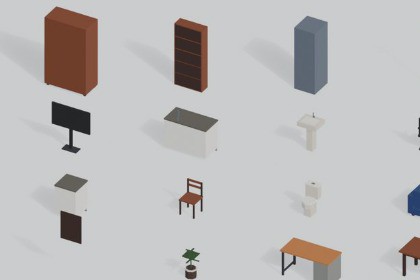
35 low-poly interior props sharing one 256×256 atlas: one material, one draw call, and real-world metric scale verified by an automated check.Furnish a whole house with 35 low-poly props — living room, bedroom, kitchen, bathroom and office. The entire pack is 3,760 triangles and one 256×256 texture.One material, one texture, one draw callAll 35 models sample the same palette atlas. There are no per-model materials to reconcile and no texture folder to wire up. Drop the whole set into a scene and the batcher treats it as one.Real-world scale, and it is checkedProportions come from the dimensions real furniture has to have:Dining chair seat at 0.45 m, dining table top at 0.75 m — the 0.30 m of legroom an adult needs.Kitchen counter, cooker and base cabinets all at 0.90 m, so they line up in a continuous run.Wall cabinets from 1.45 m, leaving 0.55 m of clearance above the counter.Every model declares its intended measurements in its source, and an automated check confirms the geometry matches within 10–15 mm. All 35 pass. The per-model report ships with the pack as report.json.Origin at the baseEvery pivot sits at the centre of the footprint, on the floor plane. Drop a prefab in at y=0 and it stands on the ground — no offsets to dial in, no rotation baked into the prefab root.CustomisableThe whole pack is coloured by one 256×256 palette atlas of 24 flat swatches. Recolour that single 1 KB image and all 35 models change at once — a warm oak set, a Scandinavian set, a dark set — at no cost in memory or draw calls. No per-model material editing, ever.Because the models are plain meshes with no baked shading, they also take any shader you already use: toon, flat-lit, vertex-coloured, or your own.What it suitsAnything with interiors: first-person exploration, life and management sims, top-down RPGs, escape rooms, VR walkthroughs, mobile puzzle games, and greybox passes where you need real proportions before the art exists.The stylised look sits next to both realistic and cartoon characters, and the triangle budget is safe on mobile and standalone VR.ContentsLiving room (10) — sofa, armchair, coffee table, rug, TV stand, television, bookshelf, floor lamp, wall shelf, potted plantBedroom (7) — double bed, nightstand, wardrobe, dresser, table lamp, wall mirror, coat standKitchen (9) — counter with sink, cooker, base cabinet, wall cabinet, refrigerator, microwave, dining table, dining chair, bar stoolBathroom (4) — bathtub, toilet, bathroom sink, interior doorOffice (5) — desk, office chair, filing cabinet, desktop computer, trash canHow it was madeWritten as Python for Blender: every model is code, not a sculpt. That is why the measurements are exact and why the set is internally consistent.No generative AI was used for the geometry, the textures, the layout or the preview images.Geometry35 meshes, 3,760 triangles for the entire pack107 triangles average, 292 maximum, 24 minimumZero non-manifold edges; predominantly quadsBuilt to real-world metric dimensions, verified by an automated check (report.json lists every model's declared and measured size)Materials and textures1 material and 1 texture (256×256 PNG, 24 flat colours, ~1 KB)1 draw call for the whole set when batchedTexture filter must be set to Point (Nearest) — the atlas is flat colourMipmaps enabled, 9 levels; swatches carry 8 px of margin so mips never blend neighbouring coloursPrefabs35 prefabs, all with root transform at position 0, rotation 0, scale 1Pivot at the centre of the footprint, on the floor planeProject setupRender pipeline: Built-in. For URP or HDRP, select the material and run Edit > Rendering > Materials > Convert Selected Built-in Materials to URPNo Asset Store package dependenciesDemo scene includedTotal download under 400 KBThe geometry and the texture in this package were produced by Python scriptsthat run inside Blender. Those scripts were written with the assistance of anAI coding assistant (Anthropic Claude).No generative AI model produced any mesh, texture, image or audio in thispackage. Every vertex position and every texture pixel is computedarithmetically by the scripts: the models are parametric code, not the outputof a 3D or image generator. Running the scripts again reproduces the samefiles byte for byte.The preview images are Blender renders of those same meshes, not generatedimages.AI tool used: Anthropic Claude (code authoring only).