




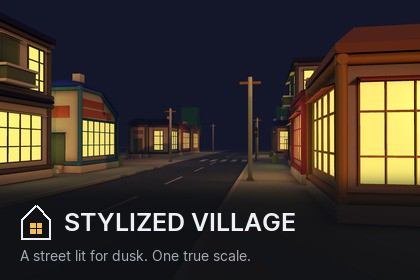
An old-town street in 21 prefabs: six shop-houses, street furniture, trees and hedges at one true scale, from one palette. LODs, mesh colliders, lightmap UVs, a baked dusk demo. Built-in, URP, HDRP.Six shop-houses, eight pieces of street furniture, five trees and two hedges in planters - and a demo street that opens already baked at dusk, the shop windows lighting the pavement in front of them.Every piece is a prefab at scale 1, standing on the ground at its pivot, at a size that was worked out rather than guessed. Drop one into a scene and it is the size the table says.ONE TRUE SCALEThe houses are scaled so a storey is 3.2 m. That was then checked against things it was not fitted to: the ground-floor window sills come out at 0.81 to 0.88 m and the shop windows 2.0 to 2.2 m tall, which is what they are on a real street.The street furniture has a scale of its own, set so a market counter is 0.9 m - and checked the same way. The stall's canopy comes out 2.0 m up, a height you walk under. The pull-up bar comes out at 2.44 m, a height you reach up to. The parallel bars come out at 1.21 m, at your hands. The trees are 7.9 m tall, their crowns starting 3.3 m up, over your head; the hedges stand in planters 53 cm high, a wall you could sit on.A person dropped next to any of it looks like a person, not a toy or a giant.ONE TEXTURE, TWO MATERIALSEverything - every house, every prop, every tree, and the demo's ground - is coloured from one palette: a 1024-pixel texture of 216 colour gradients. One material draws it all. The second is the glass, because the glass glows.So the whole village can be drawn together, and recolouring is painting: repaint a strip of the palette and everything that uses it follows.THE WINDOWS LIGHT THE STREETThe glass is emissive and its light is baked. In the demo, with the sun switched off and measured from above, the pavement in front of every house is 2.3 to 8 times as bright as the pavement at the ends of the street, and the road by every lamp post 2.2 to 2.9 times. The lamps are baked lights, shining down from under each crossbar.Every mesh has lightmap coordinates, laid out to stay clean down to a bake of 10 texels a metre - coarser than a street is usually baked. Every prefab carries static flags set for a street. The props, a few centimetres thick, are lit from light probes, as Unity advises for things that size.A FAR LEVEL YOU WILL NOT SEE SWITCHEach house has a far level that leaves out its glazing bars, window frames and door rods - a third to a half fewer triangles. It takes over when the widest of those is half a pixel on a 1080-pixel screen. That was measured, not assumed: drawn at the switch, going from one level to the other changes the picture less than moving the camera sideways by half a pixel does, for every house, from every side, by day and at dusk.Everything is culled at 0.5 % of the screen's height.COLLIDERS THAT ARE THE MODELEach prefab's collider is a mesh collider on its own model - exact, nowhere standing off in the air. A house's collider is its far level, so a glazing bar a few centimetres thick is not something to snag on. To make a prop you can knock over, tick Convex and add a Rigidbody; the guide says how.BUILT-IN, URP AND HDRPTwo materials, pointed at the right shader for your project the first time the pack is imported, and one menu item if you ever change pipeline. The package references neither URP nor HDRP, so it imports cleanly into a project that has neither.The demo street is lit and baked for Built-in and URP, and looks the same in both. In HDRP it opens cleanly with its materials set up and its lightmap in use, but HDRP measures light physically: there the demo needs a Volume and a bake of its own. The prefabs and materials are ready in HDRP as they are.A DEMO STREETTwelve houses facing each other across a road, a courtyard with the bars, a market square with the stalls, a zebra crossing with its traffic light, lamp posts along both kerbs. Baked in about ten seconds on a GPU if you change it. It is built from the pack's own prefabs, so it is also a worked example of putting them together.WHAT IT DOES NOT DOIt adds no code to your build: the one script it ships is an editor script, in an editor-only assembly, and it touches the pack's own two materials and nothing else. It needs no other package - no post-processing, no volume, no skybox material, the demo included. It changes nothing in your project: no settings, no layers, no tags.Number of meshes: 27 - one for each of the 21 objects, plus a far level for each of the six houses. The demo has one more, its ground.Triangle counts: houses 828 to 1,738 near and 514 to 938 far; street furniture 26 to 128; trees 152 to 282; hedges 164 and 166. All 21 objects together: 8,762.Number of prefabs: 21. Number of materials: 2.Textures: 1 - the palette, 1024 x 1024, uncompressed and without mipmaps on purpose (either would bleed neighbouring colours into each other at a distance). The demo scene adds its own lightmap and reflection probe.UV mapping: yes, two sets. The first places each face on the palette, so faces of the same colour share it by design. The second is for lightmaps: no overlaps, two texels between pieces at 10 texels a metre.LODs: yes - two levels for each house under a LOD group; one level for the props, trees and hedges. Everything is culled at 0.5 % of the screen.Colliders: yes - a mesh collider on every prefab, on the house's far level or on the object's only one.Rigging: no. Animation: no.Unity 6.3 (6000.3) or newer. Built-in, URP and HDRP - the pack points its two materials at your project's shader when it is imported, and references neither pipeline package. The demo street is baked for Built-in and URP.Runtime code: none. One editor script, in an editor-only assembly, sets the materials up for the project's render pipeline.Documentation: a README with every object's size and triangle count, a Getting Started guide and a changelog inside the package.