



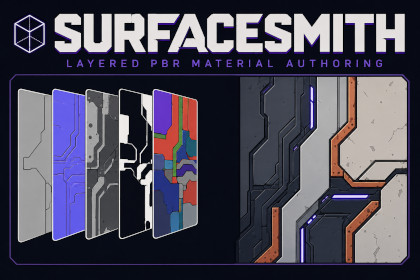
Give large models crisp, high-resolution PBR detail with tileable surfaces and RGBA masks. Edit live or bake for Built-in, URP, and HDRP.Large objects often force a compromise between soft surface detail and enormous baked texture sets. SurfaceSmith gives you another option.Use the PBR materials you already own to create rich, reusable layered surfaces directly inside Unity. Combine materials such as paint, metal, rust, dirt, plaster, stone, wood, or wear, then use model-specific RGBA masks to control exactly where each surface appears.Because SurfaceSmith layers tileable PBR materials across your model, fine surface detail remains sharp—even on large props, machinery, vehicles, architecture, and environment assets where a single traditionally baked 4K texture can quickly lose clarity.Work non-destructively and preview changes directly on selected Scene objects. Adjust tiling, UV or World Triplanar mapping, layer order, mask falloff, tint, normal strength, metallic, smoothness, emission, and more.Keep the result as a live, editable layered material, or bake production-ready textures and materials for Unity’s Built-in Render Pipeline, Universal Render Pipeline, or High Definition Render Pipeline.Reusable Surface Definitions can be shared across multiple objects. Instead of creating a separate high-resolution texture set for every asset, the same tileable surfaces can be combined with different masks and recipes. This can reduce texture duplication, project size, build size, and texture memory.Key features:Create layered materials from your existing PBR texture setsUse one complete PBR base surface with up to 20 ordered masked layersControl surface placement with model-specific RGBA masksMaintain crisp, high-resolution detail through material tilingUse UV or World Triplanar mappingPreview and refine materials directly inside UnityKeep materials live and editable or bake production-ready assetsGenerate materials for Built-in, URP, and HDRPReuse Surface Definitions across multiple modelsSave non-destructive recipes for easy editing and rebakingSurfaceSmith is designed for Unity 6 and automatically detects the active Built-in, URP, or HDRP render pipeline.FEATURESCreate reusable, layered PBR materials directly inside UnityUse one unmasked PBR base surface with up to 20 ordered masked layersAssign up to five RGBA mask textures, providing 20 independently assignable mask channelsSupports Base Color, Normal, Metallic, Roughness, Smoothness, and Emission inputsReads metallic and roughness data from ORM and RMA packed texturesSupports Unity Mask Map and Unity Metallic-Smoothness packed layoutsChoose between Smoothness, Inverted Roughness, Blend, Multiply, Minimum, and Maximum smoothness modesControl layer placement through the Red, Green, Blue, or Alpha channel of a model-specific maskUV and World Triplanar surface mappingPer-surface tint, brightness, tiling, offset, rotation, normal strength, metallic, smoothness, and emission controlsPer-layer mask inversion, influence, falloff, black point, white point, contrast, and edge-softness controlsOptional per-layer overrides for tint, mapping, PBR properties, and emissionDrag and reorder layers to control which surface takes priority where masks overlapPreview and edit layered materials directly on selected Scene objectsAutomatic live-material updates with a manual Update Live Material optionSave non-destructive recipes for later editing and rebakingLive layered materials are supported in player buildsAlpha-clipped materials with Base Color alpha or a dedicated opacity maskBake using UV0 or UV1Preset bake resolutions from 512 to 8192, with custom resolutions from 64 to 8192 per dimensionConfigurable UV-island padding from 0 to 64 pixelsBake Base Color, Normal, Metallic, Roughness, Smoothness, Metallic-Smoothness, Emission, and Opacity mapsPNG, TGA, and EXR texture exportGenerate SurfaceSmith Baked materials or native Standard, URP Lit, and HDRP Lit materialsUpdate existing baked assets in place to preserve references, or save a separate bake as newShare tileable Surface Definitions across multiple objects to reduce source-texture duplicationAutomatic 4, 8, 12, 16, and 20-layer live-shader tier selectionOptimized material updates and selective recompilation help maintain a responsive editor workflowCOMPATIBILITY AND REQUIREMENTSUnity 6 LTSBuilt-in Render PipelineUniversal Render Pipeline 17High Definition Render Pipeline 17Render pipeline is detected automaticallySurface Definitions and recipes remain portable between supported pipelinesOpaque and alpha-clipped materialsTransparent surface blending is not supportedDesigned for static MeshRenderer props, architecture, and environment objectsTerrain is not supportedEach Renderer material slot uses a separate recipe and baked texture setBaking requires suitable UVs on UV0 or UV1Automatic UV unwrapping and repair of overlapping UV islands are not includedHigh live-layer counts and World Triplanar mapping increase shader cost and should be profiled, especially on mobile or lower-end hardwareBaked native Lit materials are recommended for dense scenes and predictable runtime performance***SUPPORTED EDITOR OS***- **Windows 10**- **Windows 11**DOCUMENTATION[Insert public documentation URL]