
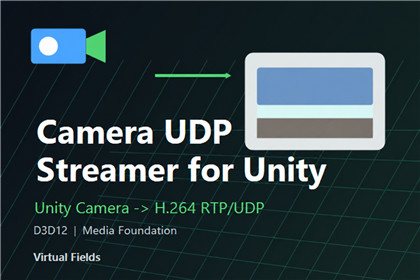
Stream a Unity Camera as H.264 over RTP/UDP using Direct3D12 and Windows Media Foundation. Editable C# and C++ source. Windows x64; Built-in and HDRP support.Requires Windows x64, Direct3D12 and a Media Foundation hardware H.264 encoder. Supports Built-in and HDRP 17.3.0 on Unity 6000.3.9f1. Sample materials use Built-in; see HDRP Setup.txt. URP, custom SRPs and XR are not validated. No GStreamer or GLib required. Latency depends on hardware, scene and receiver.Camera UDP Streamer for Unity sends a Camera's rendered view to an RTP/H.264 receiver over UDP, using Direct3D12, Windows Media Foundation hardware encoding and our RTP packetizer.Features- Capture and stream a Unity Camera over IPv4 RTP/UDP.- Support for the Built-in Render Pipeline and HDRP 17.3.0.- Inspector controls for resolution, frame rate, bitrate, GOP interval and destination.- Stream-only Color Correction, Exposure, Gamma and Lift adjustments.- Start, stop and restart streaming through the component's public API or context menu.- Optional diagnostic counters for capture, encoding and network output.- Flip Vertical defaults to OFF.RequirementsWindows x64, Unity 6000.3.9f1 and Direct3D12. Requires a GPU/driver supporting shared GPU surfaces, D3D11 video processing and a Windows Media Foundation hardware H.264 encoder. A compatible RTP/H.264 receiver must be installed separately.Included- Editable C# runtime and native C++ source.- Windows x64 native DLL, CMake build definition and rebuild instructions.- Sample scene, SDP receiver description, English documentation and troubleshooting guide.- Third-Party Notices.txt and the Unity Native Plugin API license text.LimitationsOne active stream per process. URP and custom render pipelines are not validated. The included sample scene uses Built-in materials; HDRP setup instructions are provided.Audio, RTSP signaling, WebRTC, multicast, authentication, encryption and software encoding fallback are not included. UDP does not guarantee delivery. Actual frame rate, bitrate and latency depend on the hardware, scene, network and receiver. No receiver application is bundled.The sender does not require GStreamer or GLib. Windows media components and GPU drivers are supplied by the user's system and are not included in the package.The native DLL is compiled code; readable C++ source and rebuild instructions are included. Scripts are not obfuscated.Asset uses Unity Native Plugin API under the Unity Companion License; see Third-Party Notices.txt file in package for details.Version: 1.0Validated Unity Editor: 6000.3.9f1Platform: Windows x64 Editor and standalone playerGraphics API: Direct3D12Render pipelines: Built-in and HDRP 17.3.0Encoder: Windows Media Foundation hardware H.264 encoderTransport: IPv4 UDP unicast, H.264 RTP (RFC 6184)RTP clock: 90 kHzPayload type: 96Resolution presets: 640x360, 854x480, 1280x720, 1920x1080Requested capture rate: 1-120 fps; hardware/workload dependentDefault configuration: 1280x720, 60 fps requested, 8000 kbps requestedDefault destination: 127.0.0.1:5600RTP payload size: 256-1400 bytes; default 1200Concurrent streams: one per processFlip Vertical: OFF by defaultColor defaults: enabled, Exposure 1, Gamma 2.2, Lift 0Low Latency checkbox: compatibility setting; this version always requests low-latency and real-time encoding.Native rebuild: Visual Studio 2022 C++ tools, Windows SDK, CMake 3.24+ and Unity Editor PluginAPI headers.Editable C# and C++ source included.Validation environment: Windows x64, Unity 6000.3.9f1, Direct3D12, NVIDIA Quadro RTX 4000.Other GPUs, Unity versions, IL2CPP and long-duration operation were not validated for this release.URP, custom render pipelines, XR, AOV output and path-traced capture are not validated.No GStreamer or GLib runtime is included or required by the sender.OpenAI Codex assisted with the C# capture and HDRP integration, native C++ Media Foundation/RTP implementation, color controls, documentation and validation scripts. Editable source and native rebuild instructions are included. The publisher performed manual playback comparisons in their Unity projects.OpenAI's image generation tool was used to revise technical wording on the marketing cover and card images. These marketing images are outside the runtime package.