





Real Vision — Damage, Hit Feedback & Vision Modes Fullscreen FX
u3d
$32.99
(no ratings)
Jump AssetStore
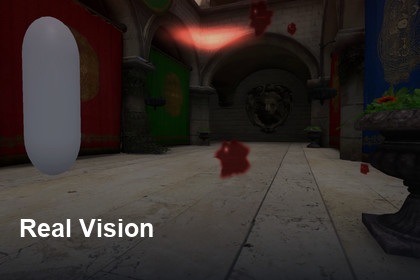
Damage feedback and vision modes for Unity 6 in one fullscreen pass: hit indicators, blood on the lens, low health, stun, night vision, thermal, sonar, scope. Built-in + URP + HDRP.Real Vision is the screen your game shows the player when something happens to them. One fullscreen pass, driven by Volume profiles and one static API, covers both halves of first-person feedback: what damage does to the view, and what the player sees through a device. Nothing in your materials changes, nothing is spawned, and no particle system is added.Damage feedback, triggered from gameplay. Call Hit() with the direction the damage came from and a wedge of light lands on that edge of the screen with a blood vignette pushing in behind it; up to eight hits stack and decay independently. Blood lands on the lens, refracts what is behind it, runs down the glass and dries away over a time you set. Call SetHealth01() and the view answers: a heartbeat vignette whose rate climbs as health falls, colour draining out, contrast washing away, the edges going soft while the centre stays readable. Call Stun() for a flashbang — a blinding flash, an exposure that crawls back, a short double-vision ringing. Call Adrenaline() for the rush: extra bite on the image, colours flooding, radial speed lines, and a field-of-view kick faked as a radial stretch, so your real camera is never touched.Six damage types, one look each. Bullet is the plain hit. Blade cuts slash streaks across the lens. Fire brings a hot vignette, heat shimmer and embers drifting up the glass. Cold grows frost in from the edges with a refracted, sparkling rim. Electric and EMP tear rows sideways, corrupt blocks, split the colours and roll bands down the frame. Toxic burns a green cast in from the edges.Five vision modes, held for as long as you want them. Night vision is a real intensifier: the gain gates itself on how bright the scene is, photon noise boils over the image, bright sources bloom and blow out to white instead of staying green, and the round tube frames it. Thermal reads a heat mask drawn from Real Vision Heat Source components — tag a renderer with a temperature and it burns in the image — over an ambient estimate from scene luminance and depth, so an untagged level still reads correctly the moment you switch it on; white-hot, black-hot and iron palettes, edge glow, sensor blur and noise. Sonar is a wave that sweeps out from the camera through world space, lighting the depth silhouettes it crosses and leaving a fading echo behind it. Scope gives you a circular eyepiece with barrel distortion, a colour-fringed rim, breathing sway, a reticle texture slot and a built-in crosshair; switch on Binocular for two overlapping circles. Security Camera turns the feed cheap: grain, dead colour, interlace, a rolling shutter wobble and a corner vignette. Modes crossfade into each other over a time you set.One API, no setup. RealVisionAPI.Hit(dirWorld, strength, type), SetHealth01, Stun, Adrenaline, SetVisionMode, NextVisionMode, Pulse and Reset — that is the whole surface, and it is all static. Turn Use Damage Model off and the same fields become plain Volume parameters a timeline or an animator can key instead, which is how the demo presets are authored.Three pipelines, one system. Built-in, URP 17 (Render Graph) and HDRP 17 (Custom Post Process) share one shader body and identical Volume parameters, including the heat mask: a URP renderer-feature pass, an HDRP custom pass and a Built-in command buffer all draw the tagged renderers against the camera's own opaque depth, so a warm body behind a wall never shows through it. The Setup wizard installs the renderer feature or the custom post process, generates the pipeline wrappers and creates the preset profiles.Presets to start from. FPS, Horror, Arcade and Tactical set the whole feel in one click, and sixteen demo presets show one thing each: Bullet Hit, Blade Hit, Fire Hit, Cold Hit, Emp Hit, Toxic Hit, Near Death, Adrenaline, Stunned, Night Vision, Thermal, Thermal Iron, Sonar, Scope, Binoculars and Security Cam.In the box- Fullscreen damage-feedback and vision-mode effect for Built-in, URP 17 and HDRP 17 (Unity 6000.3)- RealVisionAPI: Hit, SetHealth01, Stun, Adrenaline, SetVisionMode, Pulse, Reset, plus HUD read-backs- Real Vision Heat Source for thermal, with the per-pipeline mask pass- 20 presets, generated per pipeline by the wizard; 76 controls in thirteen groups- Setup wizard, noise baker, preflight checks, debug views and per-layer kill switches- Two sample scenes with baked lighting (Firefight with an on-screen damage console, Sandbox)- Manual, changelog, third-party notices (none: all code and textures are original)Requirements and notes- Unity 6000.3.21f1 or newer; URP 17.3 / HDRP 17.3 for the SRP paths (Render Graph only)- Perspective cameras; night vision, sonar and the stun after-image keep a per-camera history buffer- Cost, measured in a URP player on an RTX 4090 at 1920×1080: FPS 0.11 ms, Sonar 0.13 ms, Thermal 0.15 ms, Night Vision 0.18 ms (0.05-0.08 ms at 1280x720). One fullscreen pass that scales with pixel count; expect several times these numbers on mid-range GPUs and use a lower resolution scale there- Screen-space by design: every layer is drawn from the frame, the depth buffer and the heat mask- One fullscreen pass per pipeline over a shared HLSL body (Built-in image effect, URP Render Graph renderer feature, HDRP custom post-process) plus a per-camera history buffer for the night-vision lag, the sonar tail and the stun after-image; no compute shaders, no VFX Graph, no material changes, no particles- Volume-driven: RealVisionSettings mirrored one-to-one in the URP and HDRP Volume components and a Built-in settings component with box volumes; 76 controls in thirteen groups (Vision, Damage, Health, Adrenaline, Stun, Damage type, Night vision, Thermal, Sonar, Scope, Security camera, Lens, Debug), 20 presets- Damage model on the CPU: a ring of eight directional hits with independent decay, a health level, a stun and an adrenaline timer, and the vision-mode crossfade; driven by the static RealVisionAPI or read verbatim from the Volume when Use Damage Model is off- Thermal heat mask: RealVisionHeatSource writes (temperature, tagged, emissivity) into each renderer's MaterialPropertyBlock; a URP renderer-feature pass, an HDRP custom pass at Before Transparent and a Built-in command buffer draw them into a screen-size ARGB32 target against the camera's opaque depth, so occlusion is correct; untagged pixels fall back to an ambient estimate- Damage layers: directional indicator wedges and a blood vignette from the hit angle, procedural blood droplets that refract, run and dry, a heartbeat vignette with a health-driven rate, an unsharp adrenaline pass with radial speed lines and a radial FOV kick, a stun flash with a recovering exposure and drifting double vision, and per-type looks (blade streaks, fire vignette with embers, cold frost with a refracted rim, EMP row tears and block corruption, toxic edge cast)- Vision modes: a self-gating night-vision gain with two-radius bloom and 2×2-grain photon noise; a thermal ramp with white-hot / black-hot / iron palettes, a five-tap sensor blur and depth-silhouette edge glow; a world-space sonar shell with an exponential echo; a scope with barrel distortion, a chromatic rim, breathing sway and a reticle slot; a security-camera feed with interlace, a rolling band and a rolling-shutter shear- Edges come from depth silhouettes only, never from luminance gradients, so a textured wall is never outlined; the baked 64-cubed RGBA noise volume (2 MB) feeds the frost, embers and heat shimmer- GPU cost in a URP player (RTX 4090, development player, medians over 48 interleaved cycles): FPS 0.106 ms, Near Death 0.109 ms, Sonar 0.126 ms, Thermal 0.145 ms and Night Vision 0.180 ms at 1920x1080; 0.052-0.082 ms at 1280x720- Zero per-frame allocations; debug views (live model, heat mask, history) and six layer kill switchesCode, shaders, editor tooling and documentation were written with AI assistance. No AI-generated art, textures or audio are bundled: the only texture in the package is baked by the included baker — a tiling 3D noise volume — and the sample scenes are built from Unity primitives and our own geometry.