





Real Volumetric — Volumetric Fog & Lighting, Fog Volumes, God Rays (URP, HDRP)
u3d
$33.00
(no ratings)
Jump AssetStore
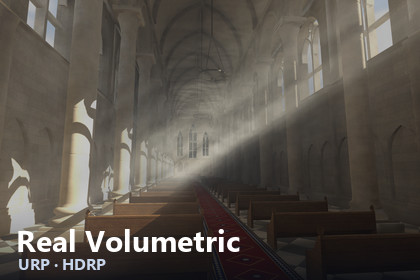
Ray-marched volumetric fog and god rays for Unity 6 in URP and HDRP: place fog volumes in the editor, pick an animated 3D density style and a measured performance preset. No compute shaders.Real Volumetric adds ray-marched volumetric fog, shadowed god rays and fog volumes you place in the editor to Unity 6 (6000.3.21 or newer) in URP, with HDRP supported from the same package. Drop a fog volume into the scene and the fog is there: rolling banks, drifting wisps or patchy mist that move, change form and catch your sun.Fog only where you put it. GameObject > Volume > Real Volumetric Fog Volume places a box of fog where the Scene view is looking. Drag a face and the fog fills exactly that box and nothing outside it, while the opposite face stays put, like a collider. Every fog volume has its own density style, shape size, coverage, edge sharpness, erosion, gaps, drift and evolution, and one click switches its style. It needs no setup: the menu installs the renderer feature if it is missing, and a volume renders on its own, sunlit and shadowed, with no profile at all until you want global fog or a profile to tune. Boxes and spheres, Add or Max blending, and Subtract to carve clear air out of the weather: a doorway, a cockpit, the inside of a building. The march spends its steps inside the volumes a ray crosses, so a small volume far away is not lost, and with no global fog a ray that crosses no volume costs nothing.Fog that is not a flat fill. A baked 128³ 3D density texture gives three styles: Rolling Banks (billowing banks with clear air between them), Drifting Wisps (long streamers that curl and re-form) and Patchy Mist (separate puffs hanging in clear air). You can also bring your own Texture3D. Coverage is literal: the texture is histogram-equalised, so 0.4 means 40 % of the air holds fog. The shapes drift with the wind and change form while they drift, because a domain warp moves them instead of a scrolling texture. Self Shadow lets every bank shade itself from the sun: its lit side glows and its core darkens. The same styles shape the global height fog too.Shafts that are real. In URP the march reads the main light's own cascaded shadow map, step by step, and the shafts fade out towards URP's shadow distance the way URP's own shadows do. HDRP gives a custom post process no cascades, so there the effect renders its own sun shadow map. Window frames, columns, arches and branches cut the light into separate beams instead of a flat glow. A screen-space sun-shaft layer rides on top and works even without a shadow map. Dispersion, off by default, splits every beam into colour at its edges, as if the light came through cut glass.One switch for performance, with measured costs. Performance, at the top of the profile, sets steps, march resolution, temporal smoothing, budgets and beam shadow size together: Mobile, Low, Balanced, High, Ultra or Cinematic. It never touches the look, and RealVolumetricAPI.SetPerformance switches it at runtime. Measured GPU time of the fog pass on an RTX 4090 in a URP player at 1920x1080: Mobile 0.10 ms, Low 0.20 ms, Balanced 0.77 ms, High 0.98 ms, Ultra 1.40 ms and Cinematic 14.5 ms (for stills and trailers). At 1280x720: 0.06 / 0.12 / 0.40 / 0.65 / 1.05 / 4.66 ms. Mid-range GPUs and phones are not measured yet. When the camera runs TAA, the effect's own temporal accumulation steps aside automatically.No compute shaders. No VFX Graph. No particle systems. One ray-marched pass at full, half or quarter resolution with a depth-aware upsample. That is why one package covers URP and HDRP, and why the URP shaders also cross-compile for Vulkan, Metal and OpenGL ES 3.Lamps whose beams stop at walls. Add Real Volumetric Light to any point or spot Light and its beam appears in the fog. Lights can render their own shadow maps (one for a spot, six cube faces for a point light), so a beam is cut by real geometry, including geometry behind the camera. A spot light's cookie patterns the beam itself.Fog on glass, water and particles. A fullscreen fog cannot fog what is not in the depth buffer, so the same march ships as an include your own shaders call in one line. It comes with a Shader Graph Custom Function node, an Amplify Shader Editor recipe, a worked URP example shader and a per-renderer Fog Receiver component. A fogged window and the fogged wall behind it agree.The editor walks you through it. A Welcome window after import has three steps to the first fog, with buttons for each. A fog volume tells you when the renderer feature is missing (with an Install button), when no profile is active (it renders anyway and offers one) and when a profile has switched fog volumes off. An override added by hand explains why it starts switched off and has a Turn on button. The URP inspectors detect a missing depth texture and a fog pass injected after transparents, and have a Fix button.AI Ready. Real Volumetric is built to be driven by AI coding agents (Claude Code, Codex, Cursor or a Unity MCP bridge) as well as by hand. Documentation/AGENTS.md ships in the package and gives an agent the model, the files, task recipes and a Verify section. RealVolumetricAPI is one static class with no pipeline types in its signatures: CreateFogVolume, SetStyle, FindFogVolumes, SetPerformance, TryGetPreset, and DescribeScene, which returns a JSON read-out of the fog volumes and the settings the last frame rendered with. The 19 look presets and the six performance presets are plain data (RealVolumetricPresets, RealVolumetricPerformancePresets). In the editor, Window > Real Volumetric > Agent has Describe Scene and Add Fog Volume Here. Headless, -executeMethod RealVolumetric.Editor.RealVolumetricAgentTools.Setup, AddFogVolume and Describe each log one REALVOLUMETRIC|AGENT line and exit with 0 or 1, so an agent checks its own result in the log instead of guessing from a screenshot.Nineteen presets as plain data: Rolling Banks, Drifting Wisps, Patchy Mist, Fog Volumes Only and Prism Shafts, plus Dawn Haze, Dusty Interior, Cathedral, Night Fog, Ground Mist, Toxic Cloud, Cold Cave, Sandstorm, Sunset Gold, Misty Forest, Smoke Filled, Mobile Fog and two Stylized variants. Three sample scenes, ready in URP, are built from a prefab library: a cathedral nave with clerestory shafts; a street at first light with patchy ground mist, a rolling bank under the underpass and volumetric street lamps; and a sandbox with the three density styles side by side.Moving from Aura 2 (Built-in) to URP? The manual maps Aura's controls to these, parameter by parameter, so you can rebuild a look you already know.Requirements and limits: Unity 6000.3.21f1 or newer, with URP 17.3 or HDRP 17.3. The Built-in render pipeline is not supported. In XR the fog buffer is not stereo-instanced, so march at full resolution there. Transparent surfaces take the fog but are not cut by the sun's shafts.Full C# and HLSL source, a manual, a changelog and an agent guide are included. Every shader, script, texture, mesh and prefab was made for this package; there is no third-party content.More from this familyReal Rain — screen-space rain, wet surfaces and lens droplets: https://u3d.as/49BWReal Snow — snow, blizzard, snow cover and frost on the lens: https://u3d.as/49YaReal Flame — screen-space fire, heat haze, embers and smoke: https://u3d.as/49XEReal Underwater — screen-space underwater rendering for any water asset: https://u3d.as/4a2ZReal Poison — poisoning, drunkenness and hallucination effects: https://u3d.as/4a1LReal Vision — damage, hit feedback and vision modes: https://u3d.as/4a31Real Outline — outlines, highlight, selection and edge detection: https://assetstore.unity.com/packages/vfx/shaders/fullscreen-camera-effects/real-outline-outlines-highlight-selection-edge-detection-for-uni-406068All packages by this publisher: https://assetstore.unity.com/publishers/20507Support: questions and bug reports are welcome in the Unity Discussions thread https://discussions.unity.com/t/released-real-volumetric-volumetric-lighting-god-rays-fog/1737528 or at cgteamorg@gmail.com. Please include your Unity version, the render pipeline, the preset and the Performance setting. If Real Volumetric works for you, a rating on this page helps other buyers find it.Unity 6000.3.21f1 or newer. URP 17.3 (required; Render Graph) and HDRP 17.3 from one package. The Built-in render pipeline is not supported.One ray-marched fullscreen pass at full, half or quarter resolution plus a full-resolution depth-aware composite. No compute shaders, no VFX Graph, no particle systems. Shader model 3.5 (URP) and 4.5 (HDRP).Fog volumes: box or sphere; Add, Max or Subtract; any number in a scene, the nearest 16 per frame; the march concentrates its steps inside the volumes a ray crosses.Density: a baked 128x128x128 RGBA 3D density texture with mips (about 9.1 MiB of video memory) holding Rolling Banks, Drifting Wisps, Patchy Mist and an erosion detail, plus a 64x64x64 noise volume and a 64x64 blue-noise mask; or your own Texture3D.Performance presets Mobile / Low / Balanced / High / Ultra / Cinematic. GPU time of the fog pass on an RTX 4090 in a URP player: 0.10 / 0.20 / 0.77 / 0.98 / 1.40 / 14.5 ms at 1920x1080, and 0.06 / 0.12 / 0.40 / 0.65 / 1.05 / 4.66 ms at 1280x720.Up to 16 volumetric point/spot lights per frame; shadow maps for the 4 nearest (a spot 1 map, a point light 6 faces) in the package's own Texture2DArray atlas; spot cookies inside the beam.Fog on transparent surfaces through Shaders/RealVolumetricFog.cginc: a Shader Graph Custom Function node, an Amplify recipe, a URP example shader and a per-renderer Fog Receiver component.55 controls, 19 presets and 10 debug views. RealVolumetricAPI plus editor and headless agent entry points (Documentation/AGENTS.md). Full C# and HLSL source.Works with TAA (the effect's own temporal accumulation steps aside) and MSAA, orthographic and multiple cameras and deferred URP. XR renders, but the fog buffer is not stereo-instanced (march at full resolution in XR).The C# and HLSL source and the documentation in this package were written with AI assistance and reviewed by the author. No AI-generated art is bundled. The 3D density texture, the 3D noise volume and the blue-noise mask are baked by the included bakers from fixed seeds. The sample surface textures and skies are generated procedurally by the author's own scripts from fixed seeds, the sample meshes are generated by the author's scripts, and the Sandbox model is the author's own Blender work.

