





Delete Safe – Asset Clean up & Dependency Finder
Tinny Studios
$16.49
$32.99
50%OFF
(no ratings)
Jump AssetStore
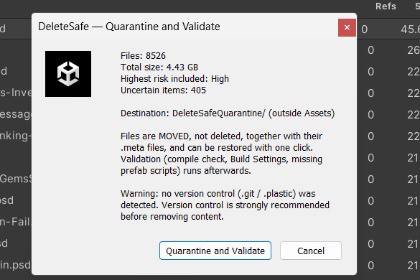
See what depends on an asset before you delete it. Quarantine instead of deleting, check the project still works, and restore everything with one click if it doesn't.Every Unity project ends up with folders nobody dares to touch.Old prototypes, packs you imported for one mesh, three generations of UI. You know most of it is dead weight, but deleting anything feels like a gamble: maybe a prefab still points at it, maybe something loads it by name at runtime.DeleteSafe answers one question before you delete: what breaks if this goes?How it worksRight-click any assets or folders and pick Analyse Removal Impact, or scan the whole project at once.DeleteSafe builds a reverse dependency map and shows every reference chain: which prefab uses the texture, which scene uses the prefab, whether that scene is in Build Settings.Each asset gets a risk rating with written reasons, from Blocked ("this is your active render pipeline asset") down to Low ("no known references").Instead of deleting, you quarantine. Files move outside Assets, together with their .meta files, in a journaled transaction that survives crashes and editor restarts.DeleteSafe then compares the project against a baseline taken before the move: new compile errors, missing build scenes, missing scripts in prefabs. Problems that already existed are never blamed on your cleanup.If something broke, restore the whole transaction or a single file with one click. GUIDs are preserved, so references reconnect as they were.When you're sure, delete the quarantine for good. Until then, nothing is lost.Find the dead weightAfter a project scan, the Suggestions tab lists folders where every asset came back low risk, folders that are nearly all unused, and your largest unreferenced files, with the reclaimable size next to each.Why it's built this way?Most cleanup tools hunt for unused assets and offer to delete them in bulk. One false positive on a real project and you stop trusting the tool. DeleteSafe never claims an asset is safe. "Low risk" means "no known references", and anything that might be loaded through Resources.Load, scene-name strings, or filename matches in code is flagged as uncertain instead of quietly marked green. It also reads references most tools miss entirely: render pipeline assets, quality settings, and project-wide input actions live in ProjectSettings, not in any scene.What this package doesn't doIt can't see references built from strings at runtime, and it doesn't analyse Addressables entries or AssetBundle contents yet (you get a warning when those are in play). It also doesn't replace version control. Commit first, DeleteSafe tells you what will break before you delete; Git gets files back after.Runs entirely in the editor. No runtime code in your build, nothing leaves your machine, no account, no telemetry. Full C# source included.Questions or a project it struggles with? Tinnystudios@gmail.comImpact analysis for any selection, folder, or the entire project (cancellable at any time)Reverse dependency index with incremental updates; full reference chains traced to build roots: Build Settings scenes, ProjectSettings references, Resources, StreamingAssets, preloaded assetsDynamic reference detection: Resources.Load / LoadAll / LoadAsync, SceneManager.LoadScene by name, filename strings in scripts — always reported as possible, never as proofFive risk levels plus a separate confidence rating, with written reasons for every assetQuarantine: hash-verified, journaled file moves outside Assets; automatic rollback on failure; crash recovery on next editor startValidation against a pre-quarantine baseline: compile errors, missing Build Settings scenes, missing scripts in prefabsRestore all or per file; original paths and GUIDs preserved; existing files are never overwrittenSuggestions: unused folder candidates with reclaimable size, mostly-unused folders, largest unreferenced assetsHTML and versioned JSON reports, saved with every transactionSortable, searchable, virtualised results list; stays responsive on scans of 10,000+ assetsEditor-only assembly, no runtime code, no package dependencies, no internet access; full source includedWorks with Built-in, URP, and HDRP; Force Text serialization (the Unity default) gives the deepest analysisThe C# source code in this package was written with AI assistance (Anthropic's Claude, via Claude Code), working from a product and technical design document I authored.I directed the architecture and feature set, reviewed the generated code, and tested the tool by hand in real Unity projects as seen in the screenshots / video, including iterating on analysis accuracy, performance, and UX based on that testing.