




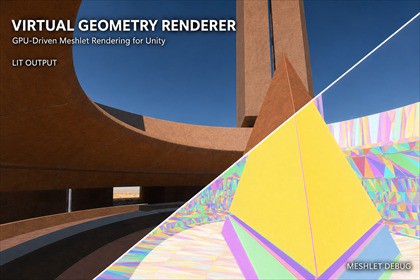
GPU-driven virtual geometry rendering for Unity URP and HDRP, featuring meshlet LOD, GPU culling, visibility-buffer material rendering, shadows, guided setup, and built-in diagnostics.Supports Unity 2022 through Unity 6.5 in principle, with official validation performed on Unity 2022.3.62f2 and Unity 6.5. Compatible with both URP and HDRP. Due to the large number of Unity and render pipeline package combinations, other versions within this range have not been individually tested.Virtual Geometry Renderer is a GPU-driven, meshlet-based geometry rendering solution for detailed Unity scenes. It converts compatible source meshes into hierarchical meshlet data, selects visible geometry and LODs on the GPU, and resolves compatible Lit materials through a visibility-buffer deferred rendering path.The package is designed for projects that need to render dense opaque geometry while reducing CPU-side draw submission and avoiding traditional per-object LOD authoring. Static scene geometry uses a baked workflow, while Dynamic Geometry Instance components provide incremental transform updates for movable objects.Key features:- Hierarchical meshlet generation with automatic geometry simplification- GPU-driven instance, hierarchy, and meshlet selection- Screen-space error-based LOD selection with separate camera and shadow budgets- Optional depth-pyramid occlusion culling- Visibility-buffer rasterization and material-tile deferred GBuffer resolve- Dedicated integrations for URP Deferred and HDRP Deferred- Directional and local-light virtual geometry shadows- Opaque Lit and configurable alpha-clipped material support- Baked lightmaps, directional lightmaps, shadow masks, light probes, and reflection probes- Dynamic transform synchronization without rebuilding scene geometry- Multiple scene-anchor registration for additive scene workflows- Setup Wizard, Debug Window, runtime statistics, and meshlet visualization modes- Detailed user, troubleshooting, shader-integration, and AI-assistant documentation- Optional Courtyard showcase supplied as a separate demo packageVirtual Geometry Renderer includes compatible URP and HDRP Lit shaders. Custom shaders can be integrated by preserving the supplied visibility reconstruction, material resolve, GBuffer encoding, and shadow passes. A source-shader allow list controls which materials are admitted during scene building.The included Setup Wizard detects the active render pipeline, installs the matching support package, configures the required scene components, and reports incomplete integration steps. HDRP integration is an advanced operation because it embeds and patches the project's local HDRP package; the installer presents a confirmation notice before making those changes.- Rendering architecture: GPU-driven hierarchical meshlets, indirect drawing, visibility buffer, tiled material resolve, and deferred GBuffer output- Supported render paths: Universal Render Pipeline Deferred and High Definition Render Pipeline Deferred- Geometry workflow: MeshRenderer scene baking; eligible LODGroup sources use LOD0 to build the generated hierarchy- Dynamic geometry: incremental world-transform updates through Dynamic Geometry Instance; runtime topology and material-layout changes require rebuilding- Materials: supplied Virtual Geometry Lit shaders; opaque surfaces and configured alpha clipping are supported- Lighting: realtime direct lighting, baked and directional lightmaps, shadow masks, light probes, and reflection probes- Shadows: directional cascades and optional local-light shadow passes, with independent shadow LOD control- Culling: instance, hierarchy, meshlet, frustum, and optional depth-pyramid occlusion stages- Scene management: multiple enabled scene anchors can register with one Renderer Controller and can be loaded, unloaded, moved, rotated, or scaled- Diagnostics: scene/model/instance/material/meshlet/vertex/index/BVH statistics, debug visualization, Frame Debugger guidance, and RenderDoc-oriented troubleshooting- Shader requirements: Shader Model 4.5-class feature support, compute shaders, structured buffers, and indirect draw support- Editor workflow: geometry baking currently uses the included Windows native mesh-processing libraries- Compatibility code paths: Unity 2022.3 with SRP 14, Unity 2023, and Unity 6; validate the exact Unity, SRP, graphics API, GPU, and Player target used by your project- HDRP installation: the advanced integration embeds HDRP into the project and patches deferred and shadow hook locations; back up or commit the project before installation and repeat validation after an HDRP update- Experimental feature: Skinned Mesh Renderer integration is included for evaluation and is not presented as part of the stable static-geometry workflow- Demo: Courtyard showcase is optional and distributed separately from the renderer implementation- Documentation: installation, scene building, runtime configuration, lighting, shadows, custom shader integration, troubleshooting, and an AI coding-assistant skill are includedAI was primarily used for code generation, documentation, and debugging assistance.