

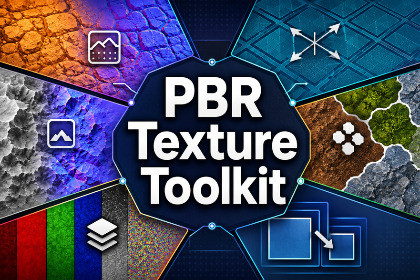
PBR Texture Toolkit: Generate, Tile, Bomb, Pack & Convert
Veridian Systems
$22.00
(no ratings)
Jump AssetStore
Generate PBR maps, make textures seamless, combine materials with blending or texture bombing, pack and swizzle channels, and batch resize or convert files through one connected Unity Editor workflow.PBR Texture Toolkit: Generate, Tile, Bomb, Pack & Convert is an integrated texture-authoring and processing workflow for the Unity Editor. Generate starter PBR maps, make synchronized texture sets seamless, blend or texture-bomb materials, pack and swizzle channels, and batch resize or convert texture libraries.It is intended for scans, generated images, incomplete PBR sets, texture libraries, and existing project materials. Each tool also works independently, while direct routing moves outputs into the next stage.GPU-Accelerated Texture ProcessingThe main generation, tiling, blending, bombing, packing, swizzling, resizing, and padding operations run through GPU Compute Shaders. This provides fast Editor processing and responsive previews on supported hardware. Saved outputs use the selected final resolution or the relevant source resolution.Exact speed depends on dimensions, map count, hardware, readback, encoding, and import time. Workload checks estimate memory use and block jobs that exceed the supported budget.PBR Map GenerationTexture Map Gen creates editable starter maps from explicitly assigned albedo textures, normal maps, or paired albedo-and-normal sets. It can generate or process:Height estimatesTangent-space normal mapsExisting normal-map adjustmentsSmoothnessCavity / ambient-occlusion estimatesColor-selected metallic masksURP Lit packed mapsHDRP Mask MapsOptional URP Lit or HDRP Lit materialsHeight extraction can use luminance, individual channels, saturation, custom mixes, color-edge detail, or a hybrid method that combines broad relief with seams, cracks, grout, and other smaller structures.Existing normals support automatic, RGB, red/green, and Unity packed A/G decoding, with strength, green orientation, blue reconstruction, and normalization controls. Smoothness can use albedo, normal detail, or a metallic mask. Cavity/AO can use normal detail or albedo-derived height. Metallic output uses deliberate color selection rather than claiming to infer material identity from color alone.Important Normal-Generation ExpectationA normal map generated from albedo is necessarily an estimate. Albedo contains color and often baked lighting, but not the original geometry or intended real-world scale of each feature. Default settings provide a starting point; they are not expected to produce the best final normal for every source automatically.Inspect the height and normal previews, then adjust extraction, detail scale, blur, contrast, edge contribution, and normal strength for the specific material. Fine fabric, weathered stone, painted panels, and large masonry should not use identical settings. The workflow is designed to make this tuning fast and visible before output is saved.Seamless and Tileable Texture SetsThe Seamless tool processes related albedo, normal, mask, and height maps together so they remain spatially synchronized. It is useful for scans, generated textures, and other images that do not tile cleanly.Mirror: Builds a mirrored tile and can add procedural disruption to reduce obvious central symmetry.Offset: Moves the original borders into the image and blends across the exposed seams with an fBm mask.Controls include seed, scale, octaves, lacunarity, persistence, directionality, and domain warping. Normal maps use normal-aware processing. Results can be inspected as individual 2D maps, in a repeated 3x3 view, or on a lit 3D tiling plane.The tool is designed to remove boundary discontinuities; it does not erase every repeated motif, baked light, shadow, or large internal feature. Different images may require different processing settings.Material Blending and Texture BombingThe Texture Combiner works with up to four focused material layers and user-defined output slots. A typical setup uses corresponding Albedo, Normal, Mask, and Height slots so one procedural distribution is applied across the complete PBR set.One-to-One Blend: Continuously cross-fades active layers through a procedural master splat map.Texture Bombing: Uses the lowest active layer as a base and places discrete patches from the remaining materials over it.Fractal-noise and cellular modes provide controls for region size, edge sharpness, directionality, domain warping, layer weight, per-layer regional scale, source tiling, muting, and seed.Texture Bombing adds stamp density, size, circular or organic shapes, rotation variation, scale variation, and material weighting. It can break up repetition or build mixed surfaces such as stone with moss, soil with debris, concrete with repairs, or panels with varied wear.Normal slots are processed as normal data. Fusion Presets store complete configurations. Outputs can include generated texture slots, an optional One-to-One splat map, and an optional URP Lit, URP Simple Lit, or HDRP Lit material.RGBA Channel Packing and Batch SwizzlingThe Advanced PBR Packer builds one RGBA texture from independent source maps. Each destination channel can read Red, Green, Blue, Alpha, Luminance, or a constant, with optional inversion.This supports URP packed maps, HDRP Mask Maps, ORM/RMA layouts, and custom shader conventions. A diagnostic preview shows the complete RGBA result or an isolated grayscale channel.The Batch Swizzler applies one routing configuration to many textures. It can perform operations such as DirectX-to-OpenGL normal conversion by preserving red, blue, and alpha while inverting green. Outputs can import as sRGB color maps, linear data maps, or normal maps.Batch Resizing, Conversion, and PaddingThe Batch Resizer & Converter accepts individual textures, multiple selections, or folders. It can:Resize by percentage or target longest edgePreserve aspect ratioPad to a square power-of-two canvasCenter content or flush it to a selected edgeConvert to PNG or TGAPreserve HDR output as EXR or convert it to LDRMatch or override source color spacePreserve normal-map handling and relevant importer settingsUse source-relative, shared, or custom output pathsApply prefixes, suffixes, subfolders, timestamps, and skip-existing rulesThe default workflow creates new assets and changes no references. Outputs are imported and verified for dimensions, texture type, color space, and valid Unity asset identity.Reviewed Project Reference ReassignmentAn optional workflow can update supported project files to reference newly processed textures while keeping the originals in place.The tool creates and verifies replacement textures first. For discovery, it does not rely on Unity’s dependency-search API. It enumerates supported text-serialized project files directly, performs a fast parallel byte-level candidate scan, and then confirms the exact texture fileID + GUID pair. Raw GUID text alone is not treated as a match.Confirmed files are shown in a review checklist, and nothing is changed until the user approves the selected files. Changes use atomic file replacement. The tool does not delete, move, rename, overwrite, or replace the original texture assets.Force Text serialization is required. Unity Undo cannot restore confirmed serialized edits, so version control or a project backup is recommended.One Connected Editor WorkflowThe five tools share one Editor hub and route compatible inputs or verified outputs directly between modules. Configurable filename rules recognize common albedo, normal, height, mask, ORM/RMA, metallic, AO, roughness, and smoothness names where automatic assignment is appropriate.Dedicated preview windows cover Map Gen, seamless tiling, material combination, and packing. Stale-preview checks block outdated Map Gen or Seamless results from being saved. Presets, verification, reporting, and output cleanup are included where supported.Guided Demo InputsThe Demo Texture Generator creates deterministic inputs for Map Gen, Seamless, blending and bombing, URP/HDRP packing, normal swizzling, conversion, resizing, and reference reassignment. It routes inputs into the real tools but does not run final operations or modify a scene. Cleanup removes only exact demo-owned files.Expanded from the Focused Free ToolsPBR Texture Toolkit combines and expands the focused free Texture Converter, Seamless Texture, Texture Bombing, and Albedo-to-Normal Map workflows. The paid toolkit adds the unified hub, direct routing, broader controls, improved previews, presets, batch processing, validation, workload safeguards, and reviewed reference reassignment.Important ScopeEditor-only processing; GPU Compute Shader support is required.No runtime texture-generation API is included.Generated textures and materials are standard Unity assets that can be used by runtime content.Core processing is pipeline-independent. Automatic packed outputs and materials target the listed URP/HDRP workflows; custom shaders can use manual channel layouts.Transformed-output rights remain subject to the source-texture licenses.Related Veridian ToolsNoise Texture Generator is available separately for high-resolution, seamlessly tileable procedural textures and PBR material baking. It generates Albedo, Normal, Height, Ambient Occlusion, Curvature, and Mask maps, including derivative-based normal and curvature workflows.Procedural Rock Generator Pro is available separately for rock and environment production. It creates editable meshes, bakes PBR textures, generates variants and LOD prefabs, combines compatible materials, and includes scatter, brush-placement, and runtime workflows.Requirements and ScopePBR Texture Toolkit is an Editor-only package requiring GPU Compute Shader support and compatible random-write RenderTexture formats. It does not include runtime texture generation; generated textures and materials are standard Unity assets usable in scenes and builds.Core processing is pipeline-independent. Automatic maps/materials target listed URP/HDRP workflows; custom shaders can use manual layouts. Outputs must be inside Assets, and device texture-size limits apply.Package Contents and ProcessingThe Editor hub contains Map Gen, Combiner / Texture Bombing, Seamless, Packer / Swizzler, and Resizer / Converter.It also includes Compute Shaders, preview/utility shaders, presets, auto-assignment rules, validation, reference scanning, and demo-input tools.The principal processing passes are GPU-accelerated. Saving also requires readback, encoding, import, and verification. Workload guards estimate memory and block jobs above the supported budget. Where batch processing is supported, item-level failures are reported instead of accepting blank or unverified outputs.Texture Map GenAccepted inputs:Albedo onlyNormal onlyAlbedo and NormalA manual multi-set queue is included. Enabled sets share one configuration and input structure. Inputs are assigned explicitly rather than grouped from filenames.Available outputs:Height estimateNormal generated from albedo-derived heightProcessed existing normalSmoothnessCavity / AO estimateColor-selected metallic maskURP Lit packed mapHDRP Mask MapOptional URP Lit or HDRP Lit materialHeight extraction supports luminance, channels, saturation, custom mixes, color-edge detail, and hybrid broad-relief / edge-detail processing.Existing normals support Auto, RGB, Red/Green Packed, and Unity Packed A/G decoding, plus strength, green inversion, blue reconstruction, and normalization. Smoothness can use albedo, normal detail, or metallic data; Cavity/AO can use normal input or albedo-derived height. Metallic masks use a selected target color and tolerance.Albedo-derived maps are estimates because the source does not provide original geometry or feature scale. Preview and tune extraction, detail, blur, contrast, edge contribution, and normal strength per material. Defaults are starting settings, not an automatic final-normal solution.Preview maximum resolution is 128–4096 pixels; saved maps use source resolution. Outputs are PNG. Source Read/Write is not required, and importer settings are applied by map type.URP packed layout:R: MetallicG: Ambient OcclusionB: Configurable unused valueA: SmoothnessHDRP Mask Map layout:R: MetallicG: Ambient OcclusionB: Configurable Detail MaskA: SmoothnessSeamless SandboxThe Seamless module accepts Albedo, Normal, Mask, Height, or untyped inputs. The same strategy, seed, offsets, and procedural mask are applied across active channels to preserve alignment.Strategies:Mirror with optional procedural disruptionOffset with fBm seam blendingControls include seed, scale, directionality, 1–8 octaves, lacunarity, persistence, domain warp, mirror disruption, and offset blend radius. Normals use dedicated processing. Resolution is 64–8192 per axis. Mismatched inputs use centered Aspect Fill and may be cropped.Preview modes include 2D maps, repeated 3x3 inspection, and a lit 3D plane. Stale previews cannot be saved. Outputs are verified PNGs, with optional URP Lit, URP Simple Lit, or HDRP Lit materials.Seamless processing removes boundary discontinuities; internal repetition, baked lighting, shadows, or strong directional features in the source can remain.Texture Combiner and Texture BombingThe Combiner uses up to four focused material layers and a dynamic list of corresponding output slots. Slots can be Albedo, Normal, Mask, Height, or custom/untyped data.Assembly methods:One-to-One BlendTexture Bombing — Base + StampsOne-to-One Blend uses Fractal Noise or Cellular distribution with scale, sharpness, directionality, domain warping, layer weights, muting, source tiling, and seed.Texture Bombing uses the lowest active layer as the base and remaining layers as stamps. Controls include density, 64–1024 pixel size, shape, rotation, scale variation, weighting, and tiling. A base and stamp layer are required.Normal slots use normal-aware processing. Corresponding maps should be aligned and use consistent color space; invalid sRGB/linear combinations are rejected.Resolution is 64–8192 per axis. Mismatched dimensions use Aspect Fill. Bombing sources are prepared up to 4096 pixels per axis. Preview is capped at 512 pixels.Fusion Presets store configurations. Outputs can include verified PNG slots, an optional One-to-One splat map, and an optional URP Lit, URP Simple Lit, or HDRP Lit material. Failures are reported per output.Advanced PBR Packer and Batch SwizzlerModes:Single Material AssemblerBatch SwizzlerEach destination channel can use Red, Green, Blue, Alpha, Luminance, or Constant, with independent inversion.Single assembly accepts R/G/B/A sources with compatible aspect ratios for URP/HDRP masks, ORM/RMA conversion, roughness inversion, normal convention changes, and custom layouts.Batch Swizzler applies one configuration to up to 100 textures. Failures are reported per item.Resolution is 32–8192 per axis. Outputs are 8-bit RGBA PNGs importing as sRGB, linear data, or Normal Maps. Preview shows RGBA or one grayscale channel. Custom shader layouts require manual configuration.Batch Resizer and ConverterThe queue supports up to 300 textures. Individual assets, multiple selections, and folders can be added.Resize modes:Percentage: 1–100%Target Longest Edge: 16–8192 pixelsTarget Longest Edge only downsizes, preserves aspect ratio, and aligns the edge to a multiple of four. Percentage mode cannot exceed the original size.Optional padding places the result on a square power-of-two canvas, centered or edge-flushed.Outputs are PNG/TGA. HDR sources remain compressed EXR unless converted to LDR, which clamps values above 1.0. Color space can match source or be forced; normal-map status and relevant importer settings are transferred and verified.Routing supports shared, source-relative, or custom Assets paths. Naming includes subfolder, prefix, suffix, timestamp, skip-existing, and unique-path handling. Memory flushing is configurable from 10–500 items.Create Safe Copies Only is the default. Last-run outputs can be removed through generation history; files reused through Skip Existing are not deleted.Exact Project Reference ReassignmentRewrite Project References first generates and verifies new textures. Original texture assets remain in place.Discovery does not rely on Unity’s dependency-search API. It directly enumerates supported files, performs a parallel GUID candidate scan, then confirms exact fileID + GUID pairs. Raw GUID text is not replaced.Common scope:.mat.prefab.terrainlayer.spriteatlasExtended scope also includes:.unity.asset.controller.anim.playable.overrideControllerForce Text and valid UTF-8 are required. UTF-16/32, binary, hidden, temporary, unsupported, outside-Assets, and immutable package files are not modified.Files above 192 MB are skipped. A configurable 8–64 MB threshold processes larger supported files sequentially.The scan returns a selectable checklist. Only confirmed files are edited, with version-control checkout where available and atomic file replacement.Unity Undo cannot restore confirmed edits. After final confirmation, the rewrite is not cancelable; assembly reloads are locked and Play Mode is blocked. Successful edits are not automatically reverted if another file later fails. Use version control or a backup.Routing, Presets, Previews, and DemoCompatible inputs and verified outputs route directly between modules. Filename rules cover common Albedo, Normal, Height, Mask, ORM/RMA, Metallic, AO, Roughness, and Smoothness conventions.Combiner uses Fusion Presets; Resizer uses Converter Settings presets; Map Gen includes a shared-settings queue. Output paths are sanitized, unique paths are generated where required, and generated files are verified after import.Dedicated preview windows are included for Map Gen, Seamless, Combiner, and Packer. Map Gen and Seamless block stale previews from being saved.The Demo Texture Generator creates deterministic inputs, runs no final operations automatically, and deletes only exact demo-owned files during cleanup.Practical Workflow Notes and LimitsAlbedo-to-normal generation requires per-texture tuning when final quality matters. Source scale, baked lighting, contrast, and material structure affect the result.Seamless processing addresses border continuity but cannot remove every internal repetition, shadow, highlight, or directional feature.Combiner output depends on aligned corresponding maps, sensible source tiling, and correct sRGB/linear settings.Packer output is standard 8-bit PNG; HDR or higher-precision packed output is not included.Target Longest Edge is a downscaling workflow, not an upscaler.Reference reassignment applies only to the listed Force Text formats and cannot be restored with Unity Undo.High-resolution multi-map jobs remain dependent on GPU support, maximum texture size, and available CPU/GPU memory.