


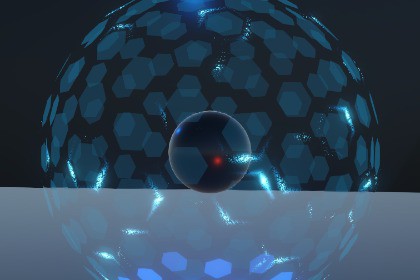
Hey! Here’s a nice-looking procedural shield you can drop into your game. It reacts to every hit and have an auto rebuild—and it’s easy to tweak to match your project.Advanced Hex Shield VFX is a procedural reactive shield system for Unity.Generate a complete geodesic shield automatically, with responsive impact effects, localized damage, animated energy, physical fragment movement, and optimized collision support.No custom sphere mesh, fracture setup, or hand-authored impact animation is required.Key FeaturesFully procedural shield generationReactive localized impactsDynamic damage and energy effectsPhysical fragment displacement and recoveryOptimized collision handlingCustomizable visual and gameplay settingsIdeal for sci-fi characters, vehicles, structures, bosses, and environmental effects.Key features:- Procedural geodesic glass shield- Adjustable subdivisions, radius, thickness, and cell spacing- Four thick triangular fragments per hexagon; cuts hidden until impact- Localized explosion falloff and fast magnetic reconstruction- Irregular whole-cell red damage ripple with smooth recovery- Sparse asynchronous ambient packets with one packet per active cell- Impact packets on damaged and visibly red vibration cells- Fragment-follow energy and optional stretch tethers- Accurate chunked mesh collision with real gaps and impact holes- Simple sphere and no-collider fallbacks- Procedural ground-contact halo and whole-cell contact glow- Up to eight simultaneous shader impacts- Pooled single-direction auto shooter with adjustable cone spread- Swept projectile collision to reduce tunnelling- Ready-to-use shield and projectile prefabs- Demo scene, one-click demo builder, validation command, and documentationIncluded content:- 2 prefabs- 1 demo scene- 6 materials- 4 custom URP shaders- 6 runtime scripts and 2 editor scripts- Runtime and editor assembly definitions- PDF and Markdown documentation- No imported models, textures, fonts, or audioRequirements and limitations:- Unity 6000.4.0f1- Universal Render Pipeline 17.4.0- URP Opaque Texture must be enabled for glass refraction- URP only; Built-in Render Pipeline and HDRP versions are not included- Advanced collision uses non-convex, non-trigger MeshColliders- Mobile, console, and XR support is not claimed in version 1.0.0; profile thetarget platform and reduce subdivisions as neededNo third-party content or dependent third-party licenses are included. See`Third-Party Notices.txt` in the package for details.Technical detailsUnity version:6000.4.0f1Render pipeline:Universal Render Pipeline 17.4.0Pipeline compatibility:- URP: Supported- Built-in Render Pipeline: Not supported- HDRP: Not supportedRequired project setting:Opaque Texture enabled on the active URP Asset for refraction.Procedural geometry:- 0 to 4 geodesic subdivision levels- 12 pentagons at every level- Subdivision 2: 162 cells, 636 fragments, up to 6 collider chunks- Subdivision 4: 2,562 cells, 10,236 fragments, up to 81 collider chunks- 4 triangular prisms per hexagon- 3 triangular prisms per pentagon- Adjustable normalized cell spacing: 0 to 0.48- Adjustable glass thickness and shield radius- No imported mesh assetsRendering:- 4 custom URP shaders: Hex Glass, Energy Seams, Ground Contact, andProjectile Energy- Transparent glass and additive energy effects- Vertex-shader fragment displacement and reconstruction- Up to 8 simultaneous registered impacts- 96-segment procedural ground-contact mesh- No texture assets requiredCollision:- Advanced spatially chunked MeshCollider mode- Maximum 32 cells per collider chunk- Dynamic local opening for displaced cells- Simple Sphere fallback- None mode- Projectile swept SphereCastCode:- Namespace: `AdvancedShieldVFX`- Separate runtime and editor assembly definitions- Public impact API and event- Public spacing, seam-stretch, ground-contact, and collider-mode controls- Pooled directional spread shooter with `Fire()` and `FireBurst(int)`- No unsafe code- No external API, account, subscription, analytics, or network requirementTested environment:Unity Editor and Windows standalone using Direct3D 11. Other platforms should beprofiled by the customer.