


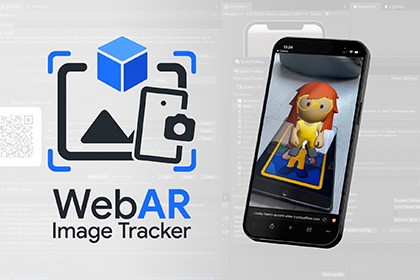
Augmented reality that opens from a link in any phone or desktop browser. No app, no ARKit, ARCore or WebXR. Author in Unity, ship a WebGL page powered by WebAssembly, with WebGPU for richer visuals.WebAR Image Tracker brings image-target augmented reality to the mobile and desktop web, with no app and no native SDK. Point a camera at a target image and your Unity content locks onto it in real time, compiled to WebAssembly and running in the browser people already have, with nothing to install.Why it exists: Unity's AR Foundation targets native ARKit and ARCore and does not build for WebGL, and browser-native WebXR image tracking is still experimental and off by default in Safari on iOS and iPadOS. WebAR Image Tracker uses the open-source mind-ar-js tracker (TensorFlow.js, GPU-accelerated on WebGL2), so one WebAssembly build runs across iOS, Android, and desktop browsers with no WebXR and no native AR SDK.🌐 Made for the open webDelivered as a web page: open from a link or QR code, no app store, no install.One WebGL build serves iOS, Android, and desktop visitors with a camera.Plain static files, no runtime backend: deploy on standard hosting; the tracker runs on the visitor's device.Modern web stack: your Unity content runs as WebAssembly (WASM) for near-native speed, with GPU-accelerated image tracking on the visitor's device.🎯 Tracking qualityTracks images: any photo or artwork with enough detail is a target.Adaptive smoothing: steadier when held still, looser in motion (driven by the accelerometer and gyroscope), so content sits stable at rest without lagging your hand.Outlier rejection: physically impossible tracker jumps are dropped before they reach your content.Stable on flat images: resolves the two equally-valid poses a flat picture presents (IPPE plus gyroscope), so the image can lie on any surface and move while tracked.Rides out brief dropouts: the gyroscope keeps content pinned to the image, then re-syncs cleanly when it returns.🛠️ Set up inside UnityOne-click rig: GameObject > WebAR > Controller builds the camera rig and reuses your scene camera; one more click adds a tracker.Compile a target in-editor: Create Marker opens the local target compiler, scores trackability, and posts the target back into your project.Test on a real device: a bundled local server hosts over HTTPS, shows a QR to open it on a phone, and streams the device console into the editor.Real-world scale: Unity works in metres, so a 30 cm model is 30 cm wide on a 30 cm print.🚀 Built for productionMultiple targets per project: compile several images into one file, each with its own content.Pipelines: URP (recommended, most tested) and Built-in; HDRP via an Unlit fallback.Self-contained: mind-ar-js and three.js are bundled into the WebGL template, no CDN at load time.Scripting and events: start, stop, and swap targets from C#; subscribe to target-found, target-lost, and per-frame pose.WebGPU-ready rendering: detects the browser graphics backend and applies a matching post-processing profile. On Unity 6's WebGPU backend the extra rendering headroom lets you push post-processing, real-time shadows, and anti-aliasing for higher visual fidelity, while WebGL2 stays the broad-compatibility default.🔗 LinksLIVE DEMODocumentation and setup guideIssues and supportWebGL Build HostPublisher: Make Games Play✅ RequirementsUnity 2022.3 LTS or newer. Tested on 6000.5.0f1, 6000.4.11f1, 6000.3.17f1, 6000.0.77f1, and 2022.3.62f3.WebGL build target. URP recommended (most tested); Built-in supported; HDRP via an Unlit fallback (less tested).An HTTPS host for deployment (camera access needs a secure context); localhost works in development.A browser with WebGL2 and the EXT_color_buffer_float extension (used by the TensorFlow.js backend).All processing runs on the device; no camera images or video are sent to a server.🌍 Browser and device supportiOS/iPadOS 16.4+: every iOS browser uses Apple's WebKit, so Safari, Chrome, Edge, Firefox, and Brave all work. A one-time motion-permission prompt enables the gyroscope and accelerometer used for smoothing; tracking still works if it is declined.Android: Chrome 89+ and current Chromium browsers (Edge, Brave, Opera, Samsung Internet); recent Firefox too.Desktop: current Chrome, Edge, Firefox, Safari, Brave, and Opera with a webcam.A browser missing WebGL2 or the float-texture extension shows a clear, named message instead of failing silently.⚡ PerformanceTracking rate depends on the device GPU, the browser, and scene weight; on capable hardware it keeps pace with the camera.Typical measured rates: recent iOS ~35-55 Hz, recent Android flagships ~30-45 Hz, budget or older Android ~10-20 Hz. The live rate shows in the diagnostic overlay and via C#.📦 What's includedRuntime components: tracked anchor, camera background, image tracker, compiled-target asset type, and the JavaScript-to-C# bridge.A WebGL template with mind-ar-js and three.js bundled in, the motion-permission prompt, and loading/error screens.A sample scene: a CC0 pumpkin model (Kenney) anchored to the included CC0 image target.A bundled local HTTPS server for on-device testing.🧩 Scripting APIInitialise from a bundled target asset or a hosted URL; stop, reinitialise, and restart for lifecycle control.Events: target found, target lost, per-frame pose, camera projection update, tracker stopped, and unsupported-browser (with a capability tag).A live tracker frame-rate value for adapting UX on slower devices.🧰 Editor toolingA Compatibility Audit that checks the project is set up correctly, plus About, under Tools > WebAR Image Tracker for Unity.Custom inspectors: a single Tracking Stability slider for quick setup, with an advanced section for fine control.An optional on-device diagnostic overlay, with one-tap copy of the full diagnostic state for support.Built on mind-ar-js by hiukim (MIT).