




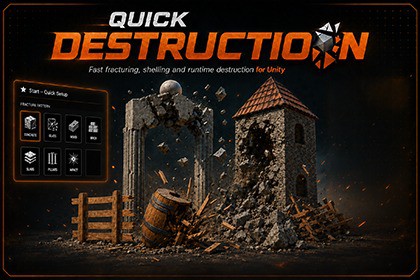
Quick Destruction - Fracture & Collapse Toolkit
Rip Vertices Studio
$34.64
$49.49
30%OFF
(no ratings)
Jump AssetStore
Turn existing static meshes into production-ready destructibles without authoring inner geometry, manually unwrapping cut-surface UVs, or creating a dedicated interior material.Works with Unity 2022.3.6 and Unity 6+( If you find any important error please contact me )Add convincing destruction to an existing project without a DCC round trip or a custom destruction framework.**- 🧱 **No manual interior preparation** - cut faces, cut-surface UVs, material assignment, fragment meshes, colliders, and prefab hierarchy are generated by the editor workflow.- ⚡ **Bake-first performance** - primary fragments are prepared before play, so the first hit activates known geometry instead of generating the complete fracture at impact time.- 🎯 **Localized, progressive damage** - open a small hole, release nearby fragments, collapse unsupported sections, or destroy the full object.- 🏗️ **Hollow Shell generation** - add configurable wall thickness to compatible thin/open meshes such as barrels, simple building shells, walls, tanks, and RTS structures.- 🧩 **Seven material-oriented patterns** - concrete, glass, wood, brick, slabs, pillars, and impact-focused shatter.- 🎮 **Ready for gameplay** - damage components, explosions, events, effects, cleanup, reset, pooling, profiles, and readable C# source are included.Quick Destruction is a complete fracture and physics toolkit for static meshes. Its primary workflow generates fragment geometry, colliders, materials, and reusable prefabs in the Unity Editor. At runtime, the system activates the prepared pieces only when they are needed, giving you predictable gameplay behavior and clear control over physics cost.Select a mesh, choose a material-oriented preset, and use **Bake & Setup** to create a playable destructible. Start quickly with one-click presets or open the full editor window to fine-tune fracture geometry, damage, physics, structural supports, lifecycle, effects, and performance.### 🚀 Designed for fast implementationQuick Destruction is intentionally focused on the complete path from an existing mesh to a reusable gameplay prefab. You do not need to assemble separate systems for fracture authoring, cut materials, localized activation, structural support, debris lifecycle, reset, and damage integration.This makes it a strong fit for indie teams, asset-heavy games, RTS destruction, shooters, physics puzzles, and projects that need many believable destructibles without turning destruction setup into a separate production pipeline.It is not positioned as an unlimited offline simulation suite. Its strength is a guided, game-oriented workflow with deterministic primary geometry, bounded optional runtime splitting, transparent performance controls, and a compact API.### 🧩 Seven purpose-built fracture patterns- **Uniform Concrete** - irregular chunks for concrete, stone, plaster, ceramic, and general rigid props.- **Radial Glass** - configurable spokes, rings, axis, jitter, and release of unsupported pane islands.- **Directional Wood** - long grain-aware pieces with directional cuts and sharper splinter ends.- **Brick Cells** - regular or jittered masonry cells with optional explicit local-space cell dimensions.- **Layered Slabs** - stacked sheets for slate, floors, plaster, layered stone, and brittle panels.- **Columnar Pillars** - long continuous prisms for columns, posts, beams, and basalt-like structures.- **Impact Shatter** - concentrated debris near a chosen focus with larger chunks farther away.Seeds make editor bakes repeatable. Change the seed to generate a new variation while preserving the rest of the profile.### ⚡ Fast editor workflow- One-click Concrete, Glass, Wood, Brick, Slabs, Pillars, and Impact setup.- Batch analysis and baking for multiple selected objects.- Edit Mode fracture preview with colorized fragments, cut-surface highlighting, wireframe, and explode spacing.- Mesh analyzer with actionable warnings and blocker codes before baking.- Reusable `DestructionProfile` assets for shared geometry, physics, damage, lifecycle, and budget settings.- Deterministic generated folders, manifests, freshness checks, safe rebaking, and owned-output cleanup.- No separate interior mesh or interior UV unwrap is required for generated cut surfaces.- Full Solid and Hollow Shell workflows, including configurable generated wall thickness for compatible thin/open surface meshes.- A simple barrel, wall, tower shell, tank, or RTS building can be given breakable thickness without first modeling every internal wall by hand.### 🎯 Localized and progressive destructionA hit can release only the fragments near its world-space impact point. Untouched pieces remain in the baked shell and can be activated by later external hits. Damage amount, activation radius, and physical break energy are independent, so a weapon can create a small hole without launching the entire object.Use Rigidbody impacts, explicit gameplay calls, or Mixed mode. Health, brittleness, minimum collision velocity, impulse-to-damage curves, layer masks, cooldowns, cracked materials, explosion force, and fragment push are all configurable.### 🏗️ Structural collapseDestructible bodies can remain static, simulate from the beginning, or stay kinematic until they lose support. Supports can be detected automatically below the object, assigned manually, or combined. Configure required support, probe density, layers, grace time, and check interval for bridges, slabs, roofs, pillars, and other connected structures.### 💥 Two deeper-destruction options- **Pre-baked Secondary Breakup** prepares deterministic child pieces inside selected large fragments. It is ideal when the exact second-level result must be known before play.- **Iterative Runtime Re-Fracture** optionally slices an already-loose piece after a later gameplay hit. It requests 2-4 real clipped children and may return fewer when the authored geometry cannot accept every bounded cut. Iteration depth and minimum fragment volume bound repeated division; automatic first-landings are throttled globally per destructible collapse.These modes are alternatives, allowing each destructible to favor deterministic precomputation or repeated local runtime damage.### ⚙️ Physics, lifecycle, and performance controls- Convex Mesh, Primitive Box, and Exact Mesh/compound collider strategies.- Fragment mass calculated from volume and density, with minimum and maximum clamps.- Mobile, Balanced, and High authoring tiers covering 8-250 requested primary fragments.- Optional visual-only treatment for small primary and secondary debris.- Local and shared active-Rigidbody budgets with deterministic delayed activation.- Cleanup after time, after settling, or both.- Freeze settled debris as static proxies or smoothly despawn it for reuse.- Reset restores baked transforms, health, colliders, velocities, hierarchy state, and pooled fragments.In the normal baked destruction path, fragment GameObjects already exist in the generated prefab: ordinary break/reset cycles do not create or destroy them.### 🎨 Interior surfaces and materialsExterior submesh materials and their existing UVs are preserved. Newly generated cut faces receive their own UVs automatically, with projected tiling or edge-stretched mapping and an adjustable texel scale.A dedicated interior material and texture are optional, not required. Cut faces can reuse the dominant source material, use the included pipeline-aware preset surface, or use your own material. This removes the usual requirement to model interior faces, unwrap them in a DCC application, and prepare a separate texture set before testing destruction.Pipeline-aware preset materials support Built-in, URP, and HDRP projects.### 🔌 Ready-to-use integration- Public C# damage, break, explosion, reset, structural, and secondary-fragment API.- C# events and UnityEvents for gameplay, VFX, audio, scoring, objectives, and save systems.- Stable IDs and documented save/load and networking-intent patterns.- Drop-in damage dealer for projectiles and melee objects.- Built-in pooled, material-aware hit particles and synthesized preset sounds, with optional custom ParticleSystem and AudioClip overrides.- Runtime and Editor code separated into assembly definitions.- Full readable C# source included.- Complete 35-page PDF manual with runtime examples and troubleshooting reference.- Demo content and example scenes included.### 🎮 Typical usesBreakable props, barrels, windows, walls, fences, pillars, bridges, roofs, floors, towers, tanks, RTS buildings, cover systems, physics puzzles, explosions, environmental damage, structural collapse, and cinematic destruction.## 🚀 Three-step setup1. Select a static mesh in the Scene or Hierarchy.2. Choose a fracture pattern or reusable profile, then preview the result.3. Click **Bake & Setup** and call the included damage component or C# API.Geometry settings remain editable: change the profile and rebake to replace the generated result safely.## 📦 Included in the package- Quick Setup and Advanced Setup editor workflows.- Seven fracture patterns and reusable `DestructionProfile` assets.- Bake pipeline, analyzer, previews, generated manifests, and freshness validation.- Localized damage, explosions, structural supports, secondary breakup, and bounded runtime re-fracture.- Collider, mass, active-Rigidbody budget, cleanup, freeze, pooling, and reset systems.- Preset particles and synthesized impact/break sounds with custom override slots.- Public C# API, C# events, UnityEvents, and a drop-in damage dealer.- Built-in, URP, and HDRP material handling.- Demo scenes and sample barrel, bridge, fence, pillar, tower, and window assets.- Full readable C# source and complete PDF manual.DOCUMENTATION LINKUniversal Render Pipeline (URP), and High Definition Render Pipeline (HDRP)- **Source type:** Static `MeshFilter` + `MeshRenderer`; live `SkinnedMeshRenderer` fracture is not supported- **Source readability:** imported meshes can be read through an Editor snapshot; runtime Read/Write does not need to remain enabled when the importer supports this path- **Recommended topology:** closed, manifold meshes produce the best cut surfaces; open and non-manifold geometry may generate approximated or imperfect caps- **Source complexity:** over 100,000 triangles produces a warning; over 500,000 triangles is blocked; use a lower-poly fracture proxy for dense assets- **Requested primary fragments:** 2-250, subject to valid geometry and pattern settings- **Fracture patterns:** 7- **Collider strategies:** Convex Mesh, Primitive Box, Exact Mesh with pre-baked dynamic compound companions- **Damage inputs:** Rigidbody impact, scripted API, or both- **Cut surfaces:** separate interior material or dominant source material; projected or edge-stretched UVs- **Interior preparation:** no authored inner mesh, manual cut-surface unwrap, or dedicated interior texture is required; generated surfaces receive UVs and a material automatically- **Hollow Shell:** optional inward shell generation with configurable thickness for compatible thin/open static meshes- **Lifecycle:** keep, freeze as proxy, or despawn/reuse; settle- and time-based cleanup- **Deeper destruction:** deterministic pre-baked secondary breakup or optional bounded runtime re-fracture of already-loose fragments- **Runtime split controls:** pieces per split, maximum split iterations, minimum fragment volume, and break-apart force- **Runtime split throttling:** automatic baked-fragment landings are queued one per rendered frame and capped at eight accepted splits per destructible collapse cycle- **Runtime assemblies:** `RipVertices.QuickDestruction.Runtime`- **Editor assemblies:** `RipVertices.QuickDestruction.Editor`- **Namespace:** `RipVertices.QuickDestruction`- **External package dependencies:** none required by the core tool- **Source code:** included- **Documentation:** 35-page PDF manual- **Support:** ripvertices96@gmail.com## Important limitations and disclosures- The standard workflow fractures static meshes. A live `SkinnedMeshRenderer` must first be baked to a static mesh snapshot.- The primary system is bake-first. Geometry-related profile changes require **Bake & Setup** again.- Requested fragment count is a target; thin, open, invalid, or very small geometry can produce fewer valid pieces.- Closed manifold meshes give the most reliable interior surfaces. Open or non-manifold inputs may need cleanup in a DCC application.- Negative transform scale can invert winding and normals; apply/freeze mirrored scale before baking.- Exact runtime trajectories are governed by Unity physics and can diverge between network peers. Replicate destruction intent and synchronize selected hero fragments separately when exact trajectories matter.- Normal baked fragment release always has priority. Iterative runtime re-fracture can cut only an already-loose fragment after a later hit; a loose baked fragment may also split on its first valid ground landing.- Runtime children do not recursively split from their own landings. A later accepted gameplay hit is required, and maximum split iterations plus minimum fragment volume bound further division.- The runtime cutter returns only geometry genuinely clipped from the parent. It uses up to three fast plane-cut attempts and one topology-repair attempt; if the first true cut fails, the source fragment remains unchanged instead of being replaced by a box, compressed copy, or invented fallback shape.- Runtime pieces use a lightweight six-support-point convex collider. Automatic landing splits are limited to one per rendered frame and eight per destructible collapse cycle; gameplay-hit splits remain immediate and do not consume that automatic allowance.- Generated runtime pieces are not silently recycled, lifetime-despawned, or removed merely for falling below Minimum Fragment Volume. Reset removes generated render/collider meshes and restores the baked hierarchy.- Because arbitrary authored topology cannot be guaranteed to accept every runtime plane cut, use pre-baked Secondary Breakup when exact second-level shapes and child counts must be deterministic.- Pre-baked Secondary Breakup and Iterative Runtime Re-Fracture are alternative modes and are not stacked on the same profile.- Demo art is sample content intended to demonstrate the tool.DOCUMENTATION LINKAI used as support in code writing