
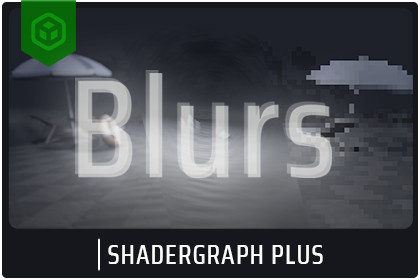
Collection of 14 production-ready blur and filter nodes for ShaderGraph. Drop a node into any graph, pick any source from texture to camera, and get high quality blurs with zero additional setup.- The Shader Graph package is required.- The minimum confirmed compatible Unity version is 2022. Unity 2021 and earlier are not supported.ShaderGraph Plus - Blurs gives you fourteen carefully implemented blur and filter algorithms as Shader Graph nodes that work under Built-in (BiRP), URP, and HDRP with no extra setup, providing a seamless, near native experience in the Shader Graph editor.Use them in any existing Shader Graph's - on scene materials, sprites, UI, and render textures, or wire them into fullscreen post-process passes for frosted glass, refraction, depth-of-field, bloom pre-passes, and stylized looks.Works on all three render pipelines from a single import: Built-in (BiRP), URP, and HDRP. No separate packages or downloads. The package is designed to be plug-and-play, with a deliberately minimal footprint and no unnecessary bloat.Included Content: - 14 blur and filter nodes for Shader Graph. - Premade basic shaders for every blur node, plus an additional Tilt Shift shader built on the Bokeh Blur node. - HLSL source includes for developing your derrivatives via custom function nodes. - Separate BiRP, URP, and HDRP demo scenes. - Full offline HTML documentation.Blur Nodes Included (14): - Gaussian Blur - smooth weighted convolution - Binomial Blur - deterministic Gaussian approximation - Box Blur - fast uniform averaging - Kawase Blur - lightweight iterative sampling - Motion Blur - directional movement streak - Radial Blur - rotational spin smear - Zoom Blur - outward radiating burst - Poisson Disk Blur - even disk sampling - Bokeh Blur - bladed lens defocus - Stochastic Blur - randomized grain-like softening - Bilateral Blur - edge-preserving smoothing - Kuwahara Filter - painterly stylization - Median Blur - impulse noise removal - Quantization Filter - pixelate and posterizeWhat You Can Blur:Every node selects it's input from a single Source dropdown: - Texture - any Texture2D: sprites, masks, albedo or lookup maps, or a Render Texture you drive yourself. - Texture Array - any Texture2DArray, with a slice Index input. - Camera - the live opaque/scene color directly behind a surface, for refraction, frosted glass, and blurred UI backdrops, sampled by screen position. - Blit Source for usage in Full Screen Render Passes. This option is available only on the URP. - Both Texture and Texture Array types allow for LOD sampling as well as standard sampling.Node Features - Four convenience outputs on every node: RGBA, RGB, RG, and R. - Standard mip-chain or explicit LOD sampling. - HDRP color-pyramid mip support with an Exposure toggle in Camera mode. - Multiple kernel variants where relevant (e.g. Gaussian and Binomial in 3x3 / 5x5 / 7x7, Box with adjustable radius and an LOD variant). - Near native ShaderGraph experience.AI assisted with bug fixing and automation of repetitive tasks during the development process as well as formated the documentation and changelog.The asset store package localization was performed entirely using a locally hosted large language model (LLM).