



NPC & AI Task System — Priority Queue Scheduler
PostanteGames
$19.24
$27.49
30%OFF
(no ratings)
Jump AssetStore
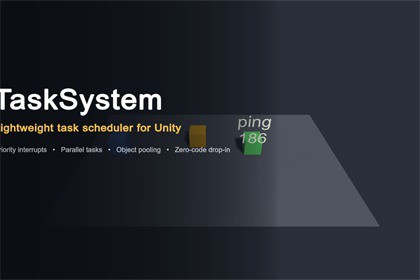
Three-tier task queue (Normal · Priority · Parallel) with pause/resume, pooling, and optional stat hooks for NPC and AI agents. Zero dependencies — drop in and use.TaskSystem is a lightweight, zero-dependency task scheduling framework for Unity. Drop it into any project and orchestrate sequenced, prioritized, pausable work for NPCs, AI agents, workers, quests, animations, or any "do these things in order with interrupts" workflow.KEY FEATURES• Three-tier queues — Normal (FIFO), Priority (pre-empts current task), Parallel (runs alongside).• Pause / resume / cancel — priority interrupts auto-pause; resumed when the priority queue empties.• ScriptableObject task templates — author once, instantiate per agent, pool freely.• Treatment types — Instant, OneTime, LongTime, Continuous.• Progress reporting — Load, Distance, Sequence, Instant, Duration.• Composite tasks via TaskSequence — chain subtasks with optional waiting and a final task.• Optional stat hooks (ITaskAgentStats) — energy costs, work speed, mistake rolls, pause notifications. Skip entirely if you don't need them.• ScriptableObject pooling baked in (IPoolableScriptableObject).• Project-agnostic — no NPC framework, no behavior tree dependency, no proprietary editor.DESIGNED FOR• AI agents that need queued behavior with priority interrupts.• Workers in sim/tycoon games (Diner Dash-style task chains).• Quest systems that queue, pause, and resume multi-step objectives.• Build/craft systems with proportional energy cost over time.• Any game loop needing "do A, then B; if X happens, do Y first, then resume."WHAT'S INCLUDED• Core runtime — full C# source, no DLLs.• Drop-in TaskController + TaskAgent components — a working actor with zero code.• Nine sample task types covering every treatment and progress mode.• Five controller-driven demo scenes plus a one-click DemoHub navigator.• On-screen HUD overlay and a custom Inspector that shows the live queue.• README, QuickStart, API reference, CHANGELOG, English XML documentation.DEPENDENCIESNone. Only UnityEngine. Minimum Unity 2021.3 LTS (developed and tested on Unity 6).LICENSINGPer-seat license under Unity Asset Store EULA. Royalty-free use in commercial builds.Support: questions and feature requests welcome through the Asset Store product page.• Three-tier task queues — Normal (FIFO), Priority (pre-empting interrupt) and Parallel (concurrent) lanes per runner.• Pause / resume / cancel — a priority task auto-pauses the running task and resumes it when the priority lane drains.• ScriptableObject task templates with built-in pooling (IPoolableScriptableObject).• Treatment types: Instant, OneTime, LongTime, Continuous. Progress types: Load, Distance, Sequence, Instant, Duration.• Composite tasks via TaskSequence — chain subtasks with optional waits and a finalizer.• Drop-in TaskController + TaskAgent components — a working actor with zero code; or subclass TaskRunnerBase to extend.• Add tasks by id or by enum; purge/clear by type; out-QueuedTask overloads; optional shared TaskRegistryAsset.• Optional stat hooks (ITaskAgentStats) for energy cost, work speed and mistake rolls — fully removable.• On-screen HUD overlay and a custom Inspector that lists the live and queued tasks in execution order.• Nine sample task types, five controller-driven demo scenes, full C# source, English XML docs + RTF manual.• Zero dependencies beyond UnityEngine. Works in Built-in, URP and HDRP. EditMode + PlayMode tests included.AI assistance (Anthropic Claude) was used during development in the following areas:• Documentation — drafting and editing the README, QuickStart, API reference, CHANGELOG, and the bundled RTF user manual.• Code comments — translating original comments to English and generating XML documentation.• Examples & tests — assisting with portions of the sample/demo scripts (scene loaders, demo UI panels) and the EditMode/PlayMode test suites.• Packaging — listing copy and metadata preparation.The core runtime — the task scheduler architecture, the three-queue logic, pausing/resuming, and the public API — was designed and written by a human developer. No AI-generated art or audio is included in the package; all sample scenes use standard Unity primitives and materials.