



Roguelike Deckbuilder Framework — Single-Player Card RPG Kit
SoloFoundry
$64.90
(no ratings)
Jump AssetStore
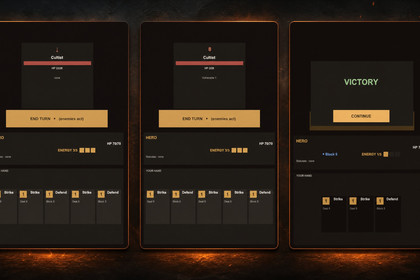
A complete, single-player roguelike deckbuilder framework in the spirit of the genre's classics. Author cards, enemies, and entire acts as data — no coding required.This is a code framework — it ships no materials, shaders, or render-pipeline-specific assets, so it works with the Built-in Render Pipeline or URP without changes. The example UI uses Unity's standard uGUI canvas (ScreenSpaceOverlay), which is render-pipeline independent. No render pipeline setup is required.Build your own single-player deckbuilder — without writing engine code.Hi, I'm the maker behind SoloFoundry. I build the tools I wish I'd had when I started — complete, honest, and ready to use. This is one of them.If you've ever wanted to make a roguelike deckbuilder in the spirit of the genre's classics, you know the hard part isn't the idea — it's the months of plumbing. The combat resolution, the save system, the map, the shops, the run loop. This framework is all of that, already built, tested, and documented, so you can skip straight to making your game.Author your content as data — not code.Add a card, an enemy, a status effect, or a relic by creating an asset and filling in a few fields. No C# required. Cards build from a simple effect vocabulary — deal damage, gain block, apply a status, draw, scale, branch on conditions — so most new cards are pure data. Even adding a card to your starting deck is just editing an asset. Truly no-code, end to end.Everything a run needs, in the box:Turn-based card combat — energy, block, multi-hit, status effects, and telegraphed enemy intentsData-driven enemies with sequenced, weighted, and conditional intent patterns — plus a bossA branching map with seeded generation that's always completableShops, rewards, rest sites (heal or upgrade), and random events — all authorable as dataAdvanced card mechanics: X-cost, scaling, conditional, card-generation, pile-searchFull save and load of an entire mid-run state — resume exactly where you left offA complete, playable example act — 23 cards, 7 enemies, a boss, events, relics, potions — every piece built as data, not codeMade to be understood.A clean, layered architecture with a pure-C# core and a clear line between engine and content. It comes with real documentation — a README, a 2-minute "add your first card" guide, an architecture overview, and a per-system reference — plus comments throughout. You won't get lost in someone else's code.Built to last.Self-contained, with no paid third-party dependencies. Works with URP or Built-in. Backed by a full suite of automated tests, so the foundation under your game is solid.I made this because the genre deserves a framework that respects both your time and your budget. I hope it helps you build something great.Complete single-player roguelike deckbuilder framework — full run loop, map to bossNo-code content authoring — cards, enemies, statuses, relics, and events created as data assetsDeterministic turn-based combat core — energy, block, multi-hit, status effects, telegraphed enemy intentsData-driven enemy AI — sequenced, weighted, and conditional intent patterns; multi-enemy fights and a bossBranching seeded map — generation guaranteed to be completableShops, rewards, rest sites (heal or upgrade), and random events — all authorable as dataAdvanced card mechanics — X-cost, scaling, conditional, card-generation, and pile-search effectsFull save and load of complete mid-run state — resume bit-for-bit identicalPlayable example act included — 23 cards, 7 enemies, a boss, events, relics, and potions, all built as dataClean layered architecture — pure-C# core, clear engine/content separationFull documentation — README, 2-minute "add a card" quickstart, architecture overview, per-system reference~80 automated tests includedSelf-contained — no paid third-party dependenciesCompatible with URP and Built-in Render PipelineThis framework was conceived, designed, directed, balanced, and quality-assured by its creator. Every system, mechanic, and design decision — the combat model, the data-driven authoring pipeline, the balance curve, the architecture — was specified and validated by me through extensive iteration and testing. AI tools were used as a coding assistant to implement that direction. The result is a deliberately engineered, fully-tested framework: a deterministic combat core, complete save/load, a no-code content pipeline, 79 automated tests, and full documentation — with significant added value over any generated output.