
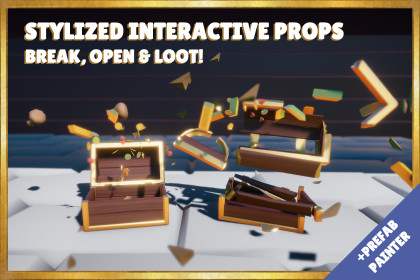
Stylized Interactive Prop System: Break, Open & Loot
DPTGames
$21.44
$42.89
50%OFF
(no ratings)
Jump AssetStore
Interactive environment framework optimized for SRP Batcher/GPU Resident Drawer via vertex colors. Features physics destruction, 3 loot modes, editor simulation, VFX, prefab painter & 24 unique props.URP & Shader Graph ready.SRP Batcher Compatible.Minimum Version: Requires Unity 6000.3.8f1+. (Note: This specific version is required because the architecture utilizes the new Renderer Shader User Value).Architecture: Textureless workflow. Reads Base Color from Vertices, PBR from packed UV channels.Tip: Disable 'Dynamic Batching' in Player Settings to maximize GPU Instancing performance.Break, Open & Loot — Destruction, Pre-WiredBuilding interactive destruction from scratch is tedious and time-consuming. Stylized Interactive Prop System bypasses the setup entirely, shipping with destruction, physics, audio, and VFX fully pre-configured. Assign your loot, choose your spawn mode, and you are ready to play.Zero Setup Required: Every prop includes pre-fractured broken states (10–17 debris fragments), impact audio, and particle effects.In-Editor Testing: Trigger explosions, tune physics, and reset props directly in the scene view. Iterate in seconds, not minutes—without hitting the Play button.Drop-in Ready: Perfect for dungeons, taverns, camps, and stylized open-world environments.Perfect for dungeons, taverns, camps, and stylized open world environmentsCore Systems1. Interactive Physics & Variant PrefabsDirectional Impacts: Props react to where they are hit, applying realistic directional force to debris and triggering cascading chain reactions with linked physics.Versatile Configurations: Every prop comes in three distinct configurations to optimize scene budgets: Lightweight Dressing (static decoration), Interactive-Only (breakable or openable), and Hybrid (both openable and breakable).2. Integrated Loot SpawningThree built-in loot modes handle player rewards automatically:Burst On Event: Arcade-style loot explosions that scatter items outward the moment a prop shatters.Pre-Spawn Hidden: Automatically spawns and hides loot inside containers at startup, revealing it only upon opening or destruction.Manual Placement: Full developer control to hand-place specific quest or high-value items exactly where they belong before runtime.3. Intelligent Audio & VFX SystemsDynamic audio variation: prevents repetitive sound effects, while built-in audio pooling keeps performance smooth even during large destruction events.Performance-Throttled Helpers: Includes a specialized physics audio script featuring smart frame-rate throttling and instance cooldowns, allowing dozens of loot items to drop simultaneously with stable audio performanceImpact VFX: Lightweight dust and debris particle systems are pre-wired to instantly sell the impact of every breaking object.4. Custom Editor ToolsInteractive Prop Tester: Provides immediate visual feedback for physics and animations directly in the scene view.Advanced Prefab Painter: Paints props onto any collider with automatic ground alignment, hierarchy organization, and randomized visual variety. Includes physics-based placement, prefab group management, automatic script assignment, and a post-placement Recolor Brush.Texture Channel Packer: Create packed textures compatible with the VCCore material for any model using MRAO pipelines.ContentIncluded Gameplay Props & Loot Assets (all hand-modeled from scratch)Every core prop includes multiple production-ready gameplay states and optimized prefab variants, including destructible versions, openable configurations, lightweight dressing prefabs, broken base states, LOD variants, and modular debris pieces.Core Environment Props11 stylized environment propsDressing variants for all propsBreakable variants for all propsOpenable & interactive (openable + breakable) variants for 6 container props (Chest, Crate, Large Crate, Barrel, Cage, Jar)Broken states for all destructible objectsHigh-density breakup system (10–17 fragments per prop) for satisfying destruction feedbackLOD0 and LOD1 included, with optimized culling beyond LOD1 for performanceAccessories & Loot13 accessory and loot assetsDressing variants for all itemsPhysics-enabled variants for 7 accessories (Coin, Gem, Goldbar, Key, Nail, Pouch, Tankard)Breakable variants for 6 accessories (Coin Pile, Crowbar, Hammer, Log Pile, Planks 1 & 2)Interactive Props Demo Scene: A curated showcase scene featuring all included props, linked barrel chain reactions, pre-configured loot containers, and practical examples of plank prefab usage — ready to explore and test straight out of the box.System Assets & ExtrasPre-configured physics audio profiles (Wood, Metal, Ceramic, Stone, Fabric)20 baseline audio clips for breaking, opening, and closingOptional DPT_PlaySoundOnCollision script for loose objects and debrisFull technical documentation covering inspector, loot setup, and physics configurationPrefab Painter & Texture Channel Packer Demo Scene: A step-by-step walkthrough covering the full setup pipeline from raw textures to a finished painted scene, including texture channel packing and per-instance colour variation.DPT Material SystemOne master material shared across all assets.Advanced controls for metallic/non-metallic tinting via the ShaderVariant script, and procedural wood grain.Full Documentation Here: Interactive Props DocumentationNote: The DPT Prefab Painter tool is included with this package but is entirely optional—the assets do not require it to function. Please note that the Prefab Painter Video showcases the tool using background scenery and foliage from other packages; this environment scenery is not included in the Stylized Interactive Prop Pack but can be purchased separately.Modern Engine Optimization (Unity 6 & SRP Ready)GPU Resident Drawer Compatibility: Background Dressing variants are deliberately configured as standard GameObjects with static rendering flags unchecked. This allows Unity 6 to automatically ingest the assets directly into the GPU Resident Drawer pipeline as instanced data, minimizing CPU overhead.Lightweight Colliders: Rigidbody components are entirely omitted from Dressing variants. They function as static environment obstacles that physics debris can bounce off of, keeping runtime physics calculations highly efficient.Zero Draw-Call Material Tinting: Visual randomization is driven in the editor via the DPT_PrefabPainter. At runtime, the DPT_ShaderVariation component leverages Unity 6's native Renderer.SetShaderUserValue API to inject a single packed uint directly into the instantiation pipeline. A custom HLSL shader node unpacks this color and brightness data via unity_RendererUserValue. This completely bypasses material uniform properties, ensuring 100% compatibility with the GPU Resident Drawer and SRP Batcher with zero material cloning or draw-call spikes.Memory & Data PackingMinimal VRAM Footprint: By packing PBR data directly into vertex attributes, the entire package consumes under 1MB of VRAM—representing up to a 97% reduction compared to traditional three-atlas texture configurations.Texture Channel Packer Utility: Includes an integrated editor tool designed to bridge traditional textured assets with the optimized DPT workflow. The tool compresses independent PBR maps into a unified, high-performance composite asset by mapping discrete data arrays directly to individual hardware channels (Red: Metallic, Green: Occlusion, Blue: Detail, Alpha: Smoothness).Universal Shader Expansion & Third-Party Compatibility: By exporting pipeline-compliant packed maps, developers can deploy the included custom shader across any external 3D model. This expands the asset ecosystem, allowing third-party meshes to seamlessly inherit our optimized GPU Resident Drawer architecture, sub-megabyte memory savings, and native zero draw-call instance recoloring without duplicating materials or generating runtime instancing overhead.Advanced Preprocessing Pipelines: The Packer utility features built-in mathematical processing rules, including channel inversion (enabling instant remapping of external Roughness maps into Unity-compliant Smoothness layouts) and a native luminance averaging algorithm ((R + G + B) / 3) to extract precise scalar attributes from standard 24-bit RGB files lacking embedded transparency channels.Adaptive Material UI: Includes a custom inspector togglable between Basic mode (clean layout hiding advanced properties) and VCCore mode (unlocks full packed data sliders and texture fallbacks).Pipeline Compatibility: Configured for URP out of the box. The primary workflow utilizes the included custom vertex-packed shader. For developers who prefer a traditional texture-based workflow, a fully configured URP Default Lit Material is also included and ready to use out of the box, with all supplied texture maps already assigned. Standard 4K PBR texture atlases are included and downscaled to 2048×2048 by default in Unity, allowing straightforward material setup for HDRP, custom shaders, or additional URP materials if required.Physics & Code ArchitectureStable Shatter Hierarchies: Shattered prefabs are rigorously structured with accurate local axes to ensure stable, jitter-free physics simulations.Directional Force Calculation: Interactive scripts calculate exact impact vectors at runtime to apply realistic directional velocity to debris fragments away from the hit source.Clean Namespaces: All codebase architecture is strictly encapsulated within custom namespaces (DPT.InteractiveProps and DPT.InteractiveProps.Editor) to guarantee zero conflicts with existing project scripts.Compilation Pipeline Footprint: Code compilation is modularized across isolated, platform-restricted Assembly Definitions (.asmdef). This decouples package scripts from the global project compilation pass, shortening iteration times and providing absolute build security by automatically stripping editor dependencies from final application builds.Asset Specifications & Geometric DensityHeavy Props (1,100 – 2,000 Tris): Tall Crate (1,982), Handcart (1,888), Cage (1,616), Crate (1,356), Chest (1,348), Jar (1,198).Standard Props (400 – 1,000 Tris): Barrel (976), Table (928), Bench (680), Pallet (548), Barricade (448).Loot & Accessories (Under 800 Tris): Coin Pile (768), Tankard (340), Pouch (248). All other tools, individual coins, and small items are under 200 Tris. (Note: Polycounts represent intact dressing variants. Openable variants feature fully modeled interiors and undersides, slightly increasing geometric density.)LOD Configurations: All intact core props include custom LOD1 meshes, averaging a 50–75% polygon reduction for distant rendering.Modular Shatter Budgets: Broken base states maintain a strict 1:1 polygon footprint with their intact versions. Debris fragments are authored as independent sub-meshes (individual planks, staves, and shards), allowing developers to manually strip out smaller pieces to aggressively scale down physics budgets for low-end or mobile platforms.Textures: The primary workflow is entirely textureless — all PBR data is packed into vertex color and UV channels with zero texture memory overhead from asset data. Optional fallback support is included for developers who prefer traditional texture-based workflows: 4K PBR source files downscaled to 2048x2048 by default in Unity. Auxiliary 512x512 wood grain noise texture is included for shader-driven surface variation on wooden props.Audio Framework & Performance ThrottlingSpecialty Audio: Tailored open, close, and shattering assets for the Cage model, and a distinct impact profile for the interactive Loot Pouch.Generic Debris Fallbacks: 2 optimized soft thud assets (Thud_Soft) designed to act as organic impact baselines for miscellaneous debris or secondary clutter accessories.Material-Mapped Audio Toolkit: Includes 20 uncompressed 16-bit PCM .wav source files (preventing double-compression artifacts and maintaining sample-accurate audio boundaries) pre-mapped to structural physics profiles:Wood & Containers: 2 distinct fracturing variants, plus dedicated open and close audio profiles for Crates and Chests.Ceramic & Metal: Full open, close, and breakage profiles for Jars, alongside 2 dedicated standalone metal impact variations.Loot & Precious Valuables: High-fidelity individual coin drop and diamond/gem drop physics assets to give physical weight to player rewards.High-Density Voice Throttling: The standalone accessory collision script (DPT_PlaySoundOnCollision) utilizes global frame-budgeting gates (Time.frameCount) and native AudioSource.isPlaying evaluation. This ensures that high-density loot bursts dynamically throttle voice allocation, completely preventing audio driver clipping, speaker distortion, or mixer channel saturation when dozens of items hit the floor simultaneously.Exposed Unity Events: Environment prefabs feature pre-configured AudioSource components with clean script integration. The custom inspector exposes native Unity Events for breaking, opening, and closing actions, allowing developers to seamlessly link external gameplay logic, UI triggers, or custom VFX systems without touching the core codebase.Requirements & CompatibilityUnity Version Compatibility: Formatted and verified for Unity Engine version 6000.3.8f1+ and higher. Fully optimized for Unity 6 Long Term Support (6000.4.8f1).Included Assembly Definitions: DPT.Core (Shared Framework Core), DPT.InteractiveProps (Package Runtime Core), DPT.InteractiveProps.Editor (Platform-Restricted Editor Inspectors), and DPT.InteractiveProps.Demo (Sandbox Scene Code). Runtime files utilize native Auto Referenced properties to preserve out-of-the-box compatibility with loose customer codebase scripts.Input System Dependency: Interactive test scene components rely on UnityEngine.InputSystem. Core system prefabs, animation graphs, shaders, and utilities contain zero dependencies and function natively across all legacy project input platforms.Included Documentation: 5x Comprehensive Technical Guides (3x Core Framework & Prefab Painter Operational Manuals, 2x Interactive Props User Guides).