




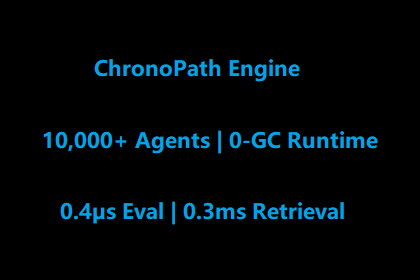
High-performance native C++ routing engine. 28k-node benchmark: 0.433μs distance eval, 0.333ms path retrieval. Features 19.25M QPS throughput, async hot updates, and strict 0-GC execution.1. Core: Custom Native C++ DLL (strictly 0-Byte GC allocations during runtime path queries).2. OS: Windows 64-bit (Editor & Standalone) ONLY. macOS, Linux, and Mobile platforms are NOT supported.3. CPU: Standard x86_64 architecture. No special instruction sets (such as AVX2 or AVX-512) are strictly required to run, ensuring maximum hardware compatibility across all 64-bit Windows machines.[ System Overview ]Traditional heuristic searches (A*) or NavMesh structures frequently encounter CPU bottlenecks and Garbage Collection (GC) latency under massive entity concurrency. ChronoPath is a highly consistent native graph routing engine. Built on a C++ core, it offloads routing computations to unmanaged native memory space, bypassing the Unity Main Thread and managed heap.[ Performance Baselines ](Evaluated on a 28,249-node, 66,722-edge topology using an AMD Ryzen 5 7500F — median of 15 cold-start runs)- Distance Evaluation: Median 0.433 μs / query.- Path Retrieval (Node Sequence): Median 0.333 ms / query.- Dynamic Synchronization: Global graph reconstruction median ~800 ms. Supports background computation with non-blocking foreground query execution.- System Throughput: Median 19,250,000 QPS under 12-thread concurrent execution.- Memory Execution: 0-Byte GC allocation throughout standard query and retrieval cycles.- Stress Test (10,000 Entities): On a 100×80 grid with dynamic exclusion zones, a baseline A* requires 14,002 ms; ChronoPath executes in 91 ms (~154× faster).[ Core Mechanisms ]- Decoupled Architecture: Separates cost evaluation from physical memory operations, perfectly suited for massive entity concurrency and simulations.- Asynchronous State Replacement: Topology modifications (e.g., edge weight updates) trigger background index reconstruction. Foreground query execution continues uninterrupted; the updated state becomes active automatically upon completion.- Concurrent Execution: The underlying native state supports concurrent reads. Integrates with standard C# Parallel.For loops and async Task scheduling.- Input Normalization: Automatically sanitizes numeric inputs. Invalid floats (NaN) or out-of-range values are converted into physical discontinuities, maintaining mathematical stability.[ 5-Step Quick Start (Beginner's Guide) ]- Step 1 (Initialize): Call new ChronoPathAPI(...) once at startup to feed your map data to the engine.- Step 2 (Translate IDs): Before querying, use GetInternalId() to translate your custom node IDs into the engine's Internal IDs.- Step 3 (Query): Create a large reusable array (e.g., new uint[32768]), and pass it to RetrievePath(). Always use Math.Min(actualLen, array.Length) in your loop to safely read the result and prevent out-of-bounds crashes.- Step 4 (Update Roads): If a road gets blocked, call UpdateEdgeWeight(), then run RebuildAll() in a background Task.Run so the map updates without freezing your game.- Step 5 (Clean Up): When closing, wait for any background rebuild to finish (.Wait()), then call Dispose() to release native memory and prevent leaks.[ IMPORTANT - READ BEFORE BUYING ]- Target Platform: This release provides pre-compiled libraries (DLL) for Windows 64-bit (x86_64) Editor & Standalone ONLY.- Hardware Recommendation: Standard x86_64 CPU. Processors with AVX2 support are recommended for peak performance, but are not strictly required.- Unity Job System Restriction: Due to managed array interoperability constraints, the engine API does not support execution within the Unity Burst/Job System.- Notice: Cross-platform binaries (Android/iOS/macOS/Linux) are NOT included in this package.[ Contact & Opportunities ]For cross-platform compilation support, source code licensing, enterprise-level integration, or career opportunities, please contact:isacbieber51@outlook.com- Core Languages: C++, C#- Target Platforms: Windows 64-bit (x86_64) Editor & Standalone ONLY- Memory Allocation: 0-Byte GC Allocation during runtime path queries- Thread Safety: Concurrent read design at the native level- Dependencies: Relies on C++ STL and OpenMP (No copyleft third-party open-source licenses, 100% proprietary IP)- Render Pipeline: Independent of render pipelines (Compatible with Built-in / URP / HDRP)