






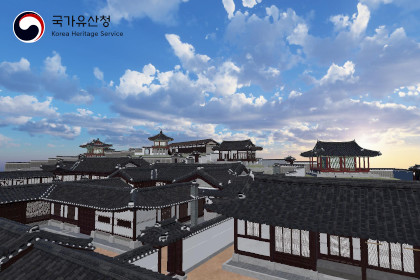
These 3D assets were produced by Korea Heritage Service as a project to build raw resources for the production and supply of Korean heritage digital contents in 2025.For commercial use, you can mark the 'Korea Heritage Service' as the source.KOREA HERITAGE SERVICE [KHS]The Korea Heritage Digital Service is a service that releases various national heritage data, so that companies, regions, and the public can easily find high-quality national heritage data. It is expected to be of great help to the public as well as companies, local governments, universities and research institutes by releasing national heritage data such as 3D data, drawings, photos, reports and videos that are difficult for the public to access.You can easily access the data by using conditional search functions such as designated items, regions, eras and production years, and also can easily check information such as 3D scanned videos and web VR contents provided by Korea Heritage Service through services such as '3D Asset' and 'Theme Contents'.Nakseonjae Hall stands in the area between Changdeokgung Palace and Changgyeonggung Palace. The complex, in which Nakseonjae is located, includes Seokbokheon and Sugangjae Halls, as well as stone stairs decorated with interestingly shaped stones and flower trees on the gently sloping hills behind the buildings. In the rear garden there are three more buildings, namely Sangnyangjeong and Chwiunjeong Pavilions and Hanjeongdang Hall. Nakseonjae was originally built in 1847 (the 13th year of the reign of King Heonjong of the Joseon Dynasty) as the king’s quarters, while Seokbokheon and Sugangjae were added to the complex the following year for the king’s grandmother and consort. With the construction of the complex, King Heonjong wanted to establish the strong authority of the royal court and show his determination to introduce reforms. After the coup in 1884, Nakseonjae was used as the king’s office for a while, while Yi Eun, the last crown prince of the Joseon Dynasty, lived here from 1963 to 1970. His wife, Yi Bangja, also lived in this place from 1966 to 1989. Unlike other buildings in Joseon royal palaces, Nakseonjae was built in accordance with the architectural style of aristocratic residences without using dancheong, or multi-color paintings, on the building’s surface. Also, the walls and fences were decorated with unique and various designs, which was not usually the case in other palace buildings. Nakseonjae has significant architectural value as it exhibits the excellent skills of master architects of the late Joseon Period.Features:Nakseonjae ComplexNumber of Unique Meshes: 1,486Vertex Count: 4 - 390,776Collision: YesLODs: NoNumber of Material Instances: 178Number of Textures: 330Number of Blueprints: 0Supported Development Platforms: (512*512, 1024*1024, 2048*2048, 4096*4096)Windows: (Yes)Mac: (No)