




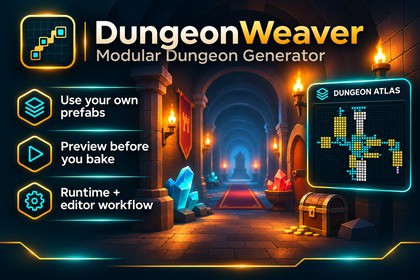
DungeonWeaver - Modular Dungeon Generator
MysticForge
$5.49
$7.69
29%OFF
(no ratings)
Jump AssetStore
DungeonWeaver procedurally generates modular 3D environments for any genre using your prefabs. Design dungeons, stations, caves and more—with custom rules, previews and runtime generation.DungeonWeaver – Modular Dungeon GeneratorYour Prefabs. Your Rules. Endless Procedural Possibilities.DungeonWeaver is a powerful and highly customizable procedural 3D environment generator for Unity 6, designed to help developers create complex, interconnected environments with minimal effort.More Than Just DungeonsDespite its name, DungeonWeaver is not limited to traditional fantasy dungeons or low-poly environments.Generate medieval castles, ancient temples, underground cave networks, futuristic space stations, industrial facilities, sci-fi corridors, sprawling labyrinths, and much more.The possibilities depend on your imagination and the modular prefabs you provide.Whether you're developing a fantasy RPG, a sci-fi adventure, a roguelike, or an exploration game, DungeonWeaver adapts to your project's visual style and architectural needs.Build Entire Environments From Your Own PrefabsDungeonWeaver uses a flexible, grid-based generation system to connect modular prefabs into coherent 3D layouts.Define your own corridors, rooms, intersections, staircases, and specialized modules using configurable footprints and connection sockets.The generator automatically evaluates compatible connections, occupied grid cells, rotation possibilities, and vertical space requirements to construct valid layouts.There is no requirement to use the included low-poly assets. Replace them with your own stylized, realistic, futuristic, or custom-designed modular environment pieces.As long as your prefabs follow the grid and connection requirements, they can become part of your procedural generation system.Take Full Control of Procedural GenerationFine-tune your environments with extensive generation settings.Configure dungeon dimensions, module quantities, branching behavior, room probabilities, path lengths, special-room placement, multiple height levels, and more.Use deterministic random seeds to recreate specific layouts or generate new variations whenever needed.A built-in 2D Dungeon Atlas preview allows you to inspect the generated structure before placing any objects into your Unity scene.Generate in the Editor or at RuntimeDungeonWeaver supports both editor-based generation and runtime generation.Quickly create layouts in the Unity Editor and bake them into your scene as editable prefab instances.Alternatively, use the included runtime generator and C# API to generate new environments during gameplay.This makes DungeonWeaver particularly useful for roguelikes, procedurally generated adventures, replayable levels, and dynamic world-building systems.Designed for Customization and ExtensibilityDungeonWeaver provides a dedicated editor interface for managing modular prefabs, configuring generation rules, previewing results, and creating environments.Its modular architecture makes it possible to expand existing module libraries, introduce completely new environment themes, and create unique generation configurations for different projects.Included fantasy-themed demo assets help you get started immediately, while the underlying generation system remains independent of visual style.Spend Less Time Building Levels and More Time Creating Your Game.DungeonWeaver transforms collections of compatible modular prefabs into customizable procedural environments, giving you the freedom to focus on gameplay, atmosphere, and world design.1. Genre-Independent Procedural GenerationGenerate interconnected 3D environments from modular prefabs.Suitable for fantasy dungeons, sci-fi facilities, space stations, castles, temples, caves, labyrinths, and more.Compatible with low-poly, stylized, and realistic environments.Use your own modular assets to create entirely different themes.The generation system is independent of the visual appearance of your prefabs.2. Randomized and Reproducible LayoutsGenerate unique procedural layouts using configurable random seeds.Reproduce specific environments with deterministic generation settings.Generate new variations without manually rebuilding level layouts.Create branching paths, interconnected rooms, junctions, and multi-level structures.3. Customizable Modular Prefab SystemBuild environments using your own Unity prefabs.Configure modules for corridors, corners, intersections, rooms, stairs, dead ends, and special areas.Define individual spawn weights, module categories, and placement restrictions.Enable automatic 90-degree rotation for compatible modules.Create and maintain multiple Module Sets for different environment themes.4. Advanced Grid-Based Placement and Connection SystemAutomatic alignment of compatible modular pieces.Configurable grid cell sizes for different architectural scales.Connection sockets define valid attachment points and directions.Footprint-based placement prevents modules from occupying the same grid cells.Supports both regular and irregular module footprints.5. Flexible Room Sizes and Custom FootprintsCreate rooms and structures spanning multiple grid cells.Easily configure rectangular footprints using width, length, and origin settings.Define advanced custom-shaped footprints with individual occupied cells.Supports modules with occupied cells on multiple logical floors.Configure multiple connection points for larger or more complex structures.6. Multi-Level Environment GenerationGenerate environments across multiple vertical levels.Connect floors using compatible staircase modules.Configure maximum levels, starting height, and vertical spacing.Automatic mesh-height measurement helps prevent vertical intersections.Adjustable vertical clearance and manual height overrides provide additional control.7. Advanced Procedural Generation RulesControl target module count and maximum environment dimensions.Adjust branch lengths, junction frequency, and module selection weights.Configure loop connection probabilities for interconnected layouts.Influence primary path length and overall structure.Define minimum placement depth and maximum instance limits for individual modules.Control special and boss-room placement.Optionally cap open branches with compatible dead-end modules.8. Interactive Dungeon Atlas PreviewPreview generated layouts before placing objects into your scene.Inspect a color-coded top-down representation of your environment.Distinguish rooms, corridors, stairs, entrance modules, and different height levels.Experiment with random seeds and generation rules.Review generation warnings before baking the result.9. Dedicated Four-Tab Editor WindowGenerate: Configure and preview procedural layouts.Modules: Manage prefab libraries, footprints, sockets, and module properties.Rules: Customize the procedural generation behavior.Output: Bake environments, manage generated objects, and configure runtime generation.Helpful tooltips, module validation, and accessible documentation simplify setup and customization.10. Editor and Runtime GenerationGenerate and bake modular environments directly in the Unity Editor.Preserve prefab connections for further scene editing.Generate environments dynamically during gameplay.Includes a runtime generator component with an optional Generate On Start feature.Use the C# API to integrate generation into your own gameplay systems.Separate planning and spawning APIs provide additional development flexibility.11. Efficient, Non-Destructive WorkflowGenerate previews without modifying your Unity scene.Bake results as individual prefab instances.Undo generated scene operations or clear generated environment roots.Reuse existing module libraries and generation presets.Included low-poly demo content provides lightweight environment pieces.12. Custom Prefab Authoring and ValidationAdd compatible custom prefabs to your Module Sets.Import module properties using the optional prefab authoring component.Import socket positions from child socket markers.Use built-in helpers to create rectangular footprints and common door configurations.Validate module configuration before generating.Includes a self-test utility for checking supported generation constraints.13. Render Pipeline SupportIncludes example asset libraries for the Built-in Render Pipeline, URP, and HDRP.Choose the appropriate demo Module Set for your project's render pipeline.The procedural generation logic works independently of the visual materials used by your modular prefabs.14. Documentation and Learning ResourcesIncludes a detailed, searchable HTML documentation manual.Step-by-step instructions for setting up your first procedural environment.Guides for custom modules, footprints, sockets, and multi-level structures.Runtime API examples and troubleshooting information.Documentation is accessible directly from the editor.Included Package ContentTextures and Materials2K textures for walls, floors, ceilings, and environmental props.24 texture maps, including Base Color, Normal, and Ambient Occlusion.54 materials across the included render-pipeline variants.Prefabs and Models39 environmental props for decorating your scenes.16 modular environment-building models, including floors, walls, ceilings, and stairs.Fantasy-themed low-poly demo content to get started quickly.Polygon Counts of the Included Demo ModelsEnvironment-building models: approximately 1–40 polygons.Environmental props: approximately 200–2,000 polygons.CompatibilityDesigned for Unity 6 (6000.x).Includes Built-in, URP, and HDRP example libraries.Supports editor-based and runtime procedural generation.Important: The included low-poly content is provided as a ready-to-use example library. DungeonWeaver's procedural generation system is not limited to these models or their visual style. Compatible custom modular prefabs can be used to create environments for a wide variety of genres and projects.AI-assisted tools were used during the development process to help write and improve the package documentation, as well as to assist with analyzing and optimizing parts of the procedural dungeon generation logic.AI was used as a development support tool rather than as a runtime dependency. DungeonWeaver's environment generation is based on procedural algorithms, predefined rules, and user-configured modular prefabs, not generative AI.