


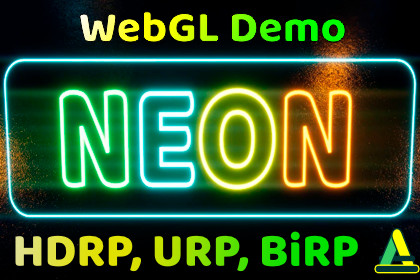
Animated neon signs, billboards and screens. One shader for URP, HDRP and Built-in with 25 transitions, 20 screen effects and atlas, flipbook or video sources. Full C# and HLSL source.Neon is a set of animated screens, billboards and neon signs for Unity 6.3. It is built around one shader, Neon/Billboard, which works in URP, HDRP and the Built-in Render Pipeline. A material made in one pipeline renders the same in the other two.WebGL demo Put a Neon material on a quad, add the NeonBillboard component and pick a source:Slideshow. Frames come from one texture atlas and change on a timer, with a transition between each pair.Flipbook. Frame animation that runs through a chain of atlases, each at its own frame rate.Video. A single clip or a playlist, with shader transitions between clips. Brightness can follow the audio.The shader has 25 transitions between frames, including crossfade, slides, dissolve, iris, radial wipe, card flip, pixelate, CRT off/on, glitch burst, TV static and shuffle tiles. It also has 20 screen effects that you enable per material: interlace, scanlines, LED matrix with RGB subpixels, chromatic aberration, block glitch, line jitter, vertical roll, TV snow, flicker, channel flicker, pulse, hue shift, ticker scroll, dead pixels, LCD viewing angle, grime, posterize and more. Effects you leave off add no cost.Neon signs use a segment mask. Broken letters flicker on their own, and PowerOn() lights the sign one segment at a time. NeonBillboardEcho draws a tunnel of fading copies behind a board.Any number of billboards can share one material. Each one picks its starting frame and timing from its world position, so a street full of screens does not change frames all at once.Included:Neon/Billboard shader with full HLSL sourceNeonBillboard and NeonBillboardEcho components with full C# sourceDemo scenes for URP, HDRP and Built-in: a night street and a grid of 193 effect materialsTest atlases, a neon sign with its segment mask, a test videoDocumentation Unity 6000.3 URP 17.3, HDRP 17.3 and Builtin Render Pipeline in one shader. The URP and HDRP SubShaders compile only when their package is installed, so the other pipelines get no shader errors Unlit HDR output, made for Bloom Surface modes: Opaque, Alpha, Additive. Cull mode per material, optional shadow casting 25 transitions and 20 effects. Each effect is a local shader_feature keyword SRP Batcher compatible (one UnityPerMaterial buffer), GPU instancing Atlas sampling with explicit gradients, no mipmap seams at cell borders URP: Forward, DepthOnly, ShadowCaster and Meta passes. Fog support. Emission bakes into lightmaps HDRP: ForwardOnly, DepthForwardOnly and ShadowCaster passes. Fog support. Exposure weight slider to switch between the URP look and physical exposure HDRP ray tracing: billboards appear in ray traced reflections and recursive rendering on DX12. Optional simplified mode for cheaper reflections Builtin: Forward, ShadowCaster and Meta passes, no SRP Core dependency Shader target 3.5 (URP, Builtin), 4.5 (HDRP) Video mode uses VideoPlayer and AudioSource with 3D audio rolloff. Audioreactive brightness from the audio spectrum. Video plays in Play mode only Custom material inspector with collapsible sections. The component inspector previews transitions in Edit mode Public API: Advance, Restart, PreviewTransition, PowerOn. A billboard can run on your own clock Deterministic slideshow and flipbook schedulers, covered by EditMode tests Glow needs Bloom. In the Builtin pipeline that means the Post Processing packageTextures generation via flux local model