


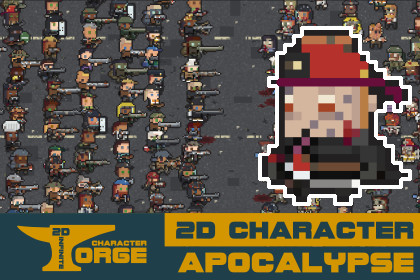
Create infinite animated pixel characters from different apocalypse scenarios with 2D Infinite Character Forge – a Procedural pixel character generator and animator.2D Infinite Character Forge – Apocalypse Edition is a procedural pixel-art character generator for end-of-the-world games. It has no pre-made sprite sheets. Every person is drawn by C# code, in the Editor or live at runtime, so you can create unlimited unique survivors, zombies, fungal hosts and mutants from a seed.Who’s in itThere are 22 roles in four groups. Authorities: police, riot police, firefighter, paramedic, soldier and hazmat trooper. Civilians: office worker, construction worker, doctor, nurse, chef, mechanic, farmer, student and business person. Survivors: prepper, looter, hunter, prison guard, prisoner and security guard. Scientists: a lab researcher. Each role has its own clothes, headwear, gear and colours. People vary by age, build, skin tone, hair, beards, glasses, scars and tattoos.Infection, step by stepAny person can be healthy or infected. Zombification has five stages, from a fresh bite to a decayed corpse with bare bone. Fungal infection has four stages, from threads under the skin to a head buried in growth. Mutation has four levels. The layers combine, so a rotting zombie can also be overgrown with fungus and mutated. Clothes and gear decay along with the body, but the uniform stays recognisable: a dead police officer still looks like a police officer. Mutants can grow into giants about 1.5× as tall. Giants are real larger sprites, not scaled ones, and can carry a minigun, flamethrower or plasma gun.Gear that tells the story of the outbreakEvery item has a material, a craft level and a condition, shown as dirt, rust, patches, tears, dents and blood. Outbreak phases age a whole outfit at once. On Day One gear is clean and as issued. After weeks it’s worn, after months it’s reinforced, and after years it’s mostly scavenged and taped together, with improvised side armour such as sports pads and taped magazines.Animated and game-readyThere are 20 animation slots: standard actions (idle, walk, run, jump, attack, shoot, reload, die and more), zombie-specific slots (Shamble, Lurch, Grab, Bite), Throw (grenade or Molotov) and Kneel Shoot. Animation events (shoot, attack, reload, throw, completed) let your gameplay react at the right frame. You can export PNGs, editable prefabs, baked animated prefabs with sprite atlases, or JSON presets.Fully customizableEverything is editable in the Editor window or through the runtime API. You can change role, phase, quality per slot, infection stage, and single details such as eye type per side, wounds, exposed bone, growths and colours. Characters are stored as serializable data, so you can generate, save, load and change them at runtime: for example, turn a survivor into a zombie when they’re bitten. You get the full C# source, and the engine is plain C# with no UnityEngine dependency.Suitable genresIt’s built for zombie, fungal-infection, mutant and post-apocalyptic games: survival, tower and horde defense, top-down and side-view shooters, roguelikes, strategy, colony and management sims, RPGs and tactics games. It works well wherever you need large crowds of distinct characters. The included Standoff demo generates almost two hundred characters live on a city street. The modern roles and catalog also suit present-day settings without the apocalypse, such as city, police, emergency-services or crime games.Included87 C# scripts, an Editor window and exporters, two demo scenes (Showcase and Standoff), optional URP lit-sprite shader, 48 EditMode tests and full English documentation. No dependencies required. Works on all Unity platforms. Unity 2022.3 or newer.Scope: The package is visual only. Animations, infection and gear wear are graphics; movement, damage, infection spread and AI are handled by your game.Package type: Editor tool + runtime library (procedural 2D pixel-art character generator). No pre-made sprite sheets: all character art is generated by C# code in the Editor or at runtime.Generated imagesFrame size: 112×80 px by default (32×32 style canvas plus padding for animations; the style canvas can be set from 16 to 128 px). Giant characters use a canvas 8 px larger each way (120×88 px by default).Characters are about 18–24 px tall and giants about 29–35 px. Sprites are never scaled, so a giant just has more pixels at the same pixel size. The sprite pivot is at the feet, and the default is 16 pixels per unit.Color depth: 32-bit RGBA (Texture2D RGBA32, point filtering, no mipmaps)Transparency: binary alpha (fully transparent background). The only partial alpha is a few spark pixels on the plasma gun’s charge frame.Export: PNG (integer scale 1–16×), editable prefabs, baked animated prefabs (sprite atlas per animation), JSON presetsContent22 roles in 4 groups (Authorities, Civilians, Survivors, Scientists); humans only, with 3 ages, 5 builds and 8 skin tones; unlimited variations from seedsInfection layers that can be combined: zombification (5 stages), fungal infection (4 stages, 3 growth forms, 5 fungus colours), mutation (4 levels); giant mutant body option (about 1.5× as tall)Gear quality on 7 slots (material, craft, condition 0–100, 7 grades) and 4 outbreak phases (Day One, Weeks, Months, Years) that wear gear down, reinforce it and replace it33 weapons (including minigun, flamethrower and plasma gun), 20 headwear types, 24 outfits, 12 armour pieces, 6 shields, 9 packs/bags; home-made prostheses20 animation slots: Idle, Walk, Run, Jump, Die, Hurt, Block, Celebrate, Attack, Roll, Reload, Attack1, Attack2, Shoot, Shamble, Lurch, Grab, Bite, Throw, KneelShoot (3–12 frames each)Included files: 87 C# scripts, 2 demo scenes, 17 documentation preview images (4 PNG, 13 animated GIF), documentation (Markdown)ArchitecturePure C# engine (no UnityEngine dependency) and thin Unity components (PixelCharacterView, PixelCharacterAnimator)Editor window, inspectors, prefab exporterSeparate assembly definitions: Runtime, Editor, Samples, TestsMain API: ApocalypseLibrary.Generate / GenerateInfected, CharacterAnimationRenderer.RenderFrame, PixelCharacterView.SetRole / SetPhase / SetZombieStage / SetFungalStage / SetMutationLevel / SetBody / SetEquipment, plus animation events (ShootMoment, AttackMoment, ReloadMoment, ThrowMoment, AnimationCompleted)Characters are serialized as JSON-compatible data (CharacterDefinition)Independent namespaces, assemblies and GUIDs, so it can be installed alongside other Infinite Character Forge editionsDependencies: None required. Optional: URP + Shader Graph for the included lit sprite shader; Unity Test Framework for the included EditMode tests (48).Platforms: All Unity platforms (managed C# only, no native plugins). On WebGL, generation runs on the main thread; on other platforms the demo uses worker threads.Limitations: Animations, infection and gear quality are visual only. Movement, projectiles, collision, damage, durability, infection spread and AI are handled by your game. Effects (muzzle flash, flames, plasma, tracers) are drawn into the sprite frames as plain pixel colours: there are no particle systems, emission masks or glow layer. The zombie animation slots draw characters unarmed. No vehicles or animals.Unity version: 2022.3 or newer (Built-in render pipeline or URP)Design helpBug huntProblem solvingDevil's advocatePackage creation