








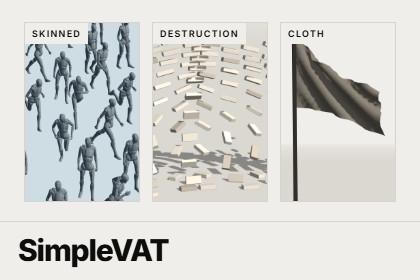
SimpleVAT turns motion into lightweight animated meshes. It bakes the motion into textures, and a URP vertex shader plays them back entirely on the GPU. The result is a plain MeshRenderer that animates with no Animator, no bones, no CPU skinning and no physics at runtime, so you can fill a scene with crowds, armies, crumbling walls and waving flags.Three kinds of motion, one playerSkinned Clips: any model with SkinnedMeshRenderers and its animation clips, as in 1.x.Rigid Simulation (new): rigid-body destruction, simulated by Unity's own physics in Edit Mode.Recording (new): anything that moves in Play Mode, recorded by the VAT Recorder component: cloth, mesh deformers, skinned meshes driven by gameplay, rigid bodies.All three play on the same VATAnimator with the same API: Play("Explode"), IsFinished, NormalizedTime, Speed.Destruction without HoudiniSimulating destruction offline and replaying it from textures is a well-known Houdini workflow. SimpleVAT does it inside Unity. Give every piece of a pre-fractured model a Rigidbody and a Collider, set an explosion origin, force and radius, and press Bake. The pieces are simulated in a separate physics scene, so your open scene is never touched, and the same input gives the same bytes. Only one position and one rotation per piece per frame are stored: a 200-brick wall exploding for 3 seconds at 30 fps is a 200 × 91 texture pair, about 0.3 MB. Replay it a hundred times at once with no physics cost.There is no fracture tool: bring your own pre-fractured mesh, for example from Blender's Cell Fracture add-on.Record anything in Play ModeAdd a VAT Recorder, press Record, then Stop. Cloth, procedural deformers and skinned meshes are recorded per vertex, rigid bodies per piece. Samples are taken at an exact frame rate whatever the game's frame rate, the Inspector shows the memory before and during recording, and Max Duration stops it for you. Recording again with the same clip name replaces the clip.Skinned charactersDrop in any model with SkinnedMeshRenderers; its clips are added for you. Press Bake: the merged mesh, materials and textures are stored inside the asset, and a ready-to-use prefab is generated. VATAnimator gives you GPU cross-fades, phase-synced blends such as walk/run driven by a speed value, and random start times so copies don't move in lockstep. New in 2.0: the Combined layout puts every clip in one texture pair, and LOD Level bakes a single level of a model with an LODGroup.The Inspector does the bookkeepingIt catches setup problems before you bake, shows the vertex or piece count, frames and texture memory the bake will use, tells you when the source or settings changed, and switches every baked material between Lit and Unlit in one click. A live animated preview plays every clip, blends and destruction included.ShadersSimple Lit supports main light shadows, ambient light and fog. Simple Unlit shows just the base map and color. Both cast shadows, have depth and depth-normals passes for SSAO, and work in the Forward, Forward+ and Deferred rendering paths. Want VAT in your own shader? Include VAT.hlsl and call one macro, or use the Custom Function node in Shader Graph.Free update from 1.xExisting sets, prefabs and custom shaders keep working with no re-bake.Need tens of thousands of characters?SimpleVAT Crowd, a separate package, draws Combined sets with no GameObjects, with GPU culling and LOD. It includes SimpleVAT.DemoA brick wall exploding in a 10 × 10 grid, collapsing walls, a toppling tower, cloth flags and wobbling jelly cubes, all generated by editor scripts, plus the scene the flags and jelly were recorded in.What it doesn't do: it has no fracture tool, the debris has no colliders at runtime (it is a replay), and the shaders write no motion vectors for TAA or motion blur.Screenshots of characters use the free Unity Starter Assets Third Person character (not included).