



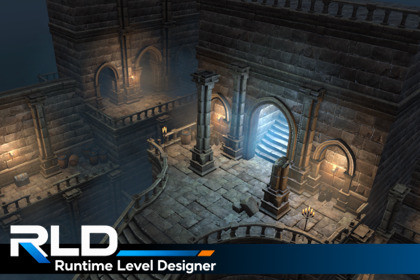
Build powerful runtime level editors in Unity with modular construction, procedural spawning, snapping, selection, Undo/Redo, scene persistence, and more.RLD is a complete runtime level-authoring framework for Unity, built for runtime level-editing applications, sandbox construction systems, user-generated-content workflows, and dedicated level-design tools.Instead of assembling separate runtime gizmo, snapping, placement, hierarchy, prefab, UI, Undo/Redo, and persistence systems, RLD provides them as one integrated editing environment.From modular construction and surface placement to paths, volumes, scatter painting, retained curves, runtime inspection, and editable scene documents, RLD provides the foundation for building serious runtime level-design tools.🛠️ Looking for level design inside the Unity Editor?Check out GSpawn – Level Designer, a powerful level-design plugin built directly for the Unity Editor.⠀📷 Trailer📖 Documentation🎮 Downloadable DemoTutorials▶ RLD Tutorial 1 - Setup & UI overview▶ RLD Tutorial 2 - Modular Environments I (Basics)▶ RLD Tutorial 3 - Modular Environments II (Modular Actions)▶ RLD Tutorial 4 - Modular Environments III (Spawn Actions)▶ RLD Tutorial 5 - Outdoor Environments I (Props Spawn)▶ RLD Tutorial 6 - Outdoor Environments II (Curve Spawn)▶ RLD Tutorial 7 - Outdoor Environments III (Scatter Brush)▶ RLD Tutorial 8 - Object GroupsPurpose-Built Runtime Level DesignRLD goes beyond a generic runtime editor by providing dedicated workflows for constructing levels.Build modular structures, place props directly on surfaces, create repeated layouts along paths, fill grid-aligned volumes, paint scattered content, and author retained Catmull-Rom curves that remain editable after creation.All of these systems share the same selection, prefab identity, Object Groups, scene queries, Undo/Redo, hierarchy, configuration, shortcuts, and persistence infrastructure.⠀Runtime Authoring EnvironmentRLD includes a complete dockable runtime workspace with:Hierarchy ViewRuntime InspectorPrefab ManagerObject GroupsDockable and floating windowsSaveable workspace layoutsRuntime settings and configurable shortcutsStyle customizationRuntime ConsoleIntegrated runtime Undo/RedoDedicated Erase toolsRuntime creation of supported primitives, lights, audio objects, cameras, empty objects, and Object GroupsSelection and EditingRLD supports:Single and multi-object selectionRectangle SelectionSelection Path3D Selection BoxGrid-level selectionSelect ConnectedSelect Similar PrefabsIsolation and RestoreConfigurable selection filtersPrefab replacementSelection BridgeGroup rotationNon-destructive transform randomizationDirect manipulation tools include Move, Rotate, Scale, TRS, Box Scale, Extrude, and Mirror, with configurable Pivot/Center and Global/Local transform spaces.⠀Snapping and PlacementRLD provides several specialized snapping workflows:Grid Snap for modular constructionModular Snap with optional Grid ClimbSurface Snap for placement against scene geometryBox SnapVertex SnapProjectionEach system is designed around a different level-design task rather than forcing every placement problem through one universal snapping mode.⠀Spawn ToolsRLD includes dedicated runtime spawning workflows:Modular Spawn — fast modular constructionProps Spawn — surface-based prop placementPath Spawn — repeated placement along authored pathsBox Spawn — grid-aligned volume constructionScatter Brush — spacing-aware prefab paintingCurve Spawn — retained Catmull-Rom curves with generated contentSpawn Mirror can reflect Modular, Path, Box, and Props output through one or more construction planes while preserving the normal spawning workflow.⠀Procedural Authoring SystemsRLD also includes higher-level authoring systems:Random Prefab Profiles for weighted prefab variationCell Layout Providers for procedural Path and Box layoutsModular Actions for reusable modular construction behaviorSpawn Actions for reusable contextual spawningCurve Spawn ProfilesObject Group routingThese systems operate through the same prefab, scene, persistence, and Undo/Redo infrastructure as the rest of RLD.⠀Scene Documents and ExportRLD includes editable .rldscene documents with New, Open, Save, and Save As workflows.Application configuration and workspace layouts can also persist through RLD.rldconfig and .rldlayout files.For projects that require their own level format, RLD provides a controlled Export API. Exporters receive a read-only, reconstruction-oriented representation of the authored scene containing identifiers, hierarchy relationships, transforms, prefab GUIDs, and supported scene data.RLD's native Save and Export systems are not designed to embed source prefab assets, Meshes, Materials, Textures, AudioClips, or similar third-party asset payloads.Developers remain responsible for ensuring that third-party content is used and distributed according to its applicable license.⠀RequirementsRLD is built for the Universal Render Pipeline (URP), uses Unity's Input System, and relies on Render Graph APIs. Built-in Render Pipeline and HDRP support should not be assumed.⠀Third-Party AssetsThe RLD demo, screenshots, tutorials, and promotional material may feature the following third-party environment assets:FANTASTIC - Village Pack — Tidal Flask StudiosFANTASTIC - Dungeon Pack — Tidal Flask StudiosMultistory Dungeons — Mana StationKUBES - Voxel-Style Modular Worldbuilder Kit for Unity — Zerin LabsThese assets are used for demonstration purposes only and are not included with RLD.Any other third-party environments, props, textures, audio, characters, or assets shown in screenshots, tutorials, videos, trailers, or demonstration scenes are also not included with RLD unless explicitly stated otherwise.SupportUnity Discussions | octamodius@yahoo.comAI tools were used extensively during the development of RLD, including for implementing portions of the codebase, debugging, code review, documentation, and marketing content. AI was also used to assist with some promotional graphics. All AI-generated or AI-assisted code and content was reviewed, integrated, tested, and refined as part of the normal development process. The overall architecture, feature design, product direction, and final release decisions were directed by the publisher.