






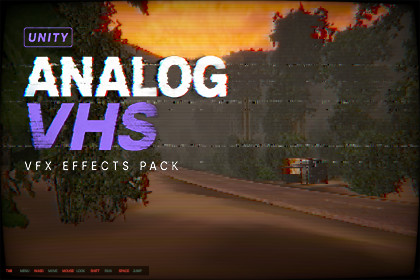
Complete retro VHS & CRT post-processing: tape artifacts, interlacing, composite color, 13 grade looks and halation. Built-in, URP, HDRP.💬 DISCORD | 📖 DOCUMENTATION | 🎮 DEMOAnalog VHS turns any camera into a worn tape deck, a broadcast monitor or a haunted camcorder. A single AnalogVhsEffect component carries the whole effect — nine independent modules following the signal chain from the lens to the glass of the tube — and renders them in shared fullscreen passes across all three Unity render pipelines.The settings live on the component. There is no profile asset in the middle, so what the inspector shows is what renders, and a slider you drag in Play mode changes the picture on that frame instead of quietly editing an asset you will have to undo later.Everything a retro look normally needs from a separate post-processing stack — colour grading, bloom, chromatic aberration and lens dirt included — is built in.Presets are a library you copy in and out of: load one to start from a security-camera feed, a damaged rental tape, a found-footage horror sting or a clean arcade CRT, then tune it in place and save it back out when you like it.Nine modules, all on the camera — Lens, Retro Resolution, Tape Artifacts, Distortion, Composite Signal, Colour Quantization, Colour Grade, Bloom and CRT Screen, in the order light travels through them. Each has a master toggle, and a module that is off costs nothing.Presets load and save — one asset per look, with Load / Save / Save As on the component. A preset is a snapshot, never a live reference, so nothing you tweak at runtime can write back into a shipped asset by accident.Real chromatic aberration — lateral dispersion along the radius from the optical axis, sampled as a spectral smear rather than three offset copies: zero in the centre, widening toward the corners, with a falloff exponent that matches it to a given piece of glass.Lens dirt — dust, grease and cleaning scratches on the front element, lit by the halation behind them and aspect-fitted rather than stretched to the viewport.Film grain from a real plate — chroma grain scaled by the picture's own brightness plus a finer luma octave, re-offset every frame so it crawls instead of sitting still.Tape stripe noise — the ragged bright dashes of a worn track, clustered into drifting horizontal bands by a separate row-selection plate rather than sprayed evenly over the frame.Plug and play — no external post-processing volume required: the colour grade and the halation pyramid are part of the effect.13 built-in colour looks — VHS Tape, Worn Tape, Retro Film, Faded Photo, Sepia, Monochrome, Sun Bleached, Cold Broadcast, Neon Night, Technicolor, Security Cam, Warm Eighties and Polaroid — pick one, or start from it and dial in your own.Analog-horror toolkit — a drifting tracking line that collapses a band of rows onto one, per-line hue phase error, wavy scanline distortion and horizontal tape smear.Real bandwidth-limited color — luma stored at half resolution and re-sharpened with an unsharp mask, chroma at ~1/16 resolution with horizontal delay: the actual mechanism behind composite-video bleed, not a blur filter.Horizontal tape smear — brightness drags to the left of every edge, one-sided the way a luma channel that cannot follow a hard transition actually behaves, and energy-normalized so widening it never brightens the picture.True interlacing — alternating line groups hold the previous field at a configurable field rate, so motion combs and fine detail flickers the way a real interlaced signal does.Composite crosstalk — Gibbs edge ringing, crawling dot-crawl checker and false-colour rainbowing on fine detail.One place for colour — the tape levels and the chroma response used to sit in the signal module and duplicated the grade's own saturation and lift. They are folded into Colour Grade now, so a pixel is graded exactly once and there is one place to look when a preset reads wrong.CRT screen model — a quartic barrel curvature that keeps the middle of the glass flat and the bulge in the corners, edge-pinned so the tube always fills the display, behind an antialiased rounded border; plus scanlines — either a cheap mask or a full beam reconstruction that rebuilds each pixel from the two raster lines around it, with a beam that fattens as the line brightens — radial beam convergence error, a fifteen-architecture phosphor mask whose triads tile exactly with the Retro Resolution pixels, full-frame flicker, a TV-style vignette and phosphor afterglow, all bowing with the same curved glass as the picture.One-click pipeline setup — Tools > Deepwave > Analog VHS > Setup Current Pipeline diagnoses and wires up whatever the active pipeline needs.20 ready-made presets — from a clean VCR to full signal chaos — plus a demo scene with first-person controls and a runtime settings menu that exposes every parameter.Built for speed — the signal pass carries film grain, stripe noise and the tracking line for less than earlier builds did without them, because two overlapping tracking systems and duplicated colour levels came out. The noise buffer is capped at 720 lines, the whole colour grade folds into two gain/offset pairs and one 3×3 matrix on the CPU, the halation pyramid is a 4-tap bilinear dual filter, and the three heaviest features — chromatic aberration, the beam raster and the phosphor mask — are shader variants rather than uniform branches, so a look that does not use them never carries their registers.Pipeline independent — Built-in via OnRenderImage, URP via a RenderGraph Renderer Feature, HDRP via a Custom Pass. No pipeline package is referenced by the shared shader library.