



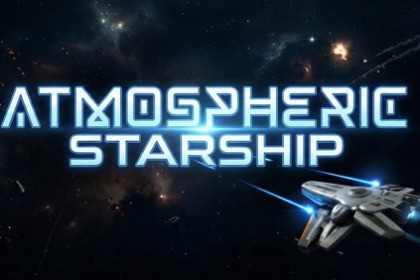
A robust atmospheric flight system with advanced drag & G-force physics. Includes modular Dogfight AI, missile systems, and a complete 1024km² sandbox environment to build in.The Atmospheric Starship Controller scripts and physics systems are fully compatible with the Built-in Pipeline, URP, and HDRP. While the included demo scene utilizes URP materials, the core framework is pipeline-agnostic. You can adapt the demo assets to other pipelines by replacing the URP shaders with standard equivalents for your specific project.Veridian Atmospheric Starship is a production-grade flight framework engineered for arcade-style combat and atmospheric exploration in Unity’s Universal Render Pipeline (URP).Designed with modularity as a priority, it provides a complete gameplay loop—from physics-based aerodynamics and input handling to a robust Utility AI system—without the overhead of rigid, monolithic scripts. Whether you are building a "Rogue Squadron" style shooter, a racing game, or an open-world sandbox, this asset offers the foundational architecture required to get ships flying immediately.A Note from the Developer:Thank you for checking out the Veridian Atmospheric Starship framework! I am providing this asset to the Unity community completely for free out of my own generosity. I make no profit from this release, and my hope is that you can learn from the codebase, dissect the architecture, and potentially use it as a strong foundation for your own projects.Because this is a free asset, please understand that I cannot reasonably answer every support question or provide custom tutorials to make this framework fit into everyone’s specific game design. However, I am committed to maintaining the core codebase and fixing genuine errors. If you find a bug, I definitely want to know about it!I highly appreciate your feedback. If you find this asset useful, educational, or fun to play with, please consider taking a moment to leave a review. I am also always open to hearing your suggestions for features, improvements, or changes.Finally, I plan on releasing an expanded, highly optimized, and feature-rich paid version of this asset within the next few months. That premium version will come with dedicated, in-depth support. If you enjoy this free preview, please consider checking out the full release when it launches!Physics-Driven Flight DynamicsThe core of the framework is the AtmosphericStarshipController, a Rigidbody-driven system that balances realistic laws of motion with the responsiveness required for arcade gameplay. It moves beyond simple transform translation, calculating forces to simulate weight, drag, and propulsion.Advanced Aerodynamics: Implements a custom drag model that calculates linear and quadratic drag based on velocity, simulating atmospheric density. It features directional drag (allowing for drift mechanics) and ground effects that create a "cushion" of lift when flying low.G-Force Simulation: Includes a G-Force governor that limits turn rates at high speeds to prevent unrealistic maneuvers, adding weight and consequence to pilot inputs.Scalable Fidelity (Physics vs. LERP): Engineered for scale, the controller features a dual-mode system. While the player and nearby enemies use full physics simulation, distant AI agents automatically switch to a low-cost Kinematic LERP mode to maintain high frame rates in large-scale battles.Modern Input Integration: Built entirely on Unity’s New Input System, complete with rebindable action maps for Mouse/Keyboard and Gamepad support.Modular Utility AI SystemThe asset features a decentralized AI architecture that separates high-level decision-making from low-level flight execution. This "Brain vs. Hands" approach allows for complex, non-cheating AI behavior that adheres to the same physics limitations as the player.The Pilot & The Brain: The AiBrain handles strategic decisions (Targeting, State Switching), while the SimpleAiPilot handles the execution, using PID controllers to fly the ship toward navigation goals. This ensures AI pilots actually "fly" the ship rather than sliding along a rail.ScriptableObject Behaviors: AI behaviors are modular and data-driven. You can create and tune complex behaviors—such as Patrol, Dogfight, Interceptor, and Sentry—entirely through ScriptableObject profiles, allowing for rapid iteration of enemy personalities without recompiling code.Squadron & Faction Logic: A centralized FactionManager handles team rosters, differentiating between Leaders and Wingmen. The AI utilizes this tactical data to form squads, execute coordinated attacks, and respect engagement/disengagement zones.Integrated Combat SuiteThe asset includes a fully operational combat layer managed by the ShipWeaponController and HealthComponent, designed to support diverse weapon types and damage models.Multi-Role Weaponry: Support for primary energy weapons (Lasers with accuracy falloff), secondary ballistics (Unguided Rockets and Guided Missiles with target locking), and heavy bombardment payloads (Gravity Bombs).Predictive Targeting: The AI leverages a first-order interception calculator to lead targets based on projectile speed and enemy velocity, ensuring capable and dangerous opponents rather than static turrets.Gimbal & Turret Logic: Weapons feature configurable gimbal constraints, allowing hardpoints to rotate and track targets independently of the ship’s nose, within defined arcs.Lifecycle Management: A robust health and shield system handles damage mitigation, shield regeneration, and death sequences, including automated respawning via the Faction Manager.Massive Sandbox EnvironmentTo demonstrate the scalability of the framework, the package includes a massive, production-ready demo scene (1024km² playable area) built for the Universal Render Pipeline (URP).Open World Architecture: The scene features 5 distinct 64km² islands, each populated with unique biomes, alien flora, and rocky terrain.Live Faction Warfare: The environment is populated by two opposing factions with distinct "Home Bases." You will encounter AI squads flying patrol routes, engaging in dogfights, and defending strategic locations with ground-based turrets.Free Art Assets: Includes a library of production-ready assets, including Starship prefabs (Player and Enemy variants), modular buildings, turrets, and environmental assets (alien trees, rocks).Architecture & ConfigurationThe system emphasizes a Profile-First Workflow, utilizing ScriptableObjects to decouple configuration from code. This ensures that designers can tweak the "feel" of the game without modifying scripts.Data-Driven Profiles: Define ship handling (StarshipProfileSO), AI personalities (FlightPersonalitySO), and weapon statistics (WeaponStats) as reusable assets.Decoupled FX & UI: Core logic broadcasts state changes via C# Events. The included StarshipFXController and StarshipHUDManager listen for these events to handle visual effects (thruster particles, muzzle flashes) and UI updates, keeping the core physics loop clean.Ecosystem & RoadmapVeridian Atmospheric Starship [Lite] is a free preview of the upcoming full Atmospheric Starship Controller. It serves as both a standalone framework and a demonstration of the Veridian performance ecosystem:Integration with BurstLOD: This controller is the foundation for the [BurstLOD] runtime demo. When paired with BurstLOD, the ships in this kit support runtime mesh sculpting—allowing lasers to carve holes in armor and rockets to physically dent hulls in real-time.Optimized by VeridianImpostors: The massive density of the demo environment is made possible by [VeridianImpostors], which handles the high-performance rendering of the distant alien forests and background infrastructure.Core Physics & Controller ArchitectureThe foundation of the asset is the AtmosphericStarshipController, a robust rigidbody-driven system designed to decouple flight logic from input sources. Interface-Driven InputThe system relies on the IShipDriver interface pattern. This abstraction allows the controller to accept inputs from any source—whether it’s the PlayerShipDriver (via Unity Input System) or the SimpleAiPilot—without modifying the core physics loop. This ensures that AI agents are subject to the same physical limitations and flight envelopes as the player. Advanced Aerodynamic ModelMoving beyond simple drag, the controller implements a custom aerodynamic simulation that calculates:Linear & Quadratic Drag: Simulates air resistance that scales exponentially with speed, allowing for realistic terminal velocities and "energy bleeding" during maneuvers.Directional Drag: applies differential drag coefficients to forward vs. sideways motion, preventing ships from sliding indefinitely like zero-G craft while still allowing controlled drifting.G-Force Governance: A built-in limiter monitors angular and linear acceleration, automatically throttling inputs to keep G-forces within a survival threshold defined by the ship’s profile.Modular Utility AI & Pilot SystemThe AI architecture employs a decentralized "Brain vs. Pilot" model, separating high-level strategy from low-level execution. The "Brain" (Decision Layer)The AiBrain operates on a configurable "Think Cycle" to evaluate the environment. It utilizes a prioritized list of AiActionSO (ScriptableObjects) to select behaviors. This structure supports complex decision trees, such as:Conditional Logic: Evaluates health, proximity, and role (Leader/Wingman) to switch states.Hysteresis: Uses distinct Engage/Disengage distance thresholds to prevent state-flickering during combat.Behavior Factory: Instantiates behaviors (e.g., BehaviorAttack, BehaviorPatrol) only when needed, keeping memory usage efficient.The "Pilot" (Execution Layer)The SimpleAiPilot translates the Brain's navigation goals into raw flight inputs. It features a PID Controller (Proportional-Integral-Derivative) flight style, which smooths out rotation and thrust errors. This allows for precise formation flying and organic, non-jittery movement updates that look indistinguishable from player control.Sensory & Tactical IntelligenceProvider-Based Sensory SystemThe ShipSensorySystem uses a Provider Pattern (ISensorProvider) to abstract physics queries. This allows the system to perform:Ground Detection: Calculates altitude for ground-effect physics and safety overrides.Obstacle Avoidance: Uses a state-driven scanner that switches from passive forward checks to active, multi-ray searches when an obstacle is detected, generating escape vectors for the pilot.Centralized Faction ManagementThe FactionManager acts as the tactical authority for the scene. It maintains optimized registries of all active ships, bases, and waypoints. Instead of expensive FindObjectsOfType calls, AI agents query the Manager for instant access to:Squadron Logic: Identification of friendly Leaders vs. Followers.Threat Assessment: Rapid retrieval of the nearest hostile targets sorted by distance.Lifecycle Events: Centralized handling of respawn timers and object pooling logic.Profile-First ConfigurationSimilar to the BurstLOD workflow, this asset centers around ScriptableObjects to decouple data from logic. This allows designers to tune the game feel without recompiling code.StarshipProfileSO: Defines the physical mass, engine power, maneuverability curves (agility vs. speed), and boost capacity.FlightPersonalitySO: Defines the AI pilot's skill level—tuning their PID gains, aggression, and error tolerance.WeaponStats: Configures fire rates, projectile prefabs, and guidance logic (locking angles, range).EnvironmentProfileSO: Sets global constants for gravity and atmospheric density, allowing for different "planet" feel settings.Scalability & OptimizationDual-Mode Simulation (Physics vs. LERP)To support massive scenes (like the included 1024km² demo), the controller features an automatic LOD system for Physics.Physics Mode: Nearby ships use the full Rigidbody simulation for accurate collision and interaction.LERP Mode: Distant AI agents automatically switch to a Kinematic Linear Interpolation mode. This drastically reduces CPU load by bypassing complex drag and G-force calculations while maintaining visual movement fidelity.Event-Driven VFX & UIThe StarshipFXController and StarshipHUDManager utilize a C# Event-driven architecture. This ensures that visual effects (particles, sound) and UI updates only consume resources when state changes occur, rather than polling data every frame.Upcoming Full Version FeaturesThe upcoming full release of the Atmospheric Starship Controller will expand upon this foundation with a comprehensive suite of advanced systems:Advanced Avionics: Includes a fully integrated Minimap and a significantly improved targeting system.Expanded Combat: Features enhanced weapon guidance logic and a new physics layer for high-fidelity starship collisions and explosions.New Environments: Includes a dedicated Space Demo Scene and a specialized Racecourse Scene for testing high-speed maneuvers.Next-Gen AI: Deploys a fully expanded Utility-Driven AI system for complex, autonomous decision-making.Third-Party Notices:Asset uses Sci-Fi Sounds by Kenney under the CC0 License; see the Third-Party Notices.txt file in the package for details.DocumentationAtmospheric Starship Controller (Demo Controller): https://docs.google.com/document/d/1bK8_wqpfBkHQ05B-Yrv6QLEylCNeUeeQzIWG-dmVrLk/edit?usp=sharingBurstLOD (Core System & Runtime API): https://docs.google.com/document/d/1Sk9thBSGfofy9_fclAIcv66rbWjJ4WfckWfhqC3beGU/edit?usp=sharingGenerative AI was used to create several 3D models (meshes) provided exclusively within the optional demo scene. This content is not integral to the core asset's functionality.