


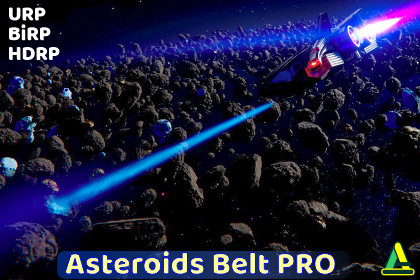
Huge GPU asteroid belts for Unity 6: hundreds of thousands of unique, lit rocks at a tiny cost. Mine, push and shatter asteroids at runtime. URP, HDRP and Built-in RP.Fill your space scenes with hundreds of thousands of unique, fully lit asteroids, and let players mine, push and shatter them.WebGPU LIve DemoAsteroid Belt Pro draws huge asteroid belts on the GPU. Visibility, level of detail and shadows are decided on the graphics card every frame. A belt of 200,000 rocks is processed in about 0.13 ms (RTX 3060) and drawn in two draw calls per layer: one for the rocks, one for their shadows. There is no GameObject per rock, no per-frame CPU work and no garbage collection.UNIQUE ROCKS, MADE IN THE EDITORThe built-in rock generator makes real rock shapes instead of deformed spheres: rounded rubble, chunks, sharp shards, ice and metal nuggets. Every shape comes with its own chain of LODs that keeps sharp edges and the silhouette, so distant rocks stay crisp at a fraction of the triangles. Each rock also gets its own size, proportions, tint, brightness, hue and metal color, so no two rocks look the same. A live preview lets you check any shape, LOD and material before you bake.A BELT THAT FEELS ALIVEBuild circular or elliptical belts of any size, thickness and density. Tilt them by rotating the transform. Inner rocks overtake outer ones like in a real orbit, and every rock spins on its own axis. The same seed always gives the same belt, and pausing, slowing down or speeding up time costs nothing.MINE, PUSH AND FRACTURE- Rocks near your ship get physics colliders automatically and return to the belt seamlessly when you fly away.- Push rocks and watch them collide. Chain reactions stay local, so one push never stirs up the whole belt.- Break rocks into pieces. The pieces settle as debris or crumble to dust.- The mining beam dents the rock, shrinks it, makes the hit point glow and pulls pebbles toward your ship. An empty rock crumbles and leaves the belt.- Resources: define your own or use Gold, Ice and Regolith. Set each one's share and the belt's total reserve. Most rocks are poor and a few are rich, and rich rocks can switch to a matching material. Save and load the belt reserve between sessions.- Ray-pick any rock in the whole belt, read its content and mass, and react to events: resource extracted, rock depleted, rock fractured, belt depleted.ONE SHADER, THREE PIPELINESURP, HDRP and the Built-in Render Pipeline are supported out of the box. Rocks use each pipeline's standard PBR lighting, with shadows, additional lights, reflection probes, SSAO and fog. Adaptive Probe Volumes are supported in URP, and HDRP volumetric fog works too. The asset includes eight materials (Default, Rock, Metal, Gold, Copper, Ice, Ice Light, Small Fast), with opaque ice that has fresnel and light scattering from behind.FROM LAPTOP TO CINEMATICQuality profiles control how many rocks are visible, LOD distance, shadows, surface detail and optional extras: smooth LOD cross-fade and close-up tessellation (URP). Desktop, Cinematic and a lightweight Mobile profile are included.READY IN A MINUTEPick one of six ready belts from the GameObject menu and press Play. The inspector has clear sections, drag handles in the Scene view, live statistics and debug views. The scripting API is documented.DEMOThe asset ships with a belt around a planet, a playable mining mini-game (fly, mine, push, fracture, save and load) and volumetric dust for URP. Each scene comes in a URP, HDRP and Built-in version.Perfect for space games, sci-fi environments, space shooters, mining and trading games, and cinematic shots.Note: version 2 is a full rewrite and is not compatible with scenes built on version 1.Rendering Hundreds of thousands of rocks per belt (up to 1,048,575 per layer) GPU visibility, LOD and shadow selection: 200,000 rocks in 0.13 ms (RTX 3060, DX12) Two draw calls per layer: rocks and shadows No GameObject per rock, no per frame CPU work, zero GC allocations Rocks outside the view still cast shadows into it Works with any number of cameras, including the Scene view; optional rendering into reflection probesRock Generator 5 ready rock libraries: Rounded Rubble, Chunk, Shard, Ice, Metallic Nugget Up to 32 shapes per library, 2 5 LODs each, with sharp edges preserved Live preview with LOD comparison and material try on Bake of 16 shapes x 4 LODs takes about 10 secondsBelt Circular or elliptical belts with thickness, vertical and radial density curves Kepler style orbits, adjustable speed spread, per rock spin Deterministic by seed; pause and time scale at no cost; animated in Edit Mode Multiple layers per belt, each with its own rocks, material, count, size range and color variation Per rock size, proportions, tint, brightness, hue and metal color variationInteraction and Mining Automatic colliders for rocks near interactors (pooled) Push, collisions with limited chain reactions, settling back into orbit Fracture into 2 8 pieces; pieces become debris or dust Mining beam with dents, shrinking, hit glow and flying pebbles Resource system: custom resources, shares, total reserve, rich and poor rocks, material by dominant resource Save and load the belt reserve (JSON ready) Async raycast over the whole belt, rock info queries and gameplay eventsMaterials and Shader One shader for URP, HDRP and Built in RP Standard PBR lighting of each pipeline: shadows, additional lights, reflection probes, SSAO, fog URP: Forward+, light layers, cookies, Adaptive Probe Volumes HDRP: full Lit light loop, volumetric fog, exposure aware mining glow 8 materials: Default, Rock, Metal, Gold, Copper, Ice, Ice Light, Small Fast Opaque ice with fresnel and back scattering Optional LOD cross fade and close up tessellation (URP)Workflow 6 ready belt prefabs: Rocky, Ice, Metal Rich, Mixed Dense, Sparse Debris, Sun Ring UI Toolkit inspector with Scene view handles, live stats and debug views Mobile, Desktop and Cinematic quality profiles Documented scripting API and full manual