



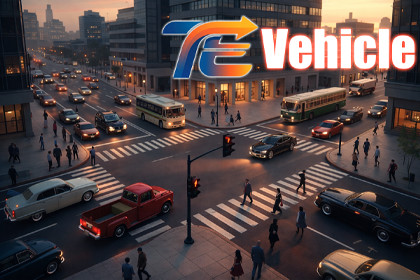
High-performance DOTS-based vehicle simulation plugin with physics-based movement, AI traffic behavior, and LaneGraph integration for realistic traffic systems in Unity.Unity Version Requirements:Unity 6000.0 or higherRequired Package Dependencies:Unity.EntitiesUnity.Entities.GraphicsUnity.Vehicles (v0.1.0-exp.1)Unity.PhysicsUnity.MathematicsUnity.CollectionsLane Graph100% Real Physics. 100% DOTS Performance. Built for Scale.Featured in 📺 CodeMonkey's Top 10 Unity Tools📖 Documentation | 💬 Discord | 📧 Email SupportTraffic Engine - Vehicle delivers authentic Unity.Vehicles physics simulation built entirely on Unity's DOTS architecture. Experience genuine vehicle dynamics with suspension, tire physics, and realistic steering — all running through ECS, Burst-compiled jobs, and native collections for exceptional performance at any scale.Physics ImplementationFull Unity.Vehicles integration with real suspension and tire grip dynamicsPhysics-based steering that responds naturally to road curves and conditionsGenuine vehicle mass, acceleration, and braking characteristicsKinematic fallback mode for distant or lower-priority vehicles, selectable per prefabEnterprise-Grade DOTS ArchitectureBuilt from the ground up with Entity Component System for maximum efficiencyJob System and Burst Compiler integration for multi-threaded performanceHandle thousands of vehicles simultaneously with smooth frameratesMemory-efficient blob assets for 10,000+ lane networksFour-tier LOD system with frustum culling and per-entity importance biasSophisticated AI SystemsIntelligent perception system with vehicle-to-vehicle awareness using spatial hashingDynamic lane changing with gap detection, turn signals, and smooth transitionsMulti-strategy obstacle avoidance with emergency braking and dynamic classificationPredictive speed control for curves and intersection managementDual-strategy stuck detection with automatic respawn recoveryRealistic lateral lane positioning — vehicles gradually converge toward lane center naturallyAudio & VisualsPooled audio system with proximity-based source assignment and speed-modulated pitch/volumeFull lights system: headlights, brake lights, turn signals, hazard lights, and reverse lightsOptional animated driver character integration via the Animecs add-onDeveloper-First DesignPublic Burst-compatible API for simulation control, vehicle state queries, lane queries, and obstacle taggingCentralized debug visualization system with per-category toggles (zero overhead in release builds)Scene Validator window, custom authoring inspector, and editor tools for fast setupAll components and systems are public and designed to be queried or extended without modifying internalsTraffic Engine - Vehicle depends on Traffic Engine - Core (included, separate package) which provides the LaneGraph ECS integration and LOD system — automatically installed as a dependency.Note: Assets shown in promotional videos are not included. Traffic Engine provides the traffic simulation system only.Vehicle Components & SystemsTrafficVehicleAuthoring: Main vehicle configuration — classification, dimensions, bumper offsets, movement mode, physics settings, and all AI behavior parametersTrafficVehicleProfile (ISharedComponentData): Shared per-chunk physical and behavioral profile; vehicles sharing the same configuration share a single instance for memory efficiencyTrafficVehicleLightAuthoring: Individual light setup for headlights, brake lights, turn signals, hazard lights, and reverse lights; compatible with all render pipelinesTrafficVehicleAudioAuthoring: Per-vehicle audio configuration for engine, brake, horn, and idle sounds with proximity-based pooled AudioSource assignmentTrafficVehicleSpawnerAuthoring: Proportional multi-type spawning with spacing checks, lane tag filtering, and optional collider avoidance on spawnTrafficVehicleDriverAuthoring: Optional animated driver character integration via the Animecs add-on (requires TRAFFIC_ENGINE_ANIMECS define)Core SystemsTrafficVehicleAwarenessSystem (OrderFirst): Rebuilds the per-frame NativeParallelMultiHashMap for O(1) lane-indexed neighbor queries; owns the shared FrameCounter used for LOD throttlingTrafficVehiclePerceptionSystem: Vehicle-ahead detection, traffic signal compliance, and curve speed awarenessTrafficVehicleLaneNavigationSystem: Spline following with cumulative-distance projection, automatic lane-end transitions, and restricted lane filteringTrafficVehicleLaneChangingSystem: Gap acceptance against awareness map data, smooth lateral interpolation, and turn signal coordinationTrafficVehicleObstacleAvoidanceSystem: Swept box cast with Static / Dynamic / Kickable / Boundary classification and five response typesTrafficVehicleStuckRecoverySystem: Dual-strategy stuck detection (lane deviation + no-movement with BoxCast confirmation) with in-place ECB-based relocationTrafficVehiclePhysicsMovementSystem / TrafficVehicleKinematicMovementSystem: Dual-mode movement supporting full Unity.Vehicles physics or direct kinematic transformPerformance & ScalabilityFour-tier LOD system (High / Medium / Low / Culled) provided by Traffic Engine - Core. LOD assignment uses frustum culling and per-entity importance bias. Each system applies frame-skip throttling for Low LOD using a shared FrameCounter. All simulation code runs in Burst-compiled IJobEntity jobs. The VehicleAwarenessMap enables lane-indexed perception queries without scanning all entities.Public API - TrafficEngineVehicleAPI provides managed and Burst-compatible overloads for enabling/disabling vehicles, setting target speed, querying vehicle state, querying lane occupants, and tagging obstacles. TrafficEngineLaneGraphAPI and TrafficEngineLODAPI are provided by Traffic Engine - Core.Critical Setup RequirementsLane Connectivity: Even small gaps between lane endpoints can cause vehicles to stop navigating or behave erratically — validate all connections before testingLaneGraph Initialization: Must be initialized at runtime before vehicle spawning; TrafficVehicleSpawnSystem will not run until initialization is confirmedLane Curvature: Gradual curves strongly recommended — tight turns cause oversteer and lane deviation with physics steeringAuto Transmission: Physics movement requires Unity.Vehicles auto transmission enabled — configured automatically by the Setup Physics buttonSubScene Workflow: All authoring components must be placed within a SubScene for DOTS bakingTechnical RequirementsUnity 6000.0 or higherRequires: com.unity.entities, com.unity.entities.graphics, com.unity.physics, com.unity.vehicles (0.1.1-exp.1), com.unity.mathematics, com.unity.collectionsRequires: Traffic Engine - Core (com.blackbytegames.trafficengine.core) — free, installed automatically