




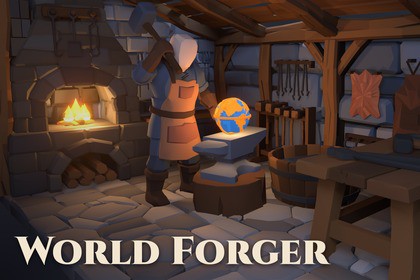
Procedurally generate villages, roads and prop layouts from a node graph. Deterministic seeds, stackable spawn filters, live preview and a full runtime API. Ships with a 475-prefab medieval kit.The tool is pipeline-agnostic - it instantiates your prefabs and never creates or assigns shaders. Only the Crooked Hollow sample art is URP-specific: six materials on URP's stock Lit shader with no custom shaders, so converting to Built-in or HDRP is a shader swap, not a rebuild. Editor overlays fall back automatically outside URP.World Forger is a node-based procedural placement system for Unity. You build a stencil in a graph editor (stamp rules, prefab choices, child stamps, spawn filters) and a Forger component turns it into scene geometry. Every build runs from a fixed seed, so the same stencil always gives the same result, and re-rolling the seed gives you a new variation of the same design.Two main Forgers come with it. Village Forger lays out complete settlements: main and side roads, a village square, residential tiers, specialised buildings, ground cover and obstacle avoidance, all driven by a profile you can tune or swap. Prefab Forger is the general-purpose one: scatter, grids, walls, decoration, anything you can describe as stamps and rules. Experimental Countryside, Road, Stream and Bridge Forgers and spline terrain tools fill the land between settlements.Nothing about the system is tied to the included art. A stencil references your prefabs, so the same graph that builds a medieval hamlet will build a sci-fi outpost or a suburban street when you point it at a different kit. The core runtime assembly has no package dependencies and doesn’t touch materials or shaders. It only instantiates prefabs, so it works with whatever render pipeline your prefabs use.REQUIREMENTS• Unity 6.3 LTS or later.• Unity’s Splines package (com.unity.splines 2.8.2 or later, free from the Unity Registry) for the Village Forger, the experimental Forgers and terrain tools, and all samples. World Forger offers to install it when the project opens. Without it, the Prefab Forger and the core still work.INCLUDED SAMPLE: CROOKED HOLLOW (no extra purchase needed)The Crooked Hollow kit is a working example: 475 prefabs across houses, shops, thatched cottages, ruins, rocks, plants, paving, market kits and hero pieces, all sharing one 2048 atlas with four colour schemes (Default, Autumn, Nordic, Desert). Seven sample scenes cover the feature set, from a 42-layout road catalogue to obstacle avoidance, boundary splines, theme swapping and a runtime API playground. The scenes ship empty and rebuild from their seeds at the press of a button, which keeps the download small without losing anything. It needs only World Forger and Splines.THIRD-PARTY ART SAMPLES (require separately purchased packs)Three more samples come as packed .unitypackage files. Each one shows World Forger building with another publisher’s art. That art is not included with World Forger, and each sample works only if you own and import the packs listed for it:• Polytope Low Poly Modular Village sample needs all three of Polytope Studio’s packs, plus their URP conversions:– Low Poly Modular Village: https://assetstore.unity.com/packages/3d/environments/low-poly-modular-village-lowpoly-medieval-fantasy-series-258073– Low Poly Environment Nature: https://assetstore.unity.com/packages/3d/environments/low-poly-environment-nature-lowpoly-medieval-fantasy-series-185195– Low Poly Tools & Props: https://assetstore.unity.com/packages/3d/props/low-poly-tools-props-lowpoly-medieval-fantasy-series-268353• Polyart Dreamscape Village sample needs Polyart Studio’s Dreamscape Village - Stylized Fantasy Open World:https://assetstore.unity.com/packages/3d/environments/fantasy/dreamscape-village-stylized-fantasy-open-world-244797• Synty Fantasy Kingdom sample needs Synty Studios’ POLYGON - Fantasy Kingdom Pack:https://assetstore.unity.com/packages/3d/environments/fantasy/polygon-fantasy-kingdom-pack-art-by-synty-164532These three samples are set up for URP.OPTIONAL: MICROVERSE INTEGRATION (requires paid third-party assets)World Forger can optionally hand its village roads to MicroVerse. This requires Jason Booth’s MicroVerse and MicroVerse Splines 1.x, both paid Asset Store products sold separately. It is tested with MicroVerse 1.7.0. Without them, the integration simply stays hidden and everything else works.– MicroVerse - Core: https://assetstore.unity.com/packages/tools/terrain/microverse-232972– MicroVerse - Splines: https://assetstore.unity.com/packages/tools/terrain/microverse-splines-232974The sample art is medieval/fantasy village, but the tool itself works in any genre.Requires Unity 6.3 or later and the Unity Splines package. The core runtime assembly has no other dependenciesNode-based stencil graph editor — stamp rules, prefab arrays, child stamps, probability, stop-flow, per-choice offsetsDeterministic output: fixed seeds with spatial salting, so the same seed reproduces the same layout every timeTwo Forgers included: Village Forger (roads, squares, residential tiers, specialised buildings, obstacle avoidance) and Prefab Forger (general scatter and placement)42 named road layouts — grid, ring, spiral, dendritic, herringbone, cul-de-sacs and moreSix stock spawn filters: Min Distance, Max Slope, Height Range, Snap To Grid, Align To Terrain Normal, Material Swap — stackable per prefab choiceLive preview fast path, full Undo integration, and per-instance tracking so edits recompose without a full rebuildRuntime API: Build() / Demolish() with ForgeStarted, ForgeCompleted, ForgeFailed and Demolished events, plus optional auto-build on startExtension points for custom spawn filters, graph validators, exporters, node context menus and inspector tools — register by attribute, no core editsEditor tooling: Welcome window, Stencil Graph Browser, Variant Generator, Village Profile BrowserOptional integrations, MicroVerseCrooked Hollow sample: 475 prefabs, 383 FBX meshes, one shared 2048 atlas with 4 colour schemes, LOD groups on every mesh prefab, 7 demo scenesAll source code in this package was written by the publisher. AI assistants were used during development as a debugging and refactoring aid — diagnosing bugs, suggesting refactors, and reviewing code. No source files were generated wholesale by AI; every file was authored, reviewed and tested by the publisher.Eight banner images shown in the editor inspector headers (World Forger, Village Forger, Prefab Forger, Dungeon Forger, and the experimental Countryside, Road, Stream and Bridge Forgers) were made with AI image generators, then cropped, resized and colour-matched by the publisher. They are decorative editor UI graphics only; nothing at runtime depends on them, and they are not used in the store listing.All documentation screenshots are direct captures of the package running in the Unity Editor.The written documentation was drafted with AI assistance and edited and fact-checked by the publisher against the shipping package.