






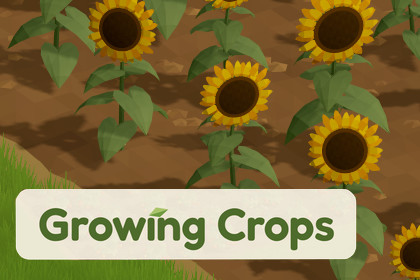
Preview the garden in the WebGL demo: DEMO HERE25 crops: barley, wheat, oats, corn, sunflower, flax, potato, carrot, beetroot, turnip, onion, garlic, cabbage, lettuce, broccoli, tomato, bell pepper, eggplant, pumpkin, watermelon, cucumber, peas, climbing beans, grapevine and hops. Each crop has five shapes and a matching harvest prop. Wooden stakes, trellises and a hops frame hold the tomatoes and climbers.Every plant grows smoothly from seedling to harvest. Set Growth from your own code, or add the Plant Auto Grow component and give it the number of seconds to grow. Ripeness is a separate control that takes produce from green to ripe. Plants with the same settings share one mesh, so a field of hundreds of plants stays light.Under the hood, meshes are generated in code when a plant’s settings change, then cached and shared by every plant that needs them, with buffers reused to avoid garbage. Generation runs in an optional native library built in Rust on Windows and WebGL, and in C# elsewhere, on worker threads where the platform allows. The WebGL demo runs the Rust generator on a single thread; desktop builds can add worker threads on top.The included URP shader adds vertex wind to whole plants, leaves and heads, also in shadows, with no mesh rebuilds. Color, shine, backlight and wind strength live on the material, so one material change restyles every crop.