




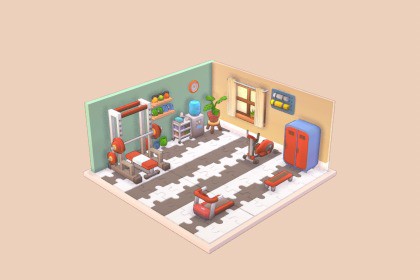
Four Scene view tools for props: drop them onto any surface with no colliders, move an object's origin, split one mesh into its parts, and recolour it from a palette. Editor onlyFour Scene view tools for the jobs that normally send a prop back to the modelling package. Editor only — nothing ships in your build.PERCH — press B and drag. The prop lands on whatever is under the cursor: floor, table, shelf, terrain, another prop. It projects the object's real vertices, so the lowest point of the mesh comes to rest no matter where the pivot sits. No colliders anywhere, no scan step, no setup. Upright or Conform, Tab to switch. Shift-drag duplicates.PIVOT — press P and drag the handle. Snaps to vertices, edge midpoints, face centres and least-squares fitted circle centres — an axle or a bolt hole has a centre you cannot hit by eye. Batch rules (Centre / Bottom / Top) measure each object's own geometry, so a whole selection is fixed in one press. Warns when an animation clip keys the position you are moving.SPLIT & MERGE — cut one mesh into its loose parts or its material slots, and put pieces back together. Every part is Separate, Leave in rest, or Group A–F, so one branch comes off a tree without the other four following. Merge shares a submesh per material, so it genuinely costs fewer draw calls. Submeshes, UV channels, vertex colours and blend shapes all survive.PALETTE VARIANT GENERATOR — recolour regions of a prop and write a new prefab. Palette mode moves the region's UVs, so the result still shares a material and a batch. Custom mode stores any colour as per-vertex Color32, flat or as a gradient. No new textures, no new materials.WORTH KNOWING• No FBX export. Results are Unity mesh assets and prefabs; your source file is never rewritten.• Pivot edits position only, not rotation.• Skinned meshes with bones cannot be split or re-pivoted — both tools refuse with an explanation.• A merge loses blend shapes. The window says so first.• Asset writes are not undoable.• The tools work in any pipeline. The demo scenes use URP.• Four Editor tools, each behind its own assembly definition. No runtime code in your build.• Unity 6000.0+. Tested on 6000.4.10f1. Built-in, URP and HDRP — the tools touch geometry and UVs, never materials.• No third-party packages, no analytics, no network calls. Full commented C# source.• Perch: vertex-accurate placement against raw mesh data, no colliders needed. Terrain from heightfield. Upright / Conform. Multi-select drags as one group, one Undo step. Shortcut B.• Pivot: vertex, edge, face, bounds and fitted-circle-centre snapping, radius in screen pixels. Batch rules per object. Handles bones by rewriting bind poses. Variant or Overwrite. Shortcut P.• Split: loose parts (welded by position) or material slots, per-part Separate / Leave in rest / Group A–F. Parts re-indexed from zero at original per-vertex widths; submeshes, material slots, UV channels, vertex colours and blend shapes preserved.• Merge: one submesh per material. Exact geometric inverse of a split.• Palette Variant Generator: UV-island region detection; UV-remap or per-vertex Color32, flat or gradient. Works on skinned meshes. Needs a palette texture with Read/Write Enabled.• Demo: 5 scenes, 35 props, 1 material, one 2048x2048 palette, 1 URP shader.• Output goes to Assets/PixeliusVita_Generated/, outside the package folder, so updates cannot touch your results.The models, textures, shader and all tool source code are hand-authored. AI assistance was used for the documentation, the CHANGELOG and the store listing text were also drafted with AI assistance. No model, texture in this package was generated by AI