



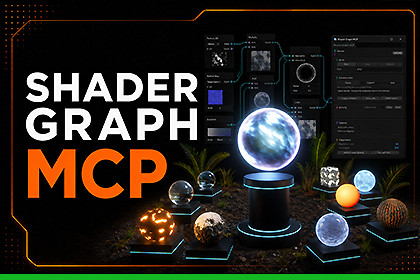
Let AI assistants author real Shader Graphs in Unity. An in-editor MCP server that builds, validates and renders URP shaders. driven from Claude, ChatGPT or any MCP client.Built and verified for URP: Unity 6000.4, URP 17.4, Shader Graph 17.4. URP is the only fully supported pipeline. Graph authoring, scene tools, post-processing and the craft guide all target it.HDRP: not supported. Built-in: partial, existing graphs can be edited but from-scratch authoring emits a URP target.Editor-only. No runtime assembly ships in your build.Your AI assistant can already write C#. Now it can author shaders.Shader Graph MCP runs a Model Context Protocol server inside the Unity Editor. Point any MCP client at it (Claude Code, ChatGPT via the Codex CLI, Cursor, Kimi) and describe the shader you want in plain language. It builds the graph node by node, wires it, compiles it, renders it, and looks at the result to correct its own mistakes.No Node.js. No second process. No npm install—one C# package, running inside the editor.WHY MOST AI-GENERATED SHADERS LOOK WRONGA node schema can tell a model that Gradient Noise has a Scale input. It cannot tell it that leaving Scale at its default shatters a low-poly mesh into facets, that Position defaults to World and not Object, or that a Fresnel at Power 1 reads as cheap plastic.So this package ships the part that is not in any schema: a production craft library of 21 documents and 244 topics, served directly to the assistant. Targets and passes. Custom lighting in URP with working HLSL. Look development, PBR value ranges, vertex displacement limits, transparency and sorting, performance budgets, and a symptom-to-cause diagnostic index.Alongside it, a node codex covering every node in your project: what it computes as a formula, what it is for, and how it fails.IT CHECKS ITS OWN WORKValidation does not stop at "it compiled". The graph is imported, drawn, and measured: mean colour, per-channel variation, clipped fractions. A shader that compiles cleanly and renders as a solid white blob is reported as a problem, because that is exactly what a silently broken shader looks like.Then it can render the material on any mesh, place it in a scene with lights and post-processing, and read exact pixel values back.WORKS WITHClaude Code · Claude Desktop · ChatGPT via the Codex CLI · Cursor · Kimi · anything that speaks MCP over HTTPSetup is a one-line command in a terminal, shown with a copy button in the editor window.REQUIREMENTSUnity 6000.4 or newer · Shader Graph 17.x · Universal Render PipelinePRIVACY AND SECURITYThe server binds to 127.0.0.1 only and validates the Origin header on every request, so a web page cannot reach it. Asset paths are confined to your project's Assets folder. Nothing is uploaded anywhere; your project never leaves your machine.• In-editor MCP server: Streamable HTTP, protocol 2025-06-18, hosted by Unity itself. No Node.js, no npm, no external process. Survives domain reloads.• 50+ tools covering discovery, authoring, validation, materials, meshes, scenes, lighting, post-processing and rendering.• Whole-graph authoring: target, properties, nodes, options, edges and literal values in a single atomic call. A failure leaves no half-written asset.• Render-backed validation: imports, draws, and reports real shader compiler errors plus image statistics, so a shader that compiles but renders wrong is still caught.• Hand-written HLSL: Custom Function nodes with declared ports, returning the exact signature Shader Graph will generate.• Node catalog generated from your project, so it tracks your Shader Graph version and picks up your own custom nodes automatically, with correct slot IDs.• Craft guide: 21 documents, 244 topics, searchable by symptom, served to the assistant on demand.• Node codex: every node in the project described by formula, purpose, and failure mode.• Sub-graphs, shader keywords (including dynamic_branch), gradients, master-stack blocks, and every URP target through Unity's own templates.• Scene tools: create scenes, place meshes, configure lights, environment and post-processing, then render from the camera with image statistics and exact pixel sampling.• Generated HLSL readback: see which passes exist, which keywords were declared, and what a Custom Function expanded to.• Live activity feed in the editor window, so an assistant working in your project is visible rather than silent.• Self-test that drives the running server over real HTTP, including a full authoring round trip that must compile.• 300+ automated tests across 27 suites.• Written entirely in C#. Full source included.This package was developed with AI assistance. The C# source was written collaboratively with an AI coding assistant, with all code reviewed, tested, and maintained by the author; the package ships 300+ automated tests that gate its behaviour.The included example Shader Graphs were generated by the package itself, which is what the package does.No AI-generated art, audio, textures,s or third-party content is included. No user data is sent anywhere: the server runs locally, and the project never leaves the user's machine.