


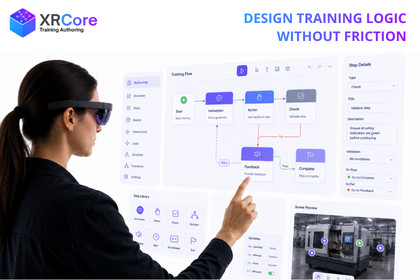
Visual XR workflow authoring environment for creating procedural training scenarios, assessment-ready workflows, and playable XR demo scenes without writing runtime code.XRCore Authoring requires XRCore SDK, XRCore Training Toolkit, and XRCore Assessment. The package is render-pipeline agnostic and compatible with Built-in, URP, and HDRP. Supports Unity XR projects using OpenXR and XR Interaction Toolkit with Input System support. Generated scenarios and demo scenes are compatible with desktop and standalone XR workflows.XRCore Authoring is a visual XR workflow authoring environment built on top of XRCore SDK, XRCore Training Toolkit, and XRCore Assessment.The package accelerates the creation of procedural XR training experiences through editor-first workflows, visual scenario configuration, assessment-ready step orchestration, and automatic demo scene generation.Where XRCore Training Toolkit focuses on runtime workflow execution and XRCore Assessment provides competency evaluation and scoring, XRCore Authoring delivers the content production layer required to rapidly create, validate, and iterate XR training workflows without writing runtime code.Developers, training designers, and operations teams can visually build reusable XR workflows using configurable steps, validators, assessment profiles, and generated runtime-ready scenarios.XRCore Authoring includes:• Visual Training Configurator for scenario authoring• Modular Step Builder with multiple procedural step types• Visual validator assignment workflows• Assessment profile configuration and scoring setup• Playable XR demo scene generation with automatic runtime wiring• Runtime-compatible generated scenarios and templates• JSON export for external tooling and workflow versioning• Preflight validation and auto-fix systems• QA automation and release validation workflows• Guided onboarding and sample authoring environmentsThe package supports procedural XR workflow authoring including:• Guided industrial training flows• Operational onboarding scenarios• Validation and checklist workflows• Decision-based XR interactions• Safety and compliance procedures• Assessment-ready certification flowsXRCore Authoring is designed for:• XR training content production• Procedural workflow authoring• Industrial XR onboarding• Assessment-driven XR experiences• Scalable XR course creation• Runtime-ready XR workflow generationThe architecture is modular, editor-oriented, and compatible with Built-in, URP, and HDRP. Generated scenarios and demo scenes integrate directly with XRCore Training Toolkit and XRCore Assessment runtime systems.XRCore Authoring requires XRCore SDK, XRCore Training Toolkit, and XRCore Assessment and is designed as part of the XRCore ecosystem alongside future modules for contextual XR memory, voice-guided workflows, and advanced Spatial AI systems.Unity 2022.3+ / Unity 6 compatible workflow (editor tooling and generated assets).Editor-first architecture for scenario authoring and generation.Training Configurator for scenario metadata, step setup, validators, and profile flow.Step condition engine with configurable match mode (ALL / ANY).Condition types:LookAtTargetProximityToTargetActionKeyPressHoldObjectWaitSecondsInteractionSignalInteraction signal presets:buttonwheelleverjoystickcustomRuntime-ready output generation for XRCore Training Toolkit and XRCore Training Assessment integration.Playable demo scene generator with automatic reflection-based runner wiring diagnostics.Demo interaction support for wheel/lever/joystick with controlled object mapping and axis configuration (1/2/4 axes).Preflight gate with safe auto-fixes and report export.Dependency compatibility validator for XRCore module version checks.Golden demo lock snapshot and validation utilities.QA smoke runner and consolidated release check report generation.Session report export support (JSON/TXT) for final demo validation workflows.Publisher/client boundary guard to avoid leaking publisher-only export tooling into customer package.AI was used as a development assistant during the package creation process.It helped with code structure planning, documentation drafting, naming consistency, demo workflow design, and generating initial implementation ideas for editor tooling, diagnostics, reporting, and assessment logic.All final code, package behavior, documentation, and Unity integration were reviewed, tested, and curated by the publisher before submission.