


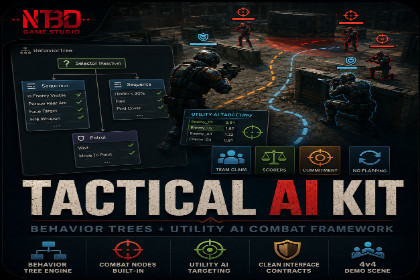
Behavior tree + utility AI combat framework. Plug-in interfaces, 8 combat BT nodes, weighted target scoring, and a one-click 4v4 dogfight demo.Tactical AI Kit is a behavior-tree-driven combat AI framework for Unity 2022.3+. It gives you a complete, extensible architecture for building combat agents — ships, drones, turrets, soldiers — without locking you into a specific physics or movement system.WHAT'S INCLUDEDA behavior tree engine with Sequence, Selector (reactive), and Parallel composites. Each agent gets its own runtime clone of the tree at startup — no shared state corruption between agents.8 combat action nodes: pursue rear arc, face target, move to target, fire weapon, flee, patrol, strafe, orbit, and evasive maneuver.6 condition nodes: has target, health below threshold, in orbit range, being tailed, in target rear arc, has ally.Utility AI targeting via TargetPicker — OverlapSphere candidate scan with team-aware claim spreading, a commitment threshold to prevent target flapping, and a pluggable scorer interface.4 built-in scorers: distance, health, damage output, and BusyEnemyScorer — a scorer that preferentially targets enemies already engaged with your teammates, producing emergent flanking behaviour without any explicit coordination code.4 clean interface contracts your game objects implement: ITargetable, IDamageable (with directional hit vector for armour and shield systems), IWeaponSystem, and IAgentAgility (speed-scaled turn rate). No forced inheritance. Plug into your own MonoBehaviours.One-click 4v4 demo scene via Tools > TacticalAIKit > Setup Demo Scene. Ships have directional damage (rear hits deal 2×), per-ship agility variation, and teamwork via the BusyEnemyScorer. Demonstrates real emergent behaviour: 2v1 flanking, last-ship evasion, critical-health fleeing.Full BT diagnostics — throttled logging per agent, Tools menu toggles, and a BTDiagnosticsEnabler component for in-scene control.Fast Enter Playmode ready — all static state resets cleanly with Domain Reload disabled.IS THE CONTENT CUSTOMIZABLE?Yes, extensively. Tactical AI Kit ships with full C# source code, no DLLs:- Add new BT action or condition nodes by inheriting BTLeaf. One method to implement.- Add new scorers by implementing ITargetScorer. One method to implement.- Combine scorers in a WeightedScorerSet ScriptableObject — no code.- All four interfaces are thin contracts. Implement on your own MonoBehaviours. Vary IAgentAgility.CurrentTurnRate dynamically based on speed, damage, energy, or anything else.- IDamageable.TakeDamage passes a hit direction vector so you can implement directional armour, shield arcs, or hit-location effects.- The BehaviorTreeAsset editor draws your tree recursively and lets you pick node types from a menu — no manual type entry.- Two assembly definitions isolate TacticalAIKit's compilation.IS IT SUITABLE FOR A PARTICULAR GENRE?Tactical AI Kit is built for real-time Rigidbody-based combat. It fits cleanly into:- Spaceship and aerial dogfights- Drone swarm combat- Top-down vehicle combat- Tower defence wave enemies- Any game where you want group tactics (flanking, focus fire, evasion) without hard-coding coordinationKEY FEATURES- Reactive BTSelector: higher-priority branches (flee, evade) always pre-empt lower ones the moment their condition is true- Per-agent runtime BT clone: no shared-state bugs between agents- BTActionPursueRearArc: forward-only thrust with anti-slip damping for arcing turns — agents pursue the point behind the target- BusyEnemyScorer: emergent 2v1 flanking with no explicit coordination code- IAgentAgility: expose speed-scaled or damage-scaled turn rate per agent, read every tick- Directional damage via IDamageable.TakeDamage hit direction vector- One-click demo scene generator (Tools > TacticalAIKit > Setup Demo Scene)- BTDiagnostics: throttled per-agent BT logging, Tools menu toggles, in-scene enabler component- Full C# source code, no DLLs, no obfuscation- Two assembly definitions for fast incremental compilation- Fast Enter Playmode compatible (Domain Reload disabled)- Unity 2022.3 LTS or newer- Zero external dependencies- Reactive BTSelector — higher-priority branches always pre-empt lower ones- Per-agent runtime BT clone at Awake — no shared state between agents- 8 combat action nodes, 6 condition nodes, 3 composite types- Utility AI targeting: OverlapSphere scan, team claim spreading, commitment threshold- 4 built-in scorers including BusyEnemyScorer (emergent flanking)- ITargetable, IDamageable (hit direction), IWeaponSystem, IAgentAgility interfaces- BTActionPursueRearArc: forward-only thrust, anti-slip damping, minSpeed stall floor- One-click 4v4 dogfight demo scene generator- BTDiagnostics: throttled logging, Tools menu toggles, in-scene enabler component- Full C# source, no DLLs (approximately 2,500 lines)- Two assembly definitions (TacticalAIKit + TacticalAIKit.Editor)- TacticalAIKit namespace — no global-scope collisions- Fast Enter Playmode compatible (Domain Reload disabled)- Unity 2022.3 LTS or newer- All render pipelines, all build targets- Zero external dependenciesThe core runtime of this package — the behavior tree engine, all BT composite and leaf node base classes, the BTContext caching system, the TargetPicker utility AI, the TargetClaimsRegistry, WeightedScorerSet, all four runtime interfaces (ITargetable, IDamageable, IWeaponSystem, IAgentAgility), and the BehaviorTreeRunner — was written by the publisher before any AI tool was involved. These files are: BehaviorTreeAsset.cs, BehaviorTreeRunner.cs, BTContext.cs, BTNode.cs, BTComposite.cs, BTDecorator.cs, BTLeaf.cs, BTSequence.cs, BTSelector.cs, BTParallel.cs, BTNoOp.cs, BTDiagnostics.cs, ITargetable.cs, IDamageable.cs, IWeaponSystem.cs, IAgentAgility.cs, TargetPicker.cs, TargetClaimsRegistry.cs, WeightedScorerSet.cs, and ITargetScorer.cs.The following files were drafted with the assistance of Anthropic's Claude (claude-sonnet-4-6) and were reviewed, edited, and integrated by the publisher before submission:Combat action nodes: BTActionFaceTarget.cs, BTActionMoveToTarget.cs, BTActionFireWeapon.cs, BTActionFlee.cs, BTActionPatrol.cs, BTActionStrafe.cs, BTActionOrbitTarget.cs, BTActionEvasiveManeuver.cs, BTActionPursueRearArc.cs.Combat condition nodes: BTConditionHasTarget.cs, BTConditionHealthBelow.cs, BTConditionInOrbitRange.cs, BTConditionBeingTailed.cs, BTConditionInTargetRearArc.cs, BTConditionHasAlly.cs.Scorers: DistanceScorer.cs, HealthScorer.cs, DamageOutputScorer.cs, BusyEnemyScorer.cs.Samples: SimpleDemoShip.cs, BTDiagnosticsEnabler.cs.Editor utilities: TacticalAIKitDemoSetup.cs, BTDiagnosticsMenu.cs, BehaviorTreeAssetEditor.cs.Utility: RigidbodyExtensions.cs (Unity 6 velocity/drag rename compatibility shim).The following non-code files were also drafted with Claude's assistance: README.md, the package's asmdef files (TacticalAIKit.asmdef, TacticalAIKit.Editor.asmdef), and an initial pass at the store listing copy. The store listing copy was subsequently rewritten by the publisher.Modifications and additions made by the publisher beyond AI generation: the reactive BTSelector restart-from-zero behaviour (replacing stateful index advancement which caused agents to lock into Patrol after a single HasTarget failure), the per-agent BehaviorTreeAsset runtime clone in BehaviorTreeRunner.Awake via Instantiate(tree) (fixing shared state corruption between agents), the IAgentAgility interface and the CurrentTurnRate read-every-tick pattern in all rotation actions (replacing static inspector values with per-agent dynamic turn rates), the minSpeed stall floor in BTActionPursueRearArc (preventing lateral velocity bleed to zero which caused pivot-in-place behaviour), the antiSlipPerTick tuning range (0.03–0.08 at 60fps), the CurrentEngagement property on ITargetable and its use in BusyEnemyScorer for emergent flanking, the directional damage convention on IDamageable.TakeDamage using hitDirection dot product against transform.forward, the RuntimeInitializeOnLoadMethod static-state resets on TargetClaimsRegistry and BTDiagnostics for Fast Enter Playmode compatibility, and verification that the package compiles in isolation with no warnings.AI was not used to generate any visual content, audio, models, animations, or trained model weights. No customer or third-party data was used in training or generation. The package contains no AI-connected runtime functionality.