






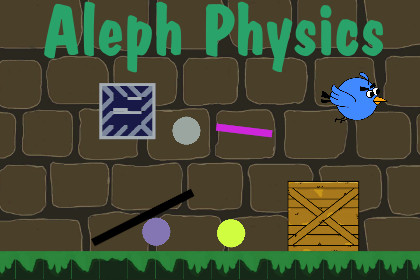
Aleph.Physics is a GPU-accelerated 2D/3D physics framework for Unity URP, enabling real-time particles, collision simulation, CPU response and interactive GUI.The simulation is compatible with HDRP in principle, but I haven’t yet found a way to implement the rendering shader for HDRP. Currently, the core simulation runs entirely on the GPU via compute shaders in URP, while rendering is handled by a graphics shader using a Custom Render Feature. If you are using a Custom RP, it should be possible to adapt it with some modifications. # Aleph.Physics – GPU-Accelerated Physics Simulation for Unity (URP)Aleph.Physics is a high-performance, GPU-driven, lightweight physics simulation framework designed for Unity projects using the Universal Render Pipeline (URP). It provides a modular and flexible system for simulating medium-scale interactive objects entirely on the GPU, minimizing CPU overhead and enabling real-time performance.The key design principle of Aleph.Physics is **not to achieve full physical accuracy**, but rather to provide **acceptable collisions** while focusing on easy integration into your game. Compared to existing particle or physics simulation systems, Aleph.Physics fills the gap between purely visual particle effects and interactive game physics.### Collision and InteractionAleph.Physics offers robust collision detection and response, along with **GPU-to-CPU asynchronous feedback**, making it ideal for integrating GPU-based physics with CPU-driven game logic. Typically, game logic runs on the CPU, and particle effects are visual-only, but Aleph.Physics allows meaningful interactions between particles and game objects. It supports four types of collision and response:1. **Particle-to-Particle**: Using GPU Bouding Volume Hierarchy, GPU ray tests, Minkowski Difference, and dynamic collision detection.2. **Particle-to-Environment**: Using Signed Distance Fields (SDF) or bounding volume checks.3. **Particle-to-GameObject**: Using GPU ray tests for static collision detection.4. **Async Feedback**: GPU-to-CPU collision notifications for game logic execution.All collision computations are performed asynchronously on the GPU for high performance.### Visualization and InteractionAleph.Physics includes an **interactive UI** that visualizes the Bounding Volume Hierarchy (BVH) and supports step-by-step simulation for debugging and experimentation.### ExtensibilityThe framework is fully **configurable and extendable**, allowing developers to integrate advanced physics systems into their projects with minimal setup while maintaining high GPU performance. You can customize solvers, forces, and collision behavior, making it suitable for games, simulations, or interactive visual effects.Key Features :Customizable Simulation: Easily adjust solvers, forces, and collision parameters through inspector or in-game GUI.2D & 3D Support: Compatible with both 2D and 3D physics, including URP 2D/3D renderers.Broad & Narrow Phase Collision: Efficient GPU-BVH-based broad-phase collision and compute-shader-driven narrow-phase detection.AABB & Sphere Support: Currently mainly support two kinds of colliders, aabb and sphere.Signed Distance Field (SDF): Fast SDF generation for tilemaps. Sphere Tracing algorithm to detect collision with SDF.Async GPU Feedback: Retrieve collision information from the GPU to trigger game logic or events.Interactive GUI: Built-in interface for testing and tuning simulations in real time.Highly Extensible: Add new solvers, materials, and features easily; fully scriptable with clean C# API.Optimize documentation and codes. No AI generated content.